George is a seasoned interior designer and property marketing strategist with over 13 years of experience. He specializes in transforming properties into visually stunning spaces, helping clients recognize the potential and beauty in each property. With an impressive international client base of exciting projects throughout Europe and America.
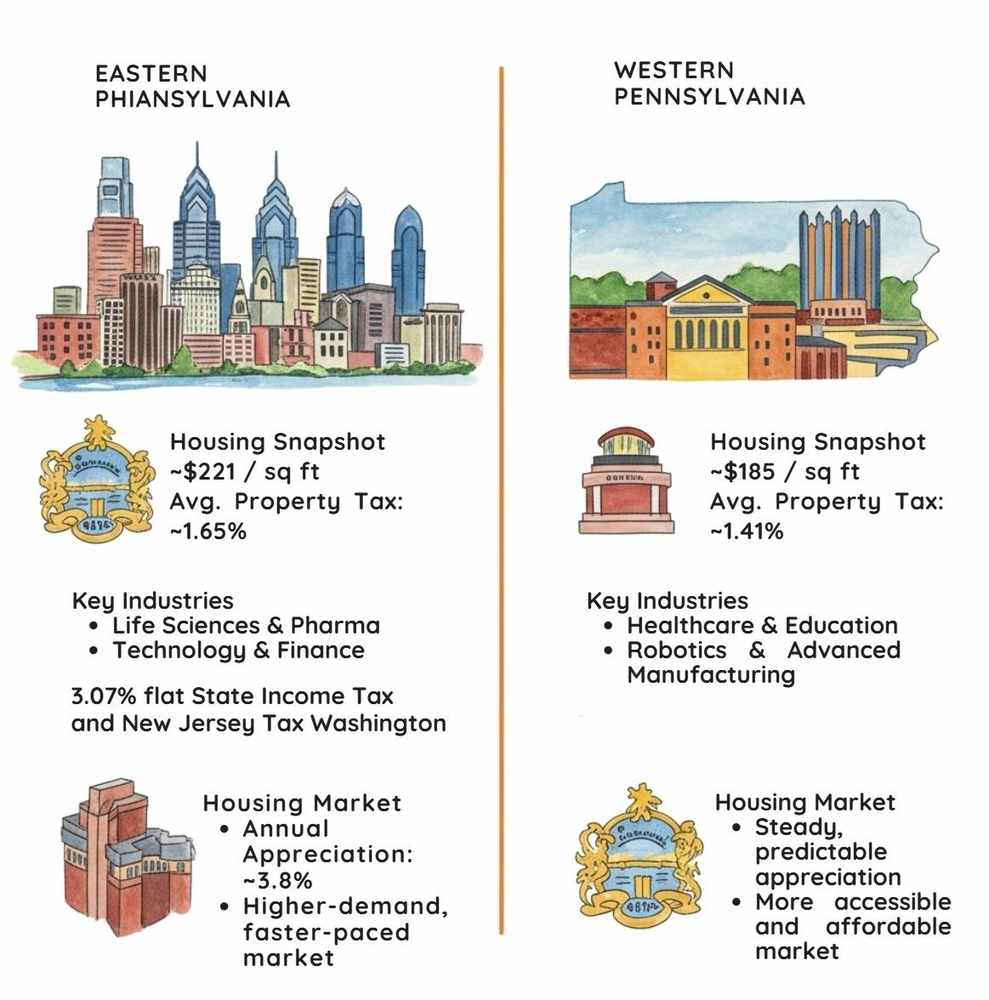
Eastern Pennsylvania, centered around Philadelphia, offers a cosmopolitan feel with a strong finance and pharmaceutical job market. The average home price is $221 per square foot, with 3.8% annual appreciation. Western Pennsylvania, anchored by Pittsburgh, has a healthcare and energy-driven economy with more affordable homes at $178–$201 per square foot and significant property tax savings. Both regions offer tax advantages over NJ, NY, and WA, with a flat 3.07% income tax and an average property tax rate of 1.41%.

Considering a move to Pennsylvania from high-cost states like New Jersey, New York, or Washington? You’re not alone. Many people are seeking a better balance of lifestyle, affordability, and opportunity.
This guide was made by TALLBOX’s team to help families compare Eastern and Western Pennsylvania to make an informed decision for for their cross-state move in 2025-2026. We compared cost of living, school quality, job markets, and lifestyle to help you see which region fits your needs.
Eastern Pennsylvania vs Eastern Pennsylvania
The primary difference between the two regions is economic focus and population scale. Eastern Pennsylvania is a densely populated life sciences hub, while Western Pennsylvania’s economy is led by healthcare and defined by an outdoor lifestyle
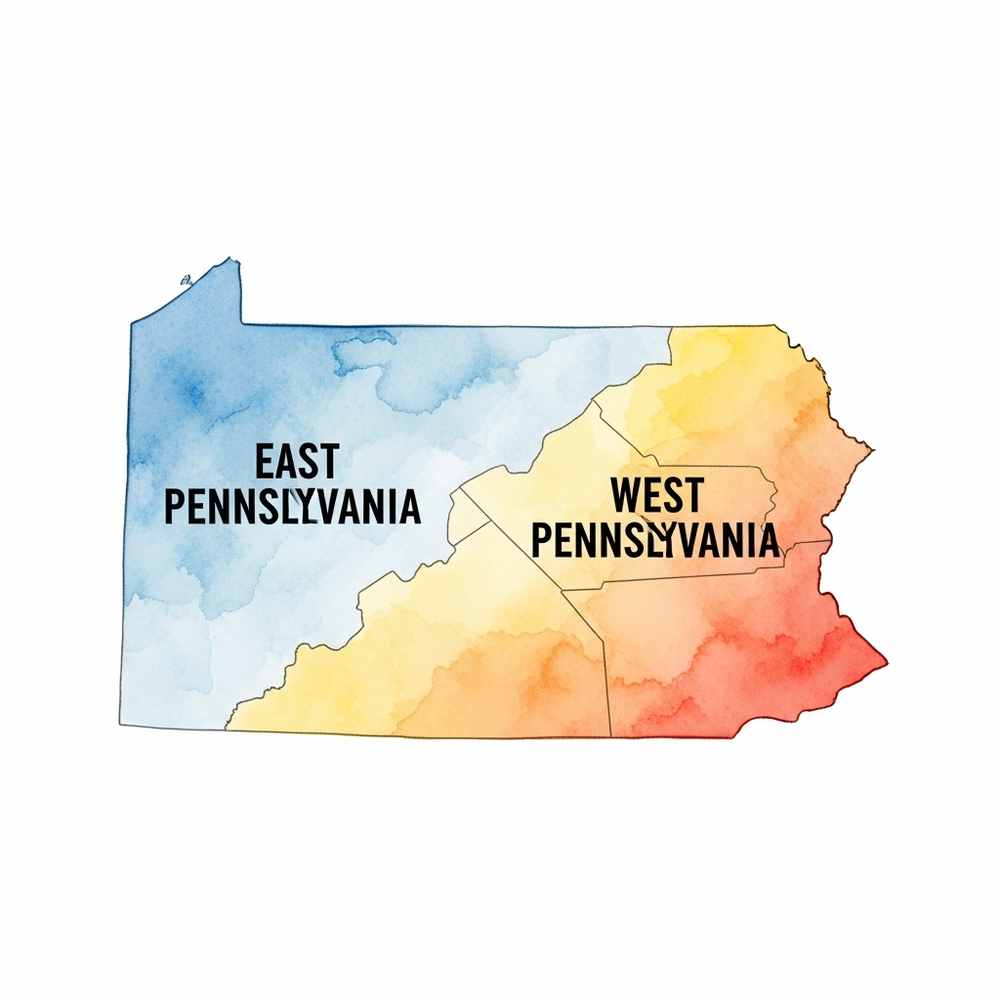
Eastern Pennsylvania Centered on the Philadelphia metropolitan area of 6.25 million people, this region is a globally recognized hub for the life sciences and pharmaceutical industry, underscored by major corporate investments of up to $800 million. Its landscape is rich with American historical landmarks, including significant colonial and Federal-style sites in York and Bethlehem.
Western Pennsylvania The Pittsburgh metropolitan area, with a population of 2.45 million, anchors this region. Its economy, diversified after the steel industry’s decline, now has healthcare as its largest employer, complemented by a significant energy sector. A defining characteristic is its outdoors-oriented culture, which constitutes a major part of the economy, contributing nearly $14 billion annually.
Cost of Living, Housing, and Taxes
Philadelphia’s median home price is $298,000 or $221 per square foot, with a 3.8% annual increase. Premium neighborhoods like Fitler Square reach $793 per square foot. South Philadelphia averages $248 per square foot with a 4.0% yearly increase.

Pittsburgh’s median home price is $254,724 with homes valued between $178 and $201 per square foot, a 5% annual rise. Downtown Pittsburgh’s prices have dropped 42.1% to a $203,000 median, while Shadyside averages $462,275.
Construction costs are higher in Philadelphia, reaching 18–22% above resale properties. Pittsburgh’s new construction costs range from $178 to $565 per square foot, depending on home features.
Pennsylvania vs WA and NJ, NY State Taxes
Pennsylvania has a flat 3.07% income tax rate for all income brackets. This is much lower than New Jersey’s 1.4–10.75% and New York’s 4–10.9% progressive rates.
Property taxes vary by region. The average rate is 1.41%, or $7,045 a year for a $500,000 home. New Jersey’s rate is 2.33% ($11,640 per year), while New York’s is 1.54% ($7,700 per year).
Washington State newcomers will find Pennsylvania’s income tax new, but it offers predictability compared to WA’s high sales taxes.
Sales tax in Philadelphia is 8% (6% state, 2% local) and 7% in Pittsburgh. New York’s combined average is 8.53%, while New Jersey’s is 6.625%.
Property Tax Variations Across PA Counties
Property tax rates differ across counties. In Eastern PA, Chester County averages 1.21%, Philadelphia County 1.45%, and Delaware County 1.32%. In Western PA, Allegheny County averages 1.37%, Westmoreland County 1.18%, and Washington County 1.09%. These differences can mean thousands of dollars in annual savings depending on location.
Higher-performing school districts often come with higher property tax rates. Radnor Township has high taxes but top schools. North Allegheny balances strong schools with moderate tax rates.
Finding Your Niche
Eastern PA’s Main Line, Chester County, and Bucks County offer various amenities and lifestyles. Western PA’s Shadyside, Squirrel Hill, Fox Chapel, and Mt. Lebanon provide options from city living to suburban estates.
Eastern Pennsylvania
The suburbs of Philadelphia are known for their excellent schools, historic charm, and vibrant town centers.
The Main Line: This collection of affluent suburbs is ideal for families and professionals seeking a high quality of life with excellent educational opportunities. The area is known for its top-ranked school districts, beautiful parks, and a robust job market with major employers in sectors like healthcare. With plentiful dining and shopping options, along with convenient train and road access to Center City Philadelphia, it suits those who desire suburban comfort with urban accessibility.
Chester County: This county appeals to those looking for a blend of rural charm and affordability with a strong sense of community. It boasts one of the more affordable housing markets in the region while still providing a low cost of living. Chester County is a good fit for individuals and families who appreciate a quieter lifestyle with access to outdoor activities and don’t mind a commute to larger employment centers.
Bucks County: Bucks County Pa because of its low crime rates, good schools and home prices is often a favorite for many relocating families. Bucks County borders Philadelphia County to the south and is considered part of the Greater Philly metropolitan area. Also is often ranked as affordable place to live in Pennsylvania.
Western Pennsylvania
The Pittsburgh area offers a range of living options, from trendy urban districts to stately suburban communities, all known for their relative affordability.
Shadyside: With its “upscale hip” vibe, Shadyside is perfect for young professionals, couples, and individuals who want a walkable, stylish urban lifestyle. The neighborhood features three distinct business districts filled with boutiques, galleries, and restaurants. Its blend of historic Victorian mansions and modern condos, combined with a dog-friendly atmosphere, creates a vibrant and convenient place to live.
Squirrel Hill: This neighborhood is a dynamic blend of affluence and bohemian energy, making it suitable for a diverse range of residents, from professionals and families to university students. It is known for its beautiful residential streets, proximity to large parks like Schenley and Frick, and a bustling commercial district with a wide variety of shops and eateries. Its location near major universities makes it a popular choice for those tied to academia.
Fox Chapel: As one of Pittsburgh’s most affluent suburbs, Fox Chapel is ideal for wealthy families and individuals seeking privacy, large estates, and a secluded community. The area is known for its top-rated schools, forested landscape, and private, exclusive atmosphere with country clubs and outdoor recreation. It appeals to those who prioritize a quiet, high-end lifestyle with convenient access to Pittsburgh.
Mt. Lebanon: This community is a top choice for families looking for a classic, walkable suburban experience with excellent schools and a strong community feel. Ranked as one of the best suburbs in Pennsylvania, it offers a perfect mix of suburban tranquility and urban access. With its tree-lined streets, numerous parks, and vibrant uptown business district, Mt. Lebanon provides a highly-rated quality of life.
Utility Costs and Hidden Expenses
Utility bills are higher in Pittsburgh, averaging $252.61 per month (22% above national average). Philadelphia’s utilities are closer to the average but can spike in the summer.
Both metro areas have strong internet infrastructure, with high-speed options between $45–$80 per month. Rural areas may have fewer options.
Water and sewer costs are higher in Philadelphia, averaging $85–$120 per month due to older infrastructure. Pittsburgh averages $65–$95 monthly but may see future increases as improvements are made.
Waste collection is free in Philadelphia but often private and $25–$45 per month in Pittsburgh suburbs, adding $300–$540 per year.
Education and Employment
Eastern PA dominates statewide school rankings, with Radnor Township (#1), Tredyffrin-Easttown (#3), and Lower Merion (#4) leading the region. Western PA’s North Allegheny (#2) and Fox Chapel Area have strong results, with North Allegheny ranking #31 nationally for teacher quality. If you are after great schools and relocating, stick to East PA!
Eastern PA after-school programs benefit from Philadelphia’s cultural institutions. Radnor has robotics clubs with University of Pennsylvania partnerships. Western PA emphasizes STEM, with North Allegheny offering Carnegie Mellon University mentorships.
Special education services in both regions are robust, often tied to nearby major medical centers.
Job Markets
Philadelphia specializes in finance, life sciences, and healthcare. Over 2,300 life sciences companies operate in the area, employing thousands. Healthcare jobs are growing, with clinical research roles paying $55,000–$80,000 and AI diagnostics engineers earning even more.
Pittsburgh is a center for healthcare, robotics, and advanced manufacturing. Computer vision engineers earn $105,000–$150,000, and robotics technicians earn $62,000–$95,000.
Major employers in Eastern PA include Comcast, Vanguard, and the University of Pennsylvania. Western PA’s top employers are UPMC, Amazon, Facebook, and Google.
Remote work is supported in both cities. Philadelphia has 85% fiber coverage, while Pittsburgh is expanding its fiber and 5G networks. Both cities have co-working spaces and professional networking events.
Lifestyle, Culture, and Recreation
Philadelphia offers top museums, theaters, and music venues. The Philadelphia Orchestra and world-class museums provide affordable family entertainment. Major sports teams and parks offer year-round recreation.
Pittsburgh’s culture combines industrial history and innovation. The Warhol Museum, Carnegie Museums, and Heinz Hall are highlights. Outdoor recreation is centered on three rivers, parks, and nearby mountains.
Eastern PA offers access to the Appalachian Trail and Pocono Mountains. Western PA has river-based activities and the Laurel Highlands for hiking and skiing.
Philadelphia’s food scene includes the Italian Market and Reading Terminal Market. Pittsburgh offers farm markets, innovative restaurants, and many ethnic festivals.
Healthcare, Infrastructure, and Connectivity
Philadelphia has nationally-ranked hospitals, including the Hospital of the University of Pennsylvania and Children’s Hospital of Philadelphia. Pittsburgh is home to UPMC and Allegheny Health Network.
Philadelphia’s SEPTA offers comprehensive rail and bus service. Most commutes from suburbs are 30–45 minutes. Pittsburgh’s compact size means most commutes are 15–45 minutes, with a less extensive but growing public transport network.
Pittsburgh has modernized its infrastructure, investing in sports facilities and convention centers. Smart city initiatives and future bus rapid transit projects will improve transportation and quality of life.
Strategic Relocation Insights
Pennsylvania’s flat 3.07% personal income tax rate (regardless of the earner’s income level is a key factor in potential tax savings when compared to the progressive, multi-bracket systems of New Jersey and New York. NJ uses a graduated tax system with rates ranging from 1.4% to 10.75% and NY has nine tax brackets with rates from 4% to 10.9%. Families moving from New Jersey or New York will see large property and income tax savings. A family earning $150,000 can save between $3,000 to $4,500 in state income taxes by moving to Pennsylvania.
-
Approximately $2,824 in savings when moving from New Jersey.
-
Approximately $4,227 in savings when moving from New York.
New Jersey has the highest property taxes in the United States. The average effective rate is approximately 1.89%, more than three times the amount paid by an average homeowner in some parts of East and West Pennsylvania.
Property taxes are comparable to Pennsylvania’s, with an average effective rate of around 1.40%, but still PA wins because of its flat rate, aimed at attracting high-income families to the state.
Career alignment with regional economic strengths maximizes earning potential. Philadelphia is best for life sciences and finance professionals; Pittsburgh is better for healthcare, robotics, and manufacturing.
Suburban Life: Philadelphia vs. Pittsburgh
Both of Pennsylvania’s major urban centers are surrounded by suburbs and neighborhoods that offer a high quality of life, though with distinct differences in cost.
Philadelphia suburbs offer urban amenities and excellent schools at lower costs than NJ/NY. Pittsburgh’s neighborhoods offer similar benefits with greater affordability.
Western PA provides outdoor recreation and tech job opportunities, especially appealing to families from Washington State.
Philadelphia Suburbs: The suburbs surrounding Philadelphia provide residents with access to top-tier schools and vibrant local amenities, often at a lower cost than comparable areas in New Jersey and New York. For instance, suburbs like Ambler feature charming downtown areas and a median home price of around $370,000, while more upscale communities like Newtown Square have median prices closer to $740,000.
Costs can be favorable when compared to New Jersey suburbs like Plainfield, which has a median home price of $449,000. The overall cost of living is also lower in Pennsylvania, with savings on expenses like utilities.
Pittsburgh Neighborhoods: The Pittsburgh area is known for its high degree of affordability while still providing the amenities of a large city. The median home sales price in Pittsburgh was $228,400 in 2024, significantly lower than in the Philadelphia region and the national median.
The city contains 90 distinct neighborhoods, many of which offer a close-knit community feel and local attractions.
Affordable neighborhoods like Brookline and Greenfield feature walkable business districts, parks, and convenient access to the city’s universities and hospitals
Safety and Local Government
Pennsylvania’s overall crime rate aligns closely with or below national averages based on resident experiences. Statewide data, however, shows significant differences between urban centers and their suburbs.
The violent crime rate is 4.3 incidents per 1,000 residents, slightly above the national average of 4.0. Most violent crime occurs in cities, which have 35% of the state’s population but account for about 60% of violent crime.
Philadelphia has a high crime rate, with a violent crime rate of 9.9 per 1,000 residents and a property crime rate of 51.06 per 1,000 residents. As of July 2025, total violent crimes increased by 3.8% year-over-year, while homicides decreased by nearly 12%. Manysuburban communities are significantly safer in comparison.
Bustleton, a neighborhood in Northeast Philadelphia, has crime rates 62% lower than the city average.
Highland Park, a suburban-style neighborhood, reports crime rates 61% lower than the Pennsylvania average.
Some suburbs face challenges from organized retail theft rings. These rings cost Pennsylvania businesses an estimated $2.3 billion annually.
Pittsburgh has a crime index score indicating it is safer than only 5% of U.S. cities, with a 1 in 189 chance of being a victim of violent crime. In 2024, homicides in the city dropped to pre-pandemic levels, but surrounding suburbs saw an increase. Despite this, many suburban communities remain among the safest in Pennsylvania.
Fox Chapel, an affluent suburb, reported zero violent crimes over a recent two-year period and has a low property crime rate of 626 per 100,000 people.
The local police chief attributes this to a hands-on approach and vigilant residents. ROther top-ranked safe suburbs include Aspinwall and O’Hara Township.
Local Government Services
Pennsylvania’s governance is highly decentralized, especially in the western part of the state. Numerous small local governments aim to be responsive to residents but can make regional cooperation difficult.
Structure and Responsiveness: Southwestern Pennsylvania has over 900 local governments, making it one of the most fragmented regions in the country. This structure offers strong local representation and makes governments more accountable to residents. In the Pittsburgh area, citizen feedback is collected through town hall meetings and digital platforms to address neighborhood issues such as crime.
Inter-Governmental Collaboration: To address the challenges of fragmentation, suburban municipalities are working together more often.
In the Pittsburgh suburbs, multiple councils of government formed a land bank to address blighted properties in 41 municipalities.
In the Philadelphia region, suburban communities in Bucks, Delaware, and Montgomery counties collaborate with the city on watershed management and economic development projects.
Conclusion
Choosing between Eastern and Western Pennsylvania means balancing financial savings, job market fit, and lifestyle preferences. Both regions offer strong reasons to relocate, including affordability, education, and cultural amenities.
We recommend visiting both regions, working with local real estate agents, and researching schools and job markets to find the best fit for your family.
FAQ Section
What are the main cost differences between living in Eastern and Western Pennsylvania in 2025?
Eastern PA (Philadelphia) is more expensive, with $221 per square foot for housing and a higher cost of living. Western PA (Pittsburgh) is more affordable at $178–$201 per square foot and a cost of living 30.6% below the national average. Monthly family expenses are about $5,731 in Philadelphia and $5,168 in Pittsburgh.
Which region of Pennsylvania has better school districts for families moving from NJ or NY?
Eastern PA typically ranks higher for school districts (Radnor, Tredyffrin-Easttown), but Western PA (North Allegheny, Fox Chapel Area) also offers excellent options. Eastern PA has more college prep resources; Western PA excels in STEM and athletics.
How do job opportunities in Philadelphia compare to Pittsburgh for professionals in 2025?
Philadelphia’s strengths are life sciences, finance, and healthcare, with high salaries in research and tech. Pittsburgh is a leader in healthcare, AI/robotics, and manufacturing, often offering higher tech salaries.
What are the property tax savings like in PA compared to New Jersey or New York?
Pennsylvania’s average property tax rate is 1.41%, much lower than New Jersey’s 2.33% and New York’s 1.54%. Savings can be $4,595 per year compared to NJ and $700–$1,200 compared to NY.
Is Eastern PA or Western PA more suitable for families seeking outdoor recreation similar to Washington?
Western PA is a better match for Washington-style outdoor activities, with three rivers and mountains for water sports and hiking. Eastern PA has the Appalachian Trail and Poconos but lacks Western PA’s river systems.
What are the typical commute times and public transportation options in both regions?
Philadelphia has a comprehensive public transportation system with 30–45 minute suburban commutes. Pittsburgh’s shorter distances result in 15–45 minute commutes but with less extensive transit options.
Are there specific healthcare facilities that stand out in Eastern versus Western Pennsylvania?
Philadelphia features top-ranked hospitals like the University of Pennsylvania and CHOP. Pittsburgh is known for UPMC and its network of over 40 hospitals, with both regions offering world-class care.