How do the automatic house worth tools work?
Automatic home value tools use AI algorithms to analyze public records, recent sales data, and property characteristics. They compare your home to similar properties, factoring in location, size, features, and market trends to generate an estimated value instantly. You can trust the automatic home valuation tools to check how much your house is worth for a ballpark estimates (2-8% median error), but not for critical decisions. They’re less reliable for unique or truly luxury homes, rural areas, and recently renovated properties. Always cross-reference multiple sources.

George is a seasoned interior designer and property marketing strategist with over 13 years of experience. He specializes in transforming properties into visually stunning spaces, helping clients recognize the potential and beauty in each property. With an impressive international client base of exciting projects throughout Europe and America.
What is a Home Value Estimator?
A home value estimator is an automated valuation model (AVM) that uses algorithms and data analysis to provide an approximate valuation of residential properties. These digital tools analyze various property characteristics, market trends, and comparable sales to generate an estimated market value without requiring a physical inspection.

Home value estimators serve several key purposes:
- Providing quick property valuations for homeowners, buyers, and sellers
- Establishing baseline values for refinancing or equity calculations
- Tracking property appreciation over time
- Assisting with initial home search and investment analysis
- Offering a starting point for pricing strategy discussions
These tools have become increasingly sophisticated, with advanced platforms achieving median error rates as low as 2.09% for on-market properties, though accuracy varies significantly based on location and property type.

How Does a Home Value Estimator Work?
Modern home value estimators leverage three core components to generate valuations, data gathering, analysis and calculation.
01
of 3
Data Collection
Home value estimators aggregate information from multiple sources:
- Public records (tax assessments, deed transfers)
- Multiple Listing Service (MLS) data on current and past listings
- Property characteristics (square footage, bedrooms, bathrooms)
- Recent sales data of comparable properties
- Geographic and neighborhood data
- Economic indicators and market trends
02
of 3
Algorithmic Analysis
The technology powering these tools has advanced significantly, employing:
- Machine Learning Models: Algorithms that continuously improve accuracy by learning from past predictions and actual sales data
- Regression Analysis: Statistical modeling to identify how specific factors influence home values
- Computer Vision: Analysis of property images to assess condition, features, and quality
- Geospatial Mapping: Location-based valuation adjustments accounting for proximity to amenities
- Natural Language Processing: Extraction of value-influencing data from listing descriptions
Advanced platforms now process over 200 variables per property, with cutting-edge systems like Zillow’s Zestimate and Redfin’s estimator incorporating AI to reduce error rates by up to 40% compared to earlier models.
03
of 3
Calculation Methods
Most estimators use one or more of these approaches:
- Comparable Sales (Comps): Analyzing recently sold similar properties
- Cost Approach: Estimating replacement cost plus land value
- Income Approach: Projecting potential rental income (for investment properties)
- Hedonic Pricing Models: Breaking down a property into its value-contributing characteristics
How Accurate Are Home Value Estimators?
Home value estimators have varying accuracy: Redfin (2.08% on-market, 7.95% off-market error) outperforms Zillow (3.2%/7.52%). They’re useful for initial estimates but miss renovations and unique features. For critical decisions, consult a realtor (CMA) or professional appraiser.

Realtor.com: Realtor.com provides three separate estimates from different valuation providers but lacks transparency on how values are calculated or comparable sales data.
RE/MAX: Offers estimates from three companies along with buyer activity data and comparable properties within the same zip code.

Factors Affecting Accuracy
The size of coverage e.g. the list of real estate transactions also plays a role.
- Property Location: Urban areas with high transaction volume yield more accurate estimates than rural regions with sparse data.
- Property Uniqueness: Standard homes in homogeneous neighborhoods receive more accurate valuations than unique or custom properties.
- Recent Renovations: Most AVMs cannot account for unpermitted remodels or interior upgrades.
- Market Volatility: Rapidly changing markets challenge algorithmic predictions.
- Data Quality: Errors in public records can propagate through estimator systems.

Professional vs. Automated Valuations
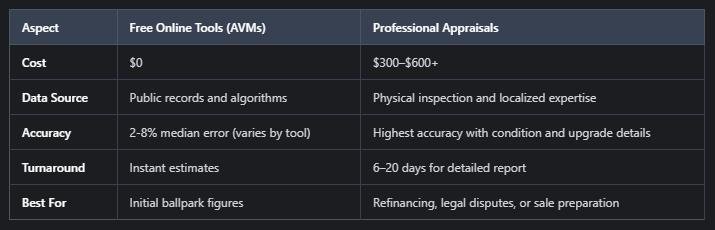
While free online tools provide convenient starting points, their limitations are significant. Professional appraisers physically inspect properties, evaluating condition, renovations, and unique features that algorithms miss. They apply local market expertise and professional judgment to specific neighborhoods, while automated tools rely solely on available data, which is often incomplete or outdated.
How to Use a Home Value Estimator Effectively?
To maximize the utility of these tools, compare multiple estimators, verify property details, consider local market trends, and consult professionals for important decisions.
01
of 5
Start with Multiple Free AVMs
Use several platforms (Zillow, Redfin, Realtor.com) to establish a range rather than relying on a single estimate. This helps identify potential outliers and provides a consensus value.
02
of 5
Input Accurate Property Details
Ensure all data points are correct, including:
- Precise square footage
- Correct bedroom and bathroom counts
- Updated property features and amenities
- Recent major renovations or improvements
Some platforms allow you to claim your property and update this information directly, which can significantly improve accuracy.
03
of 5
Cross-Reference with Local Market Data
Supplement automated estimates with:
- Recent sale prices of comparable properties in your neighborhood
- Current listing prices of similar homes
- Average price per square foot in your area
- Local market trends (days on market, list-to-sale price ratios)
04
of 5
Consult Professional Expertise
For higher-stakes decisions:
- Request a free Comparative Market Analysis (CMA) from a local real estate agent
- Consider a professional appraisal for refinancing or significant financial decisions
- Discuss valuations with mortgage lenders who may have access to proprietary estimation tools
05
of 5
Adjust for Known Limitations
Mentally adjust estimates based on factors AVMs might miss:
- Interior condition and upgrades
- Lot features (views, landscaping)
- Neighborhood nuances (school boundaries, noise levels)
- Recent market shifts not yet reflected in the data
When Should You Use a Home Value Estimator?
Use estimators for initial research, tracking appreciation, house hunting, and calculating equity. Avoid relying on them for listing prices, refinancing, unique properties, or tax appeals—seek professional valuation instead.

Ideal Use Cases
- Initial Research: Getting a baseline value when considering selling or refinancing
- Monitoring Property Value: Tracking appreciation over time
- Market Exploration: Understanding price ranges when house hunting
- General Financial Planning: Calculating approximate home equity
- Preliminary Investment Analysis: Screening potential investment properties
When to Seek Professional Valuation Instead?
- Listing Your Home: A CMA from a local agent provides market-specific pricing strategy
- Refinancing: Lenders require professional appraisals for loan approval
- Property Tax Appeals: Professional valuations carry more weight with tax authorities
- Legal Matters: Divorce settlements, estate planning, or litigation
- Unique Properties: Homes with unusual features, locations, or significant renovations
What Are the Best Home Value Estimators?
Top Free Platforms
Redfin Estimate
- Pros: Most accurate for on-market properties (2.09% median error), daily updates, cash rebate incentives
- Cons: Limited coverage in rural areas, requires Redfin agent service in some markets
Zillow Zestimate
- Pros: Broadest coverage (104M homes), includes climate risk data, most widely recognized
- Cons: Higher error rate (7.49% for off-market homes), less frequent updates
Realtor.com Estimate
- Pros: Provides equity estimates, buyer demand analytics, and local market insights
- Cons: Less transparent about error rates, fewer user-adjustment options
Chase Home Value Estimator
- Pros: Adjustable variables to test renovation impact, backed by banking data
- Cons: Less detailed property information, limited historical tracking
Professional and Premium Options
HouseCanary
- Pros: AI-powered value forecasting, rental yield analysis, detailed property reports
- Cons: Premium subscription required for full features, primarily targeted at investors
CoreLogic
- Pros: Used by many financial institutions, integrates mortgage data, detailed confidence scores
- Cons: Full access limited to industry professionals, consumer-facing tools more restricted
Free vs. Paid Home Value Estimators

Free Tools
Advantages:
- No cost barrier to entry
- Instant results available 24/7
- Useful for tracking trends over time
- Multiple options for comparison
- Sufficient for preliminary research
Limitations:
- Cannot account for property condition or upgrades
- Limited ability to factor in local market nuances
- No professional liability or guarantee of accuracy
- Minimal customization options
- Potential data privacy concerns (some services use your information for marketing)
Paid Professional Services
Advantages:
- Physical inspection accounts for condition and quality
- Detailed analysis of comparable properties
- Consideration of unique features and improvements
- Legal standing for financial transactions
- Professional liability and standards compliance
- Customized valuation for specific purposes (insurance, taxation, etc.)
Limitations:
- Significant cost ($300-$600+)
- Time-intensive process (days to weeks)
- Subject to appraiser availability and scheduling
- May still be influenced by market biases
- Less useful for frequent value tracking
Common Misconceptions About Home Value Estimators
Myth 1: “Online Estimates Are Always Accurate”
Reality: Even the best AVMs have median error rates of 2-8%, with some individual estimates off by 20% or more. Rural properties, unique homes, and rapidly changing markets yield the least reliable results.
Myth 2: “Appraisals Always Match Market Value”
Reality: Appraisals provide a professional opinion at a specific point in time. Market value is ultimately determined by what buyers are willing to pay, which may differ significantly in competitive markets where bidding wars can push prices 5-15% above appraised values.
Myth 3: “Square Footage Is the Top Value Driver”
Reality: While size matters, location, condition, layout, and amenities often have greater impact. A smaller, well-designed home in a prime location typically outvalues a larger home in a less desirable area.
Myth 4: “Renovations Always Add Dollar-for-Dollar Value”
Reality: Return on investment varies widely by project type. Bathroom and kitchen updates typically yield 60-80% returns, while pools and luxury finishes may not recoup their costs. AVMs often miss these nuances entirely.
Myth 5: “All Home Value Estimators Use the Same Data”
Reality: Different platforms access varying data sources, update at different frequencies, and employ proprietary algorithms. This explains why estimates for the same property can vary by 10% or more across platforms.
Other ways to Value the House Worth
Most often Comparative Market Analysis (CMA) is provided for free by realtors but often they may inflate values to win listings.
Professional Appraisals provide comprehensive evaluations—expensive and takes time to complete.
Comparable Sales Research examines nearby transactions—requires market knowledge to compare effectively.
Price-Per-Square-Foot calculations multiply local averages—ignores condition, features, and layout differences.
Tax Assessment Records show government valuations—often significantly below true market value.
Rental Income Analysis uses capitalization rates—only applicable for income-producing properties.
Professional Resources
- Mortgage Lenders: Can provide value estimates during pre-approval processes
- Home Inspectors: While not valuations, inspection reports identify issues that affect value
- Real Estate Attorneys: Provide guidance on valuation for legal matters
Complementary Tools
- Property Tax Assessment Records: Provides the basis for taxation, though often below market value
- Title Insurance Value Reports: Offers historical transaction data and ownership details
- Home Insurance Replacement Cost Calculators: Estimates rebuilding costs irrespective of land value
- Rental Income Estimators: Projects potential rental revenue for investment analysis
- Renovation ROI Calculators: Estimates value-add from specific improvement projects
Home Valuation Best Practices
For accurate property valuation use multi-source approach that minimizes risks and maximizes confidence in your home’s true market value.
Start with online estimators from Redfin, Zillow, and Realtor.com to establish a baseline range, but recognize their limitations with unique features and renovations. Next, engage local real estate professionals who provide market insights through comparative market analyses that reflect hyperlocal conditions and trends.
Reserve professional appraisals for high-stakes scenarios like refinancing, legal disputes, or significant sales where precision matters most. Remember that actual market value emerges only when tested through real buyer interest and offers—all other methods provide estimates with varying degrees of reliability.
Key Valuation Resources:
• Free AVMs: Quick baseline (2-8% error margin)
• Real Estate Agent CMAs: No-cost professional perspective with local expertise
• Professional Appraisals: $300-600 for legally-recognized valuations
• Personal Research: Comparable sales data from public records
• Market Testing: Ultimate validation through actual buyer offers
Can home staging help improve home valuation?
Home staging significantly influences buyer perception and selling prices, though not formal appraisals. According to the National Association of Realtors, professionally staged homes sell for 1-5% more than unstaged properties and spend 73% less time on market.
Well-executed staging highlights a property’s strengths while minimizing flaws, creating emotional connections with buyers who often pay premiums for move-in ready appearances. Vacant homes particularly benefit, as empty spaces appear smaller and flaws become more noticeable.
The investment typically returns 5-15x its cost ($300-600 for consultations, $2,000-5,000 for full staging) through higher sale prices and faster transactions, making it a high-ROI pre-listing strategy.
What happens with house value in hot or cold markets?
In hot markets, property values accelerate rapidly as demand outpaces supply, creating bidding wars that push prices 5-15% above asking. Home value estimators often lag behind these surges, underestimating true market values by using historical data that doesn’t reflect current competition. Appraisal gaps become common, with buyers paying cash differences between appraised values and purchase prices to secure properties.

In cold markets produce declining valuations as inventory accumulates and buyer urgency diminishes. Properties typically sell 5-10% below automated estimates, which tend to overvalue homes using outdated comparable sales from stronger market periods. Marketing timelines extend from weeks to months, and price reductions become necessary to attract sparse buyers, creating a downward valuation spiral in the neighborhood.
IMPORTANT: The accuracy of all valuation methods—AVMs, CMAs, and even professional appraisals—diminishes during transitional markets. Rapid appreciation or depreciation creates “time adjustment” challenges where comparable sales from even 3-6 months prior may no longer reflect current conditions. Local real estate professionals provide the best guidance during these periods, as their daily market engagement captures trends before they appear in algorithmic models.
Market Impact on Valuation Methods:
• Hot Markets: AVMs undervalue by 5-15%; appraisers apply upward adjustments
• Cold Markets: Online estimates overvalue by 5-10%; longer exposure needed
• Transitional Markets: All methods less reliable; recent sales most important
• Balanced Markets: Most accurate valuations across all methodologies
• Hyper-Local Variations: Neighborhood-specific trends may contradict broader market
Renovation Blind Spots in Home Valuation

To avoid your house being undervalued by automated systems, proactively document all renovations immediately upon completion. Capture before/after photos showcasing quality materials, craftsmanship details, and scope of improvements. Maintain organized digital portfolios containing contractor invoices, material specifications, and permit documentation.
Claim ownership of your property profiles on Zillow, Redfin, and Realtor.com, leveraging their manual update options. Zillow’s “Owner Dashboard” accepts renovation evidence directly, while Redfin’s “Owner Estimate” incorporates homeowner-verified improvements into algorithmic calculations.
When refinancing or selling, present appraisers with comprehensive renovation documentation highlighting high-value improvements. Focus particularly on kitchen renovations, bathroom upgrades, and energy-efficient enhancements, as these carry the greatest valuation weight.
Create separate line-item documentation for each major improvement rather than bundling renovations together, ensuring maximum value recognition in both automated and professional assessments.
What Can Diminish Your House Value?
Undocumented renovations vanish from automated valuations, instantly erasing thousands in equity as algorithms rely solely on permitted improvements visible in public records. School boundary adjustments can silently devalue properties by 5-15% overnight, completely undetected by historical sales data.
Appraiser-selected comparable sales frequently undervalue properties in appreciating markets, using outdated transactions that fail to capture current market momentum. Zillow’s algorithm systematically undervalues unique properties and premium finishes, defaulting to neighborhood averages rather than recognizing exceptional features.
Hyperlocal negative factors—nearby foreclosures, zoning changes, or flood zone reclassifications—immediately impact true market value but may take months to reflect in automated estimates. Renovation-quality discrepancies between perception and reality create substantial valuation gaps, as granite countertops vary dramatically in quality and value contribution.
Off-market properties consistently receive 5-8% lower automated valuations than identical on-market homes, artificially deflating equity calculations during refinancing applications.