To guide a client through a bathroom renovation, the conversation now extends beyond tile and fixtures to include integrated technology. The modern bathroom is a space for wellness, and no fixture embodies this shift more than the toilet. The choice is no longer simple; it is a decision between the traditional functionality of a regular toilet and the advanced experience of a smart toilet.

George is a seasoned interior designer and property marketing strategist with over 13 years of experience. He specializes in transforming properties into visually stunning spaces, helping clients recognize the potential and beauty in each property. With an impressive international client base of exciting projects throughout Europe and America.
This guide provides a clear comparison to help you and your clients understand the technology. We will define what a smart toilet does, analyze its reliability, and present a direct comparison to a regular toilet, helping you determine which is the best smart toilet for a given project.
What are the elements of a smart bathroom?
A smart bathroom has 8 elements to make it smart: a smart toilet with a bidet with a heated function, a smart shower, a vanity mirror, a heated towel rail, underfloor heating controlled via Wi-Fi, motion sensor lighting, smart hub integration with voice control, and a humidity-controlled extractor fan.
- Vanity mirror with integrated LED, anti‑fog and touch controls – clear reflection, quick defog and built‑in lighting for grooming.
- Smart toilet with bidet, heated seat and self‑clean functions – hands‑free hygiene, adjustable settings and automated cleaning to reduce upkeep.
- Programmable heated towel rail – pre‑warm towels and cut humidity during peak times.
- Smart shower with digital temperature and flow control – precise temperature recall and water‑saving presets.
- Underfloor heating with app‑controlled thermostat – zoned comfort and efficient scheduling.
- Humidity‑sensing extractor fan – auto runs to prevent condensation and mould growth.
- Occupancy and motion‑sensor lighting – touchless night lighting and energy savings.
- Central app or voice integration hub – single control point for mirror, shower, heating and toilet settings.
Direct Comparison: Regular vs. Smart Toilet with Bidet?
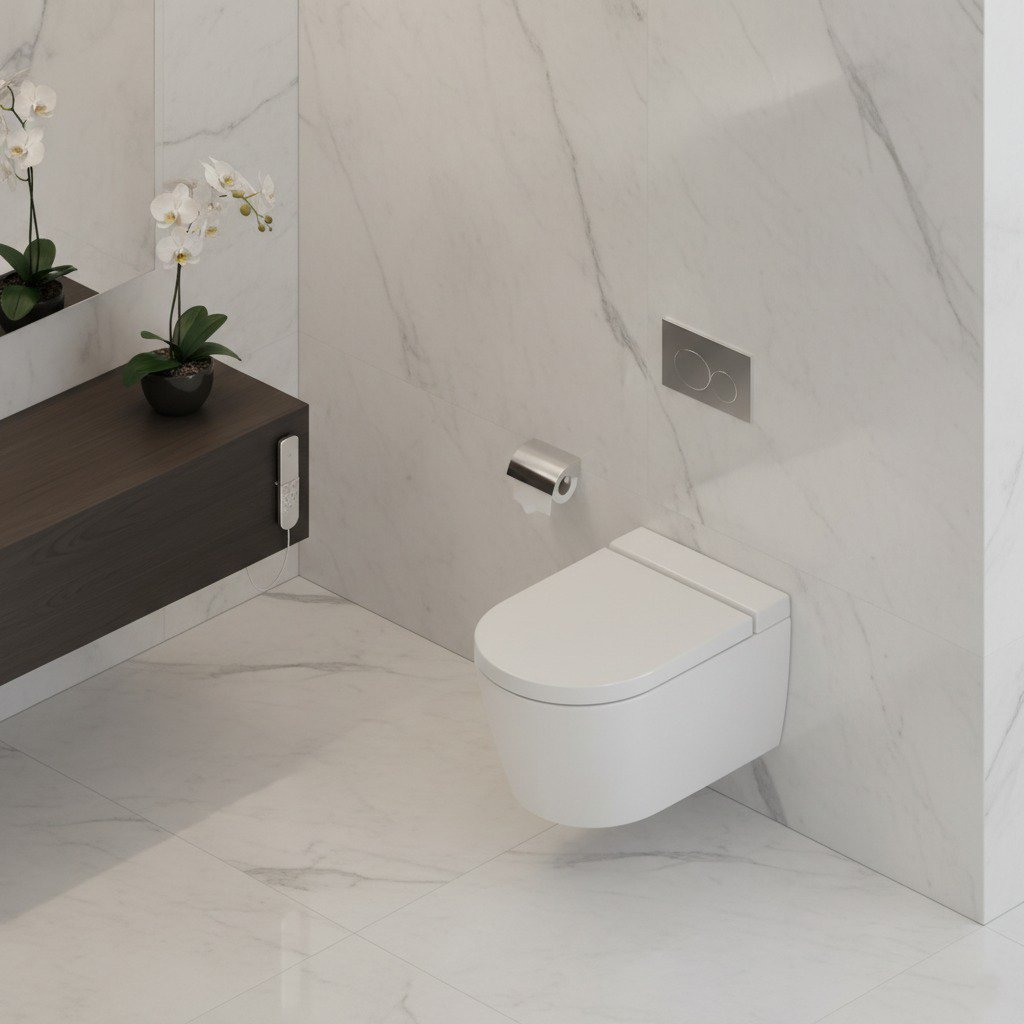
A smart toilet is a plumbing fixture that integrates technology to enhance hygiene, comfort, and efficiency. Unlike a regular toilet, which serves a single mechanical function, a smart toilet combines the standard function of a toilet with the cleansing capabilities of a bidet, controlled by an electronic interface.
To clarify the terminology, the market offers two primary categories:
Integrated Smart Toilets: These are all-in-one units where the bowl and technology are combined in a seamless design. This is often what people refer to when mentioning a smart toilet and bidet combo or a complete Kohler smart toilet system.
Smart Bidet Seats: This is an electronic seat that can be installed on most conventional toilets, transforming it with smart functionality. These are often called “smart bidets” or “washlets.”
Feature Specification
To explain the value of a smart toilet, you must first detail its features. Each function represents a significant upgrade over a non-smart toilet.
Advanced Hygiene: The Bidet and Self-Cleaning Systems
The most significant upgrade is the built-in bidet. A toilet with a jet spray uses a precise, temperature-controlled stream of water for cleansing, a feature entirely absent in standard toilets which rely on toilet paper. This jet spray is fully adjustable via a toilet remote control. Furthermore, many models qualify as a self-clean toilet by using automated systems to rinse the bidet nozzle before and after each use and misting the bowl to prevent waste from adhering. The non-smart equivalent to this is manual, chemical-based cleaning.
Advanced Hygiene: The Bidet and Self-Cleaning Systems
A key luxury and hygiene feature is automation. An automatic toilet lid and seat use a sensor to open upon approach and close upon departure. This creates a completely touchless toilet experience when combined with automatic flushing. A regular toilet, by contrast, requires manual lifting of the seat and touching a lever or button to flush, increasing contact with germs.
Personalization and Control: Remotes and Connectivity
Smart toilets put the user in control. A dedicated toilet remote control, often wall-mounted, allows each user to save their preferred settings for water temperature, pressure, and nozzle position. A standard toilet offers no adjustability. For ultimate control, a connected toilet uses Bluetooth or Wi-Fi to sync with a smartphone app. This allows for creating detailed user profiles and can integrate with smart home systems for a fully connected experience.

Design Integration: Wall-Hung Smart Toilets
From a design perspective, wall-hung smart toilets offer a major aesthetic advantage. They conceal the tank and plumbing within the wall, creating a minimalist, floating appearance that makes a small bathroom feel larger. This design makes cleaning the floor beneath the toilet effortless, a clear benefit over floor-mounted toilets that have hard-to-reach crevices at the base.

These features are making their way into high-end commercial design. The durability and hygiene benefits of a touchless toilet are ideal for luxury hotels and offices, leading to the development of sophisticated automated public toilets that offer a premium experience.
Understanding these specific features makes the value proposition clearer. Now, let’s place them in a direct, side-by-side comparison.
Framing the Regular vs. Smart Toilet Choice for Clients
To make an informed decision, a direct comparison based on key project criteria is essential.
| Feature | Regular Toilet | Smart Toilet with Bidet |
| Hygiene & Cleaning | Relies on toilet paper. Requires manual cleaning. | Provides water-based cleansing (jet spray). Features automated self-clean toilet functions. |
| Comfort & User Experience | A purely functional, cold porcelain fixture. | Offers a heated seat, warm air dryer, and an automatic toilet lid for a touchless experience. |
| Aesthetics & Design | Standard floor-mounted styles. | Sleek one-piece and space-saving wall-hung smart toilets. |
| Installation & Requirements | Standard plumbing rough-in. | Requires a standard plumbing rough-in and a GFCI-protected electrical outlet nearby. |
| Control Interface | A simple flush lever or button. | A toilet remote control or smartphone app for full personalization. |
| Upfront Cost | Lower initial investment. | Higher initial investment, with a wide price range from entry-level seats to luxury models. |
Addressing Client Objections: Are Smart Toilets a Reliable Investment?
A common client concern is whether the technology is a fleeting gimmick or a reliable long-term investment.
Provided you select a model from a reputable brand smart toilets are a reliable technology. The technology is not new; it has been standard in countries like Japan for decades and has undergone extensive refinement. Leading manufacturers, such as those that produce the Kohler smart toilet line, build these fixtures with high-quality components and back them with substantial warranties.
The “gimmick” perception often arises from an overload of features. The true value is found in the core functions: cleansing, heating, and drying. These deliver tangible daily benefits. For most users, even a model with basic smart features represents a permanent upgrade in personal hygiene and comfort, not a temporary trend.
Specification in Practice: How to Choose the Best Smart Toilet for Your Client
To select the right option, align the choice with the client’s goals and the project’s scope.
For a Full Renovation with a Modern Aesthetic: An integrated, wall-hung smart toilet is the superior choice. It offers a minimalist look that enhances the sense of space and simplifies cleaning.
For an Upgrade on a Limited Budget: A smart bidet seat is an excellent recommendation. It delivers over 80% of the core benefits at a fraction of the cost and can be installed on the client’s existing toilet.
For Clients Focused on Wellness or with Mobility Issues: The automated and cleansing features of smart toilets provide significant practical benefits, enhancing independence and hygiene.
For Increasing Property Value: In a high-end or modern home, a smart toilet is becoming an expected feature. It signals a commitment to quality and modern convenience that resonates with buyers.
Top Models to Specify: Five Smart Toilets for a Designer's Shortlist
Having covered the features that make a smart toilet “smart,” this guide now highlights what to look for from the best smart toilet models. To help you build a shortlist for your clients, here are five examples representing key categories in the market that you might encounter from leading brands.
1. Duravit Sensowash Starck F
Category: Best for Minimalist, Architect-Driven Design.
Key Features: Wall-hung to save space; smartphone/app control; auto open/close lid; heated seat and warm-air dryer.
Specification Notes: Designed by Philippe Starck, this model is the definitive choice for a modern, minimalist aesthetic. Specify it when the design brief calls for a floating appearance and maximum floor space is a priority.
2. Toto Neorest NX2
Category: Best for Ultimate Luxury & Technology.
Key Features: eWater+ self-cleaning technology; dual-flush system; heated seat; automatic deodorizer; remote control for full personalization.
Specification Notes: As a benchmark high-end Japanese smart toilet, the Neorest is ideal for lavish primary ensuites where the client desires the most advanced hygiene technology and a sleek, sophisticated design.
3. Kohler Veil Intelligent Toilet
Category: Best for Compact Elegance.
Key Features: Compact one-piece design; touchscreen remote; automatic flush; heated seat; self-cleaning wand.
Specification Notes: The Veil’s compact and elegant form offers significant space-saving benefits without requiring in-wall installation. It is a perfect specification for modern bathrooms where floor space is a consideration but a wall-hung model is not feasible.
4. Kohler Innate Smart Toilet
Category: Best for Blended Function & Style.
Key Features: Sleek one-piece design; hands-free control (auto open/close); electrolyzed pre-rinsing for bowl cleanliness; heated seat and warm air dryer.
Specification Notes: The Innate combines elegance and robust function, making it a versatile choice for a wide range of modern luxury bathrooms. It’s a strong option for clients who want advanced features in a more traditional floor-mounted form.
5. Keorh Smart Luxe 5000
Category: Best for a Feature-Rich Specification.
Key Features: Automatic lid and sensor flush; customizable bidet; built-in air purifier; comprehensive self-cleaning functionality.
Specification Notes: This model represents the feature-rich category designed for utmost comfort. Specify it for clients focused on a complete, sophisticated technology package that prioritizes a luxurious and automated user experience.
Conclusion: Making the Final Specification
The decision between a smart toilet and a conventional model is a key inflection point in the bathroom design process. It is not merely a choice between features, but a strategic decision that balances a client’s lifestyle aspirations, budget, and the long-term vision for their home. As a design professional, your role is to guide this decision by clearly presenting the scenarios where each option excels.
When to Specify a Smart Toilet?
A smart toilet is the clear choice for projects that prioritize long-term comfort, hygiene, and cutting-edge design.
You should specify a smart toilet in primary ensuite renovations where luxury, wellness, and spa-like features are a core client desire.
It is an essential feature for clients with mobility challenges or a focus on aging-in-place, as the automated and cleansing functions greatly enhance accessibility and independence.
Recommend a smart toilet to future-proof a new build or high-end remodel, adding tangible value and a compelling feature that aligns with modern home technology expectations.
When a Regular Toilet Remains the Practical Choice?
A high-quality conventional toilet is often the more prudent and appropriate specification under certain circumstances.
A regular toilet is the logical option for projects with strict and immovable budget constraints, as it allows funds to be allocated to other high-impact design elements.
Consider a conventional toilet for secondary bathrooms, guest rooms, or powder rooms where the advanced features of a smart toilet would be infrequently used.
It is often more suitable in homes with a purely traditional or historic design aesthetic, where visible modern technology might clash with the overall character of the space.
For investment properties intended for a quick resale or rental market, the immediate return on investment from a high-quality, standard fixture can be more favorable.
Your expertise lies in presenting these options clearly. By guiding your client to an investment that perfectly aligns their daily routine with their design aspirations and budget, you empower them to build a space that is not only beautiful but intelligently designed for their life.