Buying a new home is a thrilling milestone, but transforming it into a space that reflects your style and meets your needs can feel daunting—especially when working with a finite budget.
For a homeowner with a newly purchased four-bedroom house and $100,000 allocated for interior design, strategic planning is essential to maximize value. With over 13 years of experience transforming properties across Europe and America, I’ll guide you through the best practices for spending this budget wisely, prioritizing key areas, and using a matrix-based approach to classify your spending deisions.
Let’s dive into how to make your new home both functional and beautiful without breaking the bank.
Want to get 3D rendering for your interior design project?

George is a seasoned interior designer and property marketing strategist with over 13 years of experience. He specializes in transforming properties into visually stunning spaces, helping clients recognize the potential and beauty in each property. With an impressive international client base of exciting projects throughout Europe and America.
George Nicola shares:
This home renovation budget strategically allocates $100,000 across five project areas, prioritizing high-impact improvements for maximum property value and livability.
The kitchen renovation commands the largest investment at $55,000 (55%), covering appliances, cabinetry, countertops, and electrical updates. As the home’s centerpiece, kitchen renovations typically deliver the highest return on investment.
The primary bathroom renovation receives $27,000 (27%) for fixtures, tiling, vanity installation, and plumbing modifications. Bathroom upgrades consistently rank among the most valuable home improvements.
Bedroom renovations are allocated $8,000 (8%) for cost-effective updates including flooring, paint, lighting, and closet organization—essential improvements without major structural changes.
A contingency fund of $10,000 (10%) provides protection against unexpected costs, hidden issues, or design modifications during construction.
The living room renovation is deferred ($0), allowing focus on higher-priority areas while preserving this project for future phases.
| Project Area | Estimated Cost | Percentage of Budget |
|---|---|---|
| Kitchen | $55,000 | 55% |
| Primary Bathroom | $27,000 | 27% |
| Bedrooms (Minimal) | $8,000 | 8% |
| Contingency Fund | $10,000 | 10% |
| Living Room (Deferred) | $0 | 0% |
| Total | $100,000 | 100% |
TALLBOX provides information for educational purposes only and does not offer financial or law advice; users should consult with qualified professionals before making any investment decisions. TALLBOX and George Nicola are not liable for any losses or damages incurred as a result of relying on the information provided.
Step 1: Prioritize Functionality in Your New Home
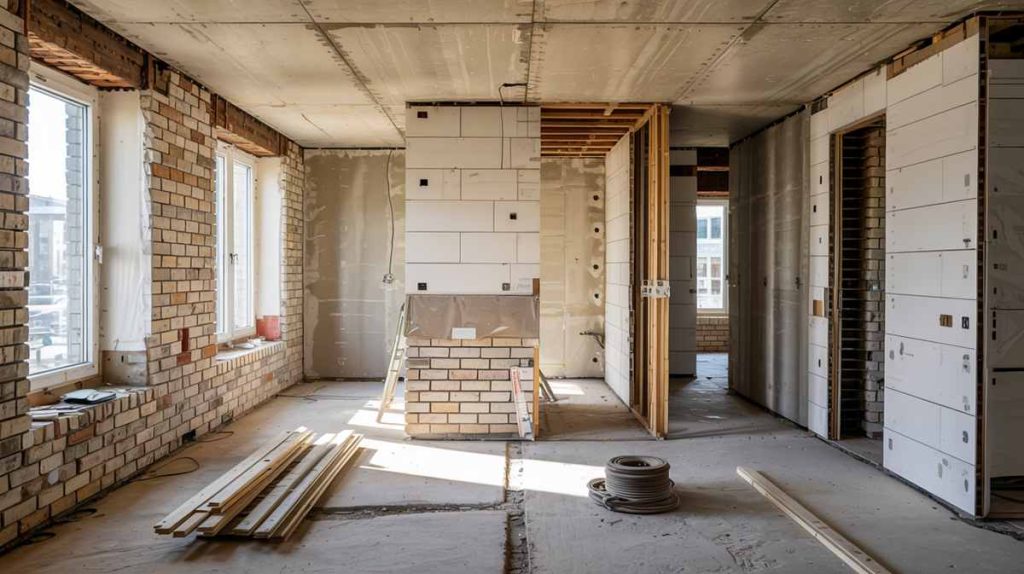
When you first step into your new four-bedroom house, the excitement of endless possibilities can be overwhelming. The first thing to prioritize is functionality—ensuring the home works for your daily life. Before hiring an interior designer, assess the home’s condition and your lifestyle needs.
Are the kitchen and bathrooms outdated or impractical? Do the bedrooms lack storage? Does the layout support your family’s flow?
For most homeowners, the kitchen and bathrooms are the heart of daily living and the most expensive to renovate. These spaces also significantly impact resale value, making them critical starting points. With a $100,000 budget, you’ll quickly realize it’s not as expansive as it seems, especially for a four-bedroom home. Focusing on high-impact, high-cost areas like the kitchen and bathrooms ensures your investment enhances both livability and long-term value.
Step 2: Hiring an Interior Designer and Setting Priorities

Once you’ve identified functionality as your north star, it’s time to hire an interior designer to bring your vision to life. A professional designer, like those at TALLBOX, can help you avoid costly mistakes, streamline decisions, and maximize your budget. $100,000 is a modest sum for a full-home redesign, so clear prioritization is crucial.
Why $100,000 Isn’t Enough for a Full Four-Bedroom Overhaul?
For a four-bedroom home (approximately 2,000–3,000 square feet), interior design costs typically range from $5 to $17 per square foot for design services alone, excluding furnishings and materials.
At an average of $10 per square foot, design fees for a 2,500-square-foot home could consume $25,000, leaving $75,000 for materials, labor, and furnishings.
Kitchens and bathrooms, known as “wet” spaces, are particularly expensive due to plumbing, tiling, and fixtures, often costing $100–$400 per square foot in major U.S. cities like New York or California.
For context, here are estimated costs in two U.S. states (2025 data):
- New York (NYC): A mid-range kitchen renovation (200 sq. ft.) averages $60,000–$80,000, including cabinetry, countertops, appliances, and labor. A bathroom (50 sq. ft.) ranges from $22,000–$35,000. Design fees add 10–30% ($6,000–$24,000 for a kitchen).
- Texas (Houston): Costs are slightly lower, with a kitchen renovation averaging $50,000–$70,000 and a bathroom at $18,000–$30,000. Design fees are similar, around $5,000–$20,000 for these spaces.
Given these figures, a $100,000 budget in a four-bedroom home is likely sufficient for a kitchen and one or two bathrooms, but not much else. For example:
- Kitchen: $60,000 (NY) or $50,000 (TX) for mid-range materials and labor.
- Primary Bathroom: $30,000 (NY) or $25,000 (TX).
- Design Fees: $10,000–$20,000 for both spaces.
This allocation leaves little for bedrooms or living areas, reinforcing the need to focus on high-priority zones.
How to Prioritize with Your Designer?

When hiring a designer, communicate your budget and goals upfront. Here’s how to set priorities:
- Focus on Wet Spaces: Allocate 60–80% of your budget ($60,000–$80,000) to the kitchen and primary bathroom. These spaces require specialized contractors and durable materials, driving up costs.
- Phase the Project: If funds are tight, complete the kitchen first, then the primary bathroom. Bedrooms and living rooms can be refreshed later with lower-cost updates like paint and furnishings.
- Leverage Designer Expertise: A designer can suggest cost-effective materials (e.g., porcelain tiles mimicking natural stone) and streamline procurement to stay within budget.
- Plan for Contingencies: Pad your budget by 10–20% ($10,000–$20,000) for unexpected repairs, such as plumbing issues or structural fixes.
By focusing on the kitchen and primary bathroom, you ensure the most essential and costly spaces are addressed, leaving bedrooms for future DIY or budget-friendly updates.
Step 3: A Matrix-Based Approach to Classify Spending

To make informed decisions about your $100,000, use a decision matrix to classify spending priorities. This method evaluates each project area based on weighted criteria, ensuring your budget aligns with your goals. Below, I outline five ways to apply this matrix, tailored to a four-bedroom home.
Decision Matrix Criteria
Assign weights to the following criteria based on their importance (totaling 100%):
Impact on Functionality (40%): How much does the space improve daily living?
Resale Value (30%): Does the investment increase home value?
Cost Efficiency (20%): Can the project be completed cost-effectively within budget?
Aesthetic Appeal (10%): Does it enhance the home’s visual appeal?
Score each project area (e.g., kitchen, primary bathroom, bedrooms) from 1–10 for each criterion. Multiply scores by weights, sum them, and rank projects to guide spending.
Five Ways to Classify Your $100,000 Spending
Prioritize Kitchen Renovation (Estimated Cost: $50,000–$60,000)
Matrix Scores: Functionality (9/10), Resale Value (8/10), Cost Efficiency (7/10), Aesthetic Appeal (8/10).
Weighted Score: (9×0.4) + (8×0.3) + (7×0.2) + (8×0.1) = 3.6 + 2.4 + 1.4 + 0.8 = 8.2/10.
Rationale: The kitchen is the home’s hub, critical for cooking and socializing. It commands high resale value (70–80% return on investment). Allocate $50,000–$60,000 for mid-range cabinetry, appliances, and countertops, plus $5,000–$10,000 for design fees.
Example: In Texas, opt for quartz countertops ($6,000) and stock cabinetry ($10,000) to save costs while maintaining quality.
Invest in Primary Bathroom (Estimated Cost: $25,000–$30,000)
Matrix Scores: Functionality (8/10), Resale Value (7/10), Cost Efficiency (6/10), Aesthetic Appeal (9/10).
Weighted Score: (8×0.4) + (7×0.3) + (6×0.2) + (9×0.1) = 3.2 + 2.1 + 1.2 + 0.9 = 7.4/10.
Rationale: A modern primary bathroom enhances comfort and adds 60–70% resale value. Use $25,000–$30,000 for a new vanity, shower, and tiles, plus $3,000–$5,000 for design.
Example: In New York, choose porcelain tiles ($2,000) over marble to reduce costs while achieving a luxurious look.
Minimal Bedroom Updates (Estimated Cost: $5,000–$10,000)
Matrix Scores: Functionality (6/10), Resale Value (5/10), Cost Efficiency (9/10), Aesthetic Appeal (7/10).
Weighted Score: (6×0.4) + (5×0.3) + (9×0.2) + (7×0.1) = 2.4 + 1.5 + 1.8 + 0.7 = 6.4/10.
Rationale: Bedrooms have lower priority due to lower costs and resale impact. Allocate $5,000–$10,000 for paint, lighting, and basic furnishings across four bedrooms, relying on DIY or budget retailers like IKEA.
Example: Spend $1,500 per bedroom on paint ($300) and thrifted furniture ($1,200).
Reserve Contingency Fund (Estimated Cost: $10,000–$15,000)
Matrix Scores: Functionality (7/10), Resale Value (6/10), Cost Efficiency (8/10), Aesthetic Appeal (5/10).
Weighted Score: (7×0.4) + (6×0.3) + (8×0.2) + (5×0.1) = 2.8 + 1.8 + 1.6 + 0.5 = 6.7/10.
Rationale: Unforeseen issues (e.g., plumbing leaks, electrical upgrades) can derail projects. Reserve 10–15% of your budget to avoid cutting corners elsewhere.
Example: In New York, a hidden pipe issue in the bathroom could cost $5,000 to fix, underscoring the need for a buffer.
Defer Living Room and Secondary Spaces (Estimated Cost: $0–$5,000)
Matrix Scores: Functionality (5/10), Resale Value (4/10), Cost Efficiency (8/10), Aesthetic Appeal (6/10).
Weighted Score: (5×0.4) + (4×0.3) + (8×0.2) + (6×0.1) = 2.0 + 1.2 + 1.6 + 0.6 = 5.4/10.
Rationale: Living rooms and secondary bathrooms have lower functional and resale impact. Defer these to future budgets, using minimal funds ($0–$5,000) for temporary decor like rugs or curtains.
Example: In Texas, spend $2,000 on a secondhand sofa and $500 on curtains to make the living room livable.
Final Thoughts
Spending $100,000 on an interior designer for a new four-bedroom home requires ruthless prioritization. By focusing on the kitchen and primary bathroom—spaces that drive functionality and resale value—you ensure your investment delivers maximum impact. Using a decision matrix to classify spending helps align your budget with your goals, balancing cost efficiency with aesthetic appeal.
At TALLBOX, we specialize in crafting tailored design plans that respect your budget while transforming your home into a stunning, functional haven. Start by assessing your needs, hiring a designer who understands your vision, and allocating funds strategically. Your dream home is within reach—one smart decision at a time.
For personalized guidance, contact TALLBOX at office.tallbox@gmail.com or visit tallboxdesign.com to explore our 3D design services and start your journey today.