What is Construction Cost Forecasting?
Construction cost forecasting is a predictive financial strategy that enables developers, architects, and contractors to assess future project costs based on historical data patterns, real-time market fluctuations, and predictive analytics. Construction forecasting is often referred to as cash flow forecasting for construction jobs. As a core component of construction budgeting, this approach mitigates financial risk, optimizes resource allocation, and ensures cost-effective decision-making for large-scale projects; in other words its used for predicting project costs.
Accurate forecasting allows construction professionals to anticipate material cost inflation, labor wage adjustments, and regulatory expenses. By integrating advanced cost estimation models, firms can develop flexible budgeting plans that adapt to changing economic conditions while maintaining financial stability.

George is a seasoned interior designer and property marketing strategist with over 13 years of experience. He specializes in transforming properties into visually stunning spaces, helping clients recognize the potential and beauty in each property. With an impressive international client base of exciting projects throughout Europe and America.
TALLBOX provides information for educational purposes only and does not offer financial advice; users should consult with qualified professionals before making any investment decisions. TALLBOX and George Nicola are not liable for any losses or damages incurred as a result of relying on the information provided.
Why Is Construction Cost Forecasting Critical?

Construction forecasting is a type of construction accounting that prevents cost overruns by identifying budget risks early and enabling proactive adjustments. Construction forecasting can reduce financial risks through predictive modeling and risk assessment.
Construction budgeting streamlines forecasting and enhances investor confidence by improving financial transparency and feasibility planning. Construction estimation uses trend analysis and predictive cost to optimize resource allocation for developers and infrastructure planners, ensuring capital efficiency and profitable project outcomes.
How Does Construction Cost Forecasting Work?

Cash flow forecasting in construction relies on a multi-layered approach that combines data-driven insights with strategic financial planning. The process incorporates:
Historical Project Data: Previous construction budgets, cost deviations, and market trends help establish accurate forecasting benchmarks. By analyzing past expenditure patterns, firms can identify predictable cost drivers.
Current Market Trends: Real-time monitoring of supply chain dynamics, material pricing shifts, and labor market fluctuations enables dynamic budgeting adjustments.
Advanced Forecasting Models: AI-driven algorithms, parametric cost estimation, and statistical financial models refine predictions by integrating historical benchmarks with real-time analytics.
For instance, a construction firm planning a large-scale infrastructure project may use forecasting models to predict the impact of steel price fluctuations. By analyzing historical cost trends and adjusting procurement schedules based on real-time data, the firm can secure materials before price surges occur, reducing overall project expenses.
Key Components of an Effective Construction Cost Forecast

Historical Data & Market Trends
Historical cost data serves construction companies as the foundation for predictive cost modeling, enabling developers and project managers to analyze inflation trends, material price fluctuations, and labor market dynamics. Examining past project expenditures allows for pattern recognition, improving cost estimation accuracy and financial planning and project schedule.
Construction firms leveraging AI-driven predictive models can refine forecasting precision by incorporating machine learning algorithms that detect economic shifts affecting material supply and labor availability and are projected to grow even further with the invention of AI agent systems. For example, analyzing five years of labor costs can reveal seasonal wage trends, allowing firms to schedule workforce hiring during lower-cost periods to optimize expenses.
Material & Labor Cost Analysis
Forecasting in construction means predicting material and labor expenses are among the most volatile cost drivers in construction projects. Effective cost forecasting requires real-time tracking of pricing models to ensure budget predictability and long-term financial stability.
Embedded Chat
Material Cost Variability Factors:
- Supply Chain Disruptions: Shortages and delays in sourcing raw materials impact procurement timelines and cost structures.
- Inflation Trends: Rising costs of steel, concrete, and lumber directly influence budgeting decisions.
- Global Market Demand: Competitive bidding and material scarcity contribute to pricing volatility.
Labor Cost Influences:
- Union wage agreements dictate skilled labor costs, affecting payroll budgeting.
- Regional wage variations create cost discrepancies in different construction zones.
- Automation & digital construction methods influence long-term labor dependency and cost reduction.
For example, a developer working on a multi-phase urban construction project can integrate labor cost forecasting models to adjust hiring strategies based on anticipated market demand, ensuring financial efficiency.
Economic & Regulatory Influences
Economic policies, government regulations, and financial market fluctuations directly impact cost forecasting accuracy. Compliance costs, tax policies, and international trade agreements influence the availability and pricing of materials, requiring developers to align forecasting models with regulatory frameworks.
Key Economic & Policy Factors Affecting Cost Forecasting:
- Inflationary Pressures: Material procurement costs and contractor wages fluctuate in response to inflation.
- Tariffs & Trade Policies: Import/export restrictions increase costs for raw materials sourced from international markets.
- Building Code Regulations: Compliance with updated safety and environmental laws may introduce new project costs.
For example, a commercial real estate developer preparing for a high-rise project must factor in anticipated zoning law revisions and environmental compliance requirements, ensuring that projected costs remain aligned with evolving regulations.
Key Factors in Construction Cost Forecasting

Construction Cost Forecasting vs. Cost Estimation – What’s the Difference?
Predictive vs. Fixed-Value Budgeting in Construction Projects
Construction cost forecasting and cost estimation are essential financial planning methodologies used in project budgeting. While both contribute to cost management, they serve distinct purposes in determining project expenses.
Construction cost forecasting is a predictive financial modeling approach that enables developers and contractors to anticipate future project costs based on historical pricing trends, inflation adjustments, and AI-driven market analysis. It provides a dynamic budgeting framework, allowing for real-time cost adjustments as economic and industry conditions evolve.
Construction cost estimation, in contrast, is a fixed-value calculation method that defines current project costs based on material pricing, labor rates, and procurement schedules. This approach is used to establish baseline project budgets before construction begins, ensuring that financial commitments align with projected expenses.
How Cost Forecasting Helps Developers Mitigate Financial Risk?
A primary advantage of cost forecasting is its ability to identify potential budget risks before they impact a project. By leveraging historical data analytics, inflation modeling, and supply chain tracking, developers can implement data-backed risk mitigation strategies that prevent cost overruns and enhance financial stability.
For example, a developer planning a multi-year infrastructure project can use forecasting models to assess rising material costs and labor market fluctuations. This insight allows for adjustments to procurement schedules, reducing the risk of cost spikes due to supply shortages or inflationary pressures.
Key Differences Between Cost Forecasting and Cost Estimation
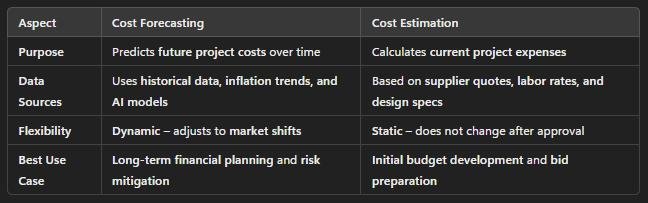
By integrating both methodologies, construction firms can ensure greater budget accuracy, improving financial decision-making while maintaining flexibility in adapting to economic uncertainties.
For example, a real estate developer planning a multi-year commercial project may rely on cost forecasting to account for projected material cost inflation and labor market changes, ensuring that financial reserves align with expected budget adjustments. Meanwhile, an architectural firm preparing a contract bid would use cost estimation to calculate immediate project expenses based on supplier pricing and contractor wages at the time of submission.
When to Use Forecasting vs. Estimation?
Cost Forecasting is ideal for long-term budgeting, financial modeling, and risk mitigation strategies.
Cost Estimation is best for project bid proposals, procurement planning, and cost breakdown analysis.
Construction firms integrating both methodologies can achieve greater cost accuracy, reducing budgetary discrepancies while ensuring flexibility in adapting to economic uncertainties
Best Methods & Models for Construction Cost Forecasting

How Forecasting Models Improve Budget Accuracy
Modern construction cost forecasting relies on advanced financial models that integrate statistical analysis, AI-driven predictions, and real-time data tracking to enhance budget accuracy and risk management. These models allow developers to anticipate material price fluctuations, workforce demand shifts, and regulatory cost impacts, providing the flexibility needed for financial stability in complex construction projects.
Key Cost Forecasting Models Used in Construction

Analogous Forecasting: Using Historical Data for Cost Predictions
Analogous forecasting compares previously completed projects with similar scope, materials, and labor requirements to estimate new project costs. This method is particularly effective for early-stage budgeting, allowing developers to generate ballpark figures based on historical spending patterns.
For instance, a contractor building a new office complex can reference past projects of similar size and scale to estimate structural costs, labor requirements, and material needs, creating an initial financial model before refining it with more precise forecasting methods.
Parametric Forecasting: Statistical Cost Modeling for Large-Scale Projects
Parametric forecasting applies mathematical algorithms and statistical analysis to predict construction costs based on quantifiable project attributes. This approach is useful for high-budget developments, where variable costs like labor rates, raw material demand, and inflation rates significantly influence financial planning. By leveraging historical data and trends, parametric forecasting allows for more accurate estimations of future costs of home building projects, thereby reducing the risk of budget overruns. Additionally, this method can adapt to changing market conditions, helping developers make informed decisions throughout the project lifecycle. As a result, stakeholders can better allocate resources and optimize spending, ultimately enhancing overall project feasibility.
For example, a developer constructing a series of residential towers may use parametric forecasting to assess the impact of rising steel prices and regional wage differences, ensuring that cost projections remain aligned with market realities.
Bottom-Up Forecasting: Detailed Cost Breakdown for Complex Projects
Bottom-up forecasting takes a component-based approach, where each individual cost factor—from foundation work to HVAC installation—is calculated separately before being aggregated into the final project budget. This method provides the highest level of accuracy but requires extensive data inputs and detailed cost tracking.
A hospital construction project, for example, may require a bottom-up forecasting approach to account for the specialized materials, skilled labor costs, and regulatory compliance expenses unique to medical facility construction.
AI-Based Forecasting: Real-Time Cost Tracking and Dynamic Adjustments
Artificial intelligence is revolutionizing construction cost forecasting by incorporating machine learning algorithms that process real-time data and automatically adjust financial models based on market fluctuations. AI-driven forecasting enhances budget adaptability, allowing construction firms to react to economic shifts, supply chain disruptions, and policy changes with greater agility.
For instance, a highway infrastructure project using AI-based forecasting can detect rising fuel costs and adjust procurement schedules and contractor payments to minimize budget overruns.
Choosing the Right Forecasting Method
The choice of forecasting model depends on project complexity, cost variability, and required accuracy levels.
- Analogous forecasting works best for early-stage budget assessments.
- Parametric forecasting is ideal for high-value projects with multiple cost variables.
- Bottom-up forecasting provides detailed cost breakdowns for regulatory-heavy developments.
- AI-based forecasting ensures real-time cost tracking and predictive analytics for dynamic cost environments.
By integrating multiple forecasting models, construction firms can enhance budget reliability, improve financial decision-making, and mitigate economic risks throughout the project lifecycle.
Tools & Software for Construction Cost Forecasting
How Digital Solutions Enhance Cost Forecasting Accuracy?
Advancements in construction technology have transformed cost forecasting from a manual, spreadsheet-driven process into an AI-powered, real-time financial analysis system. Modern construction cost forecasting tools integrate historical data analysis, market trend tracking, and predictive modeling to enhance budgeting precision and reduce financial risk.
The right cost forecasting software enables developers, contractors, and project managers to adjust budget estimates dynamically, ensuring financial stability in response to market fluctuations, labor cost variations, and material price shifts.
Essential Features in Forecasting Software
Effective construction cost forecasting software must provide:
- Real-Time Cost Tracking – Automatically updates budget estimates based on market conditions, supply chain disruptions, and material price changes.
- AI & Machine Learning Integration – Uses historical data modeling to predict future expenses with higher accuracy.
- Scenario Analysis & Risk Mitigation – Simulates multiple cost projection scenarios, allowing project managers to assess budget risks and create financial contingency plans.
- BIM (Building Information Modeling) Integration – Connects cost forecasting with 3D project modeling, improving budget alignment with design changes.
- Cloud-Based Accessibility – Enables multi-team collaboration, ensuring that all stakeholders access the most recent cost projections and financial data.
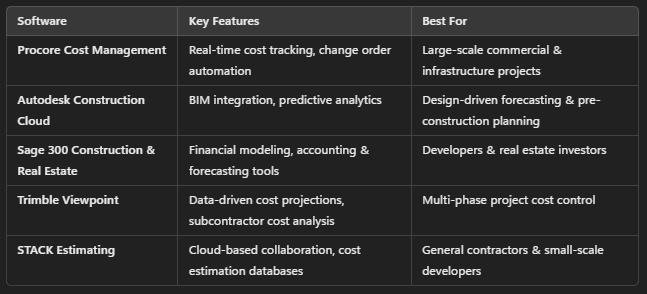
Best Construction Cost Forecasting Software in 2025
How to Choose the Right Cost Forecasting Tool?
The selection of cost forecasting software depends on project complexity, financial scope, and collaboration needs.
- For high-budget infrastructure projects, solutions like Procore Cost Management provide enterprise-grade cost monitoring and budget control.
- For real estate development, platforms like Sage 300 offer detailed financial analysis and investor reporting tools.
- For smaller contractors, software like STACK Estimating provides affordable, cloud-based cost tracking.
By integrating AI-based forecasting software, construction firms can anticipate budget fluctuations, optimize resource allocation, and enhance long-term financial planning.
Why construction forecasting is critical?
Construction forecasting is essential for effective project management, enabling better financial control, resource allocation, risk mitigation, and stakeholder communication, all of which contribute to the successful completion of construction projects. Poor project data will decrease project performance, increase project costs, and lead to a surge of overspending.
Budget Management: Accurate forecasting helps project managers estimate the costs associated with labor, materials, and equipment. This enables better budgeting and ensures that the project stays within financial constraints, reducing the risk of cost overruns.
Resource Allocation: Effective forecasting allows for the proper allocation of resources, including manpower and materials. By predicting future needs, project managers can ensure that the right resources are available at the right time, preventing delays and inefficiencies.
Timeline Planning: Construction forecasting aids in developing realistic timelines for project completion. By anticipating potential obstacles and delays, project managers can create more accurate schedules, improving overall project efficiency.
Reduces financial risks: Forecasting helps identify potential risks and challenges that may arise during the construction process. By anticipating these issues, project managers can develop contingency plans to mitigate risks, ensuring smoother project execution.
Stakeholder Communication: Clear and accurate forecasts facilitate better communication with stakeholders, including clients, investors, and subcontractors. Providing realistic expectations regarding costs and timelines helps build trust and ensures everyone is aligned on project goals.
By combining these strategies, even small spaces transform into productive offices and comfortable guest accommodations without compromise.
How Tallbox Design Optimizes Construction Cost Forecasting?
Data-Driven Forecasting Approach for Cost Accuracy
Tallbox Design applies a strategic, data-driven forecasting methodology that integrates real-time market analysis, historical data modeling, and predictive analytics to ensure high-precision cost forecasting for construction projects.
By leveraging advanced financial modeling techniques, Tallbox Design enables developers and project managers to predict material price shifts, labor cost changes, and inflation trends, allowing for accurate budgeting and risk mitigation.
AI-Driven Cost Prediction & Automation
Tallbox Design utilizes AI-enhanced cost forecasting systems to improve financial accuracy and reduce budget discrepancies.
- Automated Risk Assessment – Identifies cost drivers and market risks before they impact project budgets.
- Predictive Budget Adjustments – Uses machine learning algorithms to adjust financial models based on economic trends and inflation rates.
- Material Cost Forecasting – Tracks real-time supplier pricing, allowing for bulk purchasing strategies that reduce overall construction costs.
Industry-Specific Forecasting Solutions
Tallbox Design specializes in customized AI agent cost forecasting strategies tailored to:
- Commercial Real Estate Development – Optimizing multi-phase construction budgeting and investment planning.
- Infrastructure & Civil Engineering – Predicting cost fluctuations in large-scale projects like highways and bridges.
- Residential Construction – Enhancing budget efficiency for developers and custom home builders.