George is a seasoned interior designer and property marketing strategist with over 13 years of experience. He specializes in transforming properties into visually stunning spaces, helping clients recognize the potential and beauty in each property. With an impressive international client base of exciting projects throughout Europe and America.

Selling land in the USA involves navigating legal, financial, and market-specific considerations. This guide provides a streamlined roadmap to help landowners maximize their sale value while ensuring compliance with applicable regulations.
01
of 06
Pre-Sale Preparation
1. Verify Ownership and Resolve Legal Issues

The legal standing is the critical first step in the land-selling process. Conducting a thorough title search examines public records to confirm your legal ownership status and identify any claims, liens, or encumbrances that could impede a clean sale. This search typically extends back at least 50 years to establish clear historical ownership patterns and uncover any potential disputes.
Want to get 3D rendering for your land project?
Most title searches reveal common impediments like tax liens, judgment liens, or undocumented easements. For example, a property in Texas might have an old mineral rights reservation that wasn’t properly disclosed in previous transfers, or a parcel in Florida could have an unrecorded utility easement running through it. Professional title companies use specialized databases called “title plants” to streamline this process, though costs typically range from $300-$800 depending on the property’s complexity and location.
Boundary disputes represent another critical area requiring resolution before listing. A 2024 survey by the American Land Title Association found that 24% of rural land sales encountered boundary-related complications. Commissioning an updated boundary survey (costing $500-$2,500 depending on acreage) creates legally defensible documentation of property lines and can prevent last-minute deal collapses. Many sellers find that resolving these issues before listing not only speeds the sales process but also increases buyer confidence, resulting in stronger offers.
2. Understand Zoning and Environmental Regulations
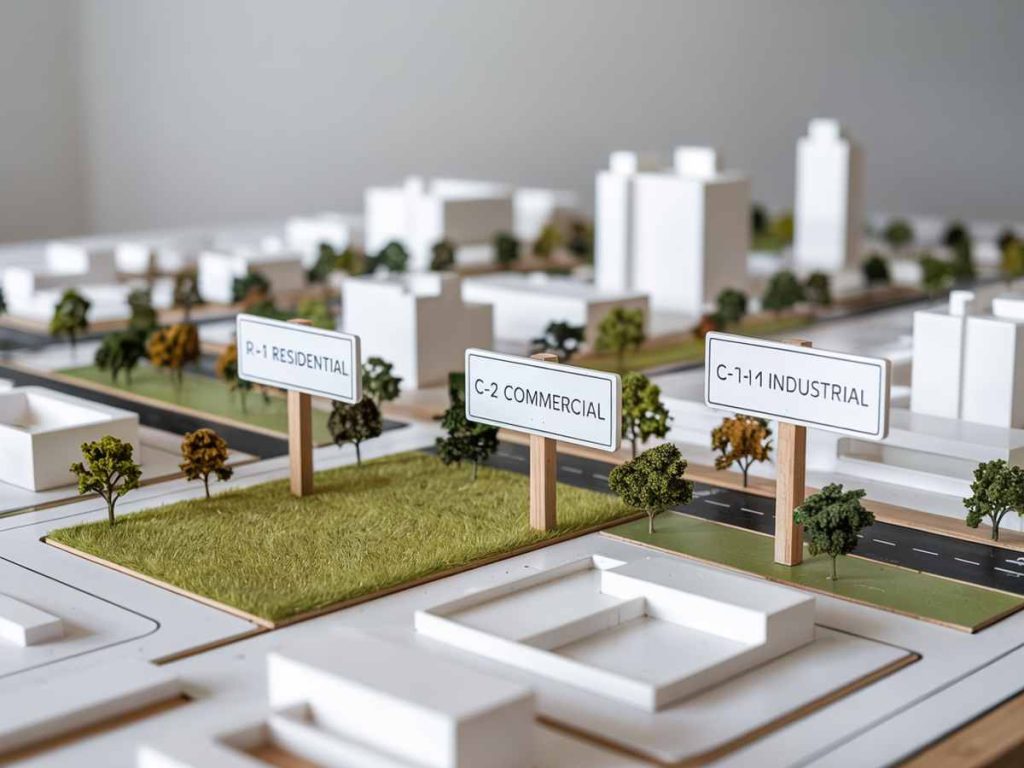
Zoning classifications function as the regulatory framework dictating permissible land uses. Most parcels fall under designations like residential (R-1, R-2), commercial (C-1, C-2), industrial (I-1, I-2), agricultural (AG), or mixed-use. Each classification carries specific development permissions and limitations that significantly impact a property’s value and marketability.
Confirming your land’s current zoning through local planning departments is essential, as inaccurate assumptions can lead to misrepresentation. For instance, a parcel zoned agricultural might allow only limited residential development, despite being surrounded by housing subdivisions. Potential buyers typically value clarity regarding development potential, and providing documentation of any conditional use permits or variance possibilities enhances your property’s appeal.
Environmental considerations have become increasingly significant in land transactions. Properties containing wetlands, endangered species habitats, or contamination concerns face additional regulatory scrutiny. Environmental assessments, which analyze soil quality, identify protected species, and evaluate water resources, provide critical information for buyers conducting due diligence. For example, a Phase I Environmental Site Assessment (typically $1,500-$3,500) identifies potential contamination risks, while wetland delineation studies (around $3,000-$6,000) map protected areas that may limit development.
Documenting any existing easements—legal rights granted to others to use portions of your property—is equally important. These might include utility corridors, shared driveways, conservation restrictions, or access pathways. Full disclosure of these limitations prevents future disputes and builds trust with potential buyers by providing a complete understanding of the property’s constraints and opportunitie
3. Assess Property Value
Establishing an appropriate asking price requires understanding both market dynamics and your land’s unique attributes. Professional appraisers employ several methodologies when valuing vacant land:
The Sales Comparison Approach analyzes recent transactions of similar properties, adjusting for differences in size, location, zoning, and features. Certified appraisers follow strict standards, typically requiring at least three comparable sales within the past 12 months, with adjustments capped at 15% per feature difference. This method works best in active markets with plentiful transaction data.

For income-producing properties (like agricultural or timber land), the Income Capitalization Approach may be applied, which calculates value based on the property’s potential revenue. The formula divides net operating income by the capitalization rate (which averaged 4.8% for agricultural land in 2024). This approach helps buyers understand the investment return potential.
Alternatively, you can conduct your own comparative market analysis by researching recent sales data through county records, online platforms like LandWatch, or local real estate professionals. While less formal than an appraisal, this research provides crucial context for pricing discussions.
Remember that land valuations fluctuate based on multiple factors. Location remains paramount—parcels near growing urban areas or planned infrastructure projects often command significant premiums. Physical characteristics like topography, soil quality, and natural features significantly impact value. Land with rolling hills and scenic views might appeal to residential developers, while flat terrain with good drainage suits commercial uses. Access to utilities (water, sewer, electricity, broadband) can increase value by $10,000-$50,000 per acre by reducing development costs for buyers.
02
of 06
Marketing the Land
1. Develop Professional Marketing Materials
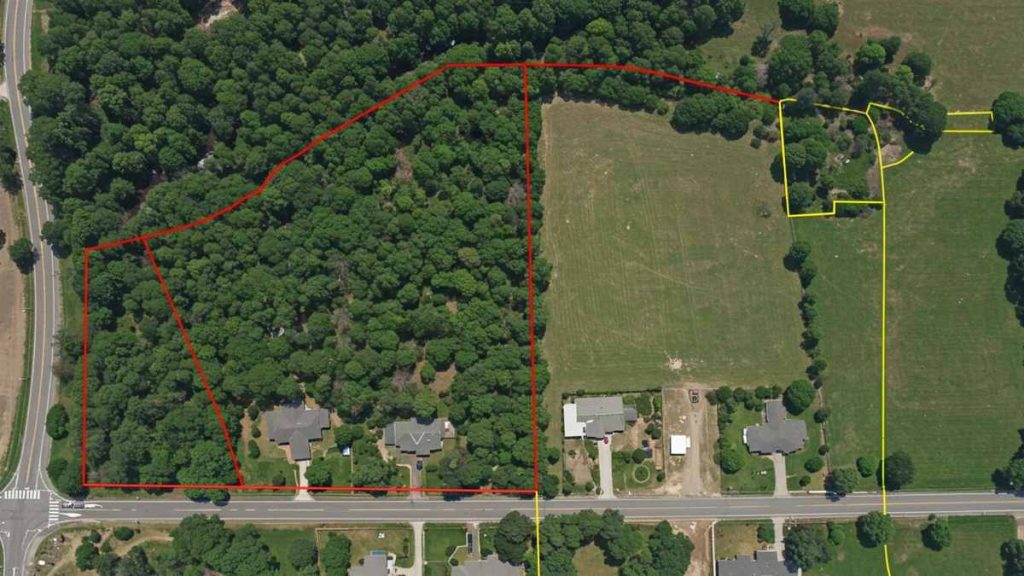
Creating compelling visual assets is essential for effectively communicating your land’s potential. Professional aerial photography provides perspective on the property’s layout, boundaries, and relationship to surrounding features. Drone videography has become increasingly affordable (typically $300-$800) and allows potential buyers to virtually “fly” over the property, viewing topography, access points, and natural features from angles impossible to capture from ground level.
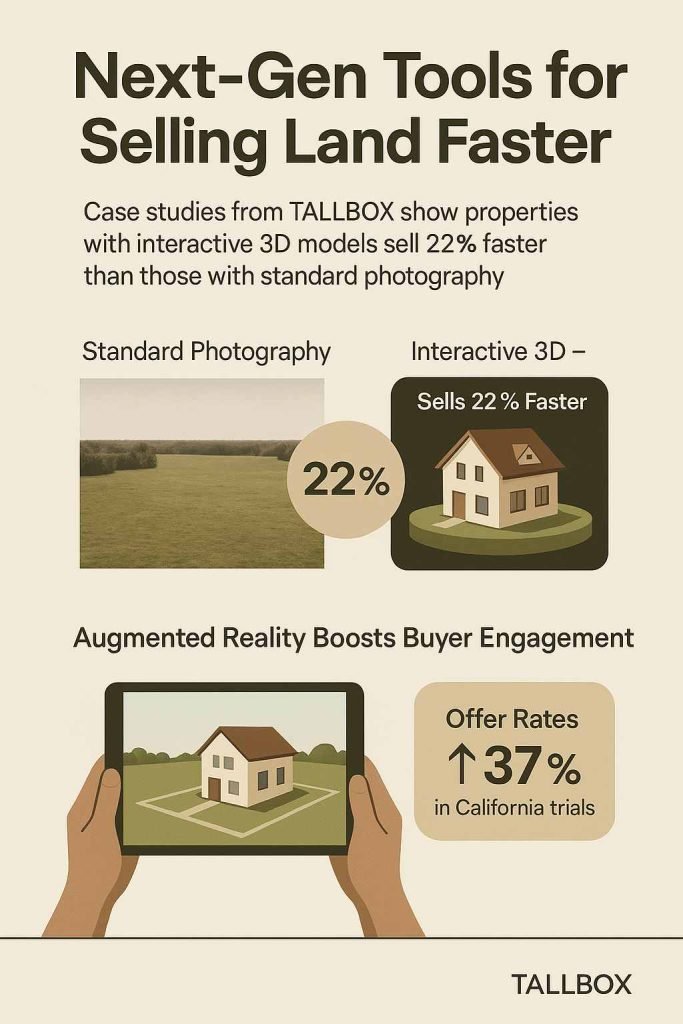
Advanced visualization tools bridge the imagination gap that many land buyers experience. Three-dimensional rendering technology can illustrate development possibilities, showing potential building placements, road networks, or agricultural configurations. Case studies from TALLBOX demonstrate that land or properties with interactive 3D models sell 22% faster than those with standard photography alone. Some progressive sellers are even utilizing augmented reality apps that allow prospective buyers to virtually “place” structures on the property during site visits, increasing offer rates by up to 37% in recent California trials.

Want to get 3D rendering for your land project?
Technical documentation complements these visual elements. Geographic Information System (GIS) maps overlay important data like soil types, flood zones, and elevation contours. Topographic maps highlighting drainage patterns and viewsheds help buyers understand the property’s physical characteristics and development constraints. Property information packages should also include documentation of all technical aspects, such as:
- Boundary survey with GPS coordinates
- Soil testing results and percolation rates
- Utility availability assessments and connection points
- Access information and road maintenance agreements
- Conservation easements or environmental restrictions
The quality of these materials directly influences buyer perception of the property’s value. Professional presentation suggests a well-managed asset and justifies premium pricing, while amateur documentation may signal distress or negligence, inviting lowball offers.
2. Identify Target Buyers
Effective land marketing demands recognizing key buyer profiles and their priorities. Developers, a major segment, seek zoning flexibility, infrastructure access, and growth potential. They typically target 50+ acre parcels for large projects, evaluating based on development yield. When marketing to developers, highlight entitlements, density allowances, and nearby infrastructure projects. Agricultural buyers prioritize different attributes: soil quality, water rights, and land classifications. Similarly, investors are often drawn to land with the potential for appreciation and cash flow, making location and future market trends critical factors in their decision-making process. When comparing land sale options for sellers, understanding these distinct buyer profiles allows for more strategic marketing approaches tailored to each segment’s unique needs. Additionally, highlighting potential ROI and market comparables can further engage prospective buyers, enhancing the appeal of the property.
Recent USDA data shows 72% prefer properties with irrigation systems already in place. This group values productivity metrics such as crop yield history, grazing capacity, and timber volumes. Marketing should emphasize these features alongside relevant agricultural tax benefits and conservation opportunities.
Outdoor enthusiasts value privacy and natural features, with 68% of recreational buyers paying more for properties with water features or wildlife habitats. Marketing should emphasize game populations, stocking records, and conservation potential. Growth markets include renewable energy developers seeking flat, sunny parcels near power infrastructure, and homesteaders wanting off-grid living.
LandWatch reports a 140% increase in “off-grid ready” property searches, highlighting the importance of showcasing renewable energy potential. Tailor your marketing by understanding buyer motivations.
Developers focus on financial metrics and regulations, while recreational buyers make emotional decisions based on lifestyle aspirations and aesthetics.
3. Utilize Multiple Marketing Channels
Leveraging diverse marketing platforms maximizes exposure to potential buyers. Land-specific websites like LandWatch, LandFlip, and Land.com specialize in vacant land listings and attract targeted traffic from serious land buyers. These platforms offer advanced search filters for acreage, price, location, and use type, helping connect sellers with appropriate buyer segments. Premium listings on these sites typically cost $100-300 monthly but provide substantially better targeting than general real estate platforms.
The Multiple Listing Service (MLS) offers essential broader market visibility, especially for residential-zoned land or properties with structures. While real estate agents provide MLS access, consider land specialists who understand timber valuation, mineral rights, and agricultural potential. These specialists typically deliver more effective representation at similar commission rates (6-10% for land compared to 5-6% for residential properties).
Want to get 3D rendering for your land project?
Today’s land sellers must leverage both digital and traditional marketing. Effective digital strategies employ specific keywords like “irrigated farmland for sale” rather than generic terms—an Iowa study showed targeted listings received 240% more views. Facebook’s geo-fenced advertising allows precision targeting to users interested in “land development” or “sustainable agriculture.” Traditional approaches remain valuable for certain demographics. Neighboring property owners, often contacted via direct mail, frequently purchase adjacent land to expand their holdings.
Farm & Ranch, Outdoor Life, and similar publications connect sellers with agricultural and recreational buyers. Networking through agricultural cooperatives, hunting clubs, and development associations effectively reaches qualified prospects who may not rely on online platforms.
03
of 06
Pricing Strategies
1. Competitive Pricing
Determining an optimal asking price requires balancing multiple considerations. Comparative market analysis (CMA) provides the foundation by examining recent sales of similar properties. Real estate professionals compile CMA reports analyzing active listings, recently closed sales, and expired listings (properties that failed to sell) within the same market area. The most accurate CMAs incorporate at least three adjusted comparables, achieving up to 92% accuracy relative to final sale prices.
Adjusting comparable sales for land-specific factors requires understanding several key principles:
- Acreage Premiums: Larger parcels typically command lower per-acre rates due to development scalability. A 100-acre parcel might sell for $4,000/acre while similar 10-acre parcels fetch $8,000/acre due to this economy of scale effect.
- Zoning Multipliers: Properties zoned for mixed-use or high-density residential development often carry 15-30% premiums over agriculturally-zoned land with similar physical characteristics.
- Infrastructure Access: Parcels with road frontage and utility connections typically show 18-22% higher values than landlocked properties or those without utilities.
Three primary pricing strategies emerge from this analysis:
- Market Value Pricing sets the asking price directly in line with adjusted comparable sales, offering the highest probability of timely sale completion.
- Aspirational Pricing positions the property 10-25% above comparable sales, targeting buyers who perceive unique value in specific attributes. This approach works best in growth corridors or with properties having exceptional features.
- Below-Market Pricing lists the property 5-15% below comparable sales to generate multiple offers and create urgency. Research shows underpriced parcels receive 2.3 times more offers than market-priced listings, often resulting in bidding competitions that elevate final prices.
Expand your potential buyer base by offering flexible financing options. Seller financing—where you collect payments with interest over time—attracts buyers who struggle with conventional loans for vacant land, which often require 30-50% down payments. Structure land contracts with buyer-friendly terms such as 10-20% down payments, interest rates just 1-3% above standard mortgage rates, and strategic balloon payments aligned with development phases.
2. Economic Factors
Regional economic indicators are critical drivers of land valuation. Infrastructure projects such as new highways, utility expansions, and internet connectivity improvements can substantially boost property values by enhancing accessibility. Research shows that land within a five-mile radius of newly constructed highway interchanges often appreciates 30-40% within just three years of the project’s announcement. Population growth functions as a key predictor of land market demand.
Regions with annual growth rates exceeding 2% typically experience parallel increases in land values, especially for residential-zoned parcels. This trend is clearly illustrated in the Dallas-Fort Worth area, where the 2.1% annual population growth (far exceeding national averages) has driven an 18% yearly increase in land prices throughout adjacent counties.
Economic diversity provides stability for land values. Regions dependent on single industries face greater price volatility than areas with balanced sectors across healthcare, technology, education, and government. Data centers have become major land buyers, with Virginia’s “Data Center Alley” properties seeing values triple since 2020. Regulatory shifts directly impact land values.
Recent zoning changes in fifteen states now exempt modular housing from certain setback requirements, increasing usable land area by 18-25% and boosting property values.
Climate risks affect pricing strategies, especially in coastal regions. Many flood-prone properties now require insurance cost disclosures, with over a quarter of coastal land contracts including clauses addressing rapidly increasing premiums in high-risk states.
04
of 06
Negotiation and Sale Management
1. Negotiate Effectively
Evaluating offers extends well beyond comparing price points. Contingencies—conditions that must be satisfied before closing—significantly impact transaction probability. Common contingencies include financing approval, satisfactory due diligence findings, or zoning changes. Each contingency introduces potential failure points, so offers with fewer contingencies merit consideration even at slightly lower prices. Cash offers typically close 21 days faster than financed transactions and fail at only 4% versus 17% for financed deals.

Buyer qualification represents another critical evaluation factor. For financed purchases, pre-approval letters should be scrutinized for lender reputation, approval conditions, and expiration dates. For cash offers, proof of funds through bank statements or investment account verification provides essential reassurance. Buyers utilizing 1031 tax-deferred exchanges operate under strict IRS timelines (45 days to identify properties, 180 days to close) and may offer premium pricing to ensure compliance.
During negotiation, consider creative deal structures that address buyer concerns while maintaining your core objectives:
- Property subdivision might allow selling portions to different buyers with varying needs, potentially increasing total proceeds. However, subdivision entails survey costs, potential zoning hearings, and infrastructure requirements.
- Conservation easements can generate tax benefits while preserving land characteristics. These legal agreements permanently restrict certain uses (like development) while permitting activities like agriculture or recreation, potentially qualifying for federal tax deductions equal to the difference between pre-easement and post-easement values.
- Owner financing provides income streams through interest payments while making your property accessible to buyers unable to secure traditional financing. A typical arrangement might include 20% down payment, 6-8% interest, and monthly payments amortized over 20-30 years with a balloon payment after 5-10 years.
Counteroffers should focus on finding mutually beneficial solutions rather than simply splitting differences. For instance, if a buyer requests a significant price reduction due to road access concerns, consider offering access easement documentation or construction cost credits rather than an across-the-board price cut.
2. Conduct Due Diligence
The due diligence period allows buyers to thoroughly investigate the property before commitment. This phase typically spans 30-60 days for land transactions (versus 7-14 days for residential properties) due to the complexity of vacant land evaluation. Your role during this period involves providing accurate information while protecting your interests.
Physical inspections commonly include:
- Boundary walks to verify survey accuracy and identify encroachments
- Soil testing to determine load-bearing capacity and septic suitability
- Environmental assessments checking for contamination or protected species
- Utility verification confirming service availability and connection costs
Documentation review encompasses:
- Title examination searching for liens, easements, or ownership disputes
- Zoning confirmation verifying permitted uses and development constraints
- Tax assessment records showing historical valuations and future liabilities
- Conservation program participation that might restrict certain activities

Transparent disclosure of known issues builds trust while protecting you from future claims. Material facts affecting value or usability must be disclosed in most states, even if not specifically requested. However, you’re generally not obligated to disclose speculative concerns or facts the buyer could reasonably discover through inspection.
Renegotiation attempts commonly arise during due diligence. Buyers may request price reductions or concessions based on findings, particularly for issues not previously disclosed. Approach these requests analytically rather than emotionally, evaluating whether newly discovered issues genuinely impact property value. Consider alternatives to price reductions, such as extending closing timelines, assisting with permit applications, or providing introductions to local contractors who could address concerns.
05
of 06
Closing the Sale
1. Work with Professionals
The closing process for land transfers involves complex legal and financial considerations that vary significantly by state. Real estate attorneys specialize in navigating state-specific requirements, drafting legally sound contracts, and ensuring proper execution of all required documents. In states like New York, Massachusetts, and Delaware, attorney involvement is mandatory for real estate closings. Even in states where attorneys are optional, their expertise often prevents costly mistakes, particularly for properties with unique characteristics like water rights, mineral interests, or development entitlements.
Title companies perform crucial functions including title insurance issuance, escrow management, and closing coordination. They conduct final title searches, prepare settlement statements, and ensure proper document recording. Unlike residential transactions, land sales frequently involve more complex title issues such as:
- Split mineral rights requiring special deed language
- Agricultural exemptions that may transfer with specific documentation
- Conservation easements requiring verification and disclosure
- Water rights documentation in Western states
The closing process typically requires coordination between multiple parties:
- Buyer and seller (or their representatives)
- Attorneys for both parties (in attorney states)
- Title company or escrow agent
- Lender representatives (for financed purchases)
- County recorder’s office staff
Professional representation during closing ensures all documents contain proper legal descriptions, convey intended rights, and comply with local recording requirements. For properties with significant value or complexity, this expertise typically justifies the cost (typically 0.5-1% of transaction value).
2. Transfer Ownership
Finalizing the ownership transfer involves meticulous document preparation and execution. The deed—the legal instrument transferring title—must be prepared according to state-specific requirements. Most land transfers utilize warranty deeds providing full ownership guarantees, though special warranty deeds (guaranteeing only against claims arising during the seller’s ownership) or quitclaim deeds (transferring only whatever interest the seller possesses) may be appropriate in certain circumstances.
Required disclosures vary by state but commonly include:
- Property condition statements
- Lead-based paint disclosures (for properties with pre-1978 structures)
- Natural hazard disclosures in states like California
- Water/mineral rights limitations
- Environmental conditions
The closing statement (also called a settlement statement or HUD-1) itemizes all financial aspects of the transaction:
- Purchase price
- Prorated property taxes and assessments
- Transfer taxes and recording fees
- Commission payments
- Liens or payoffs being satisfied from proceeds
- Net proceeds to the seller
After document signing, the deed must be recorded with the county recorder’s office to provide public notice of the ownership change. This step, typically handled by the title company or attorney, creates the official record of transfer. Most counties now offer electronic recording, significantly expediting this process.
Post-closing obligations include:
- Providing copies of recorded documents to your tax advisor
- Notifying property tax authorities of ownership change
- Canceling insurance policies on the transferred property
- Updating estate planning documents to reflect the change in assets
06
of 06
Tax Implications
1. Understand Capital Gains Taxes
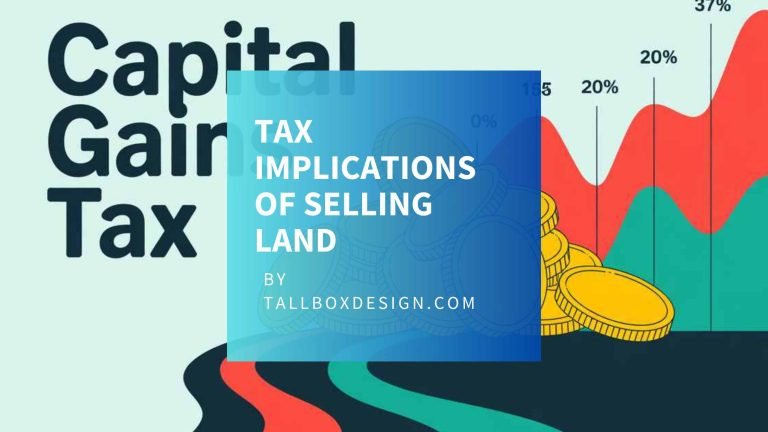
Land sales typically trigger capital gains tax obligations on the difference between your adjusted basis (purchase price plus improvements minus depreciation) and the sale price. These gains are classified as either short-term (property held less than one year) or long-term (property held more than one year), with long-term gains receiving preferential tax rates:
- 0% for taxpayers in the 10% and 12% ordinary income brackets
- 15% for most middle-income taxpayers
- 20% for high-income individuals (income exceeding $518,900 for single filers or $583,400 for married filing jointly in 2025)
An additional 3.8% Net Investment Income Tax applies to taxpayers with adjusted gross income exceeding $200,000 (single) or $250,000 (married filing jointly).
Several factors can adjust your tax basis and potentially reduce capital gains:
- Land improvement costs like road construction, drainage systems, or utility installation
- Survey expenses, legal fees, and other acquisition costs
- Carrying costs like property taxes (if not previously deducted)
- Selling expenses including commissions, legal fees, and transfer taxes
Primary residence exclusions ($250,000 for individuals, $500,000 for married couples) generally don’t apply to vacant land sales unless the land is contiguous to your residence and sold within the same tax year as the residence.
State capital gains taxes add another layer of complexity, with rates ranging from 0% in states like Florida and Texas to over 13% in California. Some states offer special agricultural land tax rates or family transfer exemptions that can significantly reduce tax burdens.
2. Explore Tax Benefits
Section 1031 exchanges (also called like-kind exchanges) allow deferral of capital gains taxes when proceeds from a land sale are reinvested in similar property. Under current tax law, 1031 exchanges apply only to real property held for business or investment purposes—personal residences don’t qualify.
A valid 1031 exchange requires:
- Identification of replacement property within 45 days of selling your land
- Acquisition of replacement property within 180 days
- Equal or greater reinvestment of proceeds (buying less valuable property triggers partial tax)
- Use of a qualified intermediary to hold funds during the transaction
Installment sales provide another tax management strategy by spreading income over multiple years. By accepting payments over time rather than a lump sum, you recognize capital gains proportionally as payments are received, potentially keeping you in lower tax brackets. The installment method requires filing Form 6252 with your tax return.
Conservation easements offer significant tax benefits for landowners willing to permanently restrict certain property uses. Qualified conservation contributions can generate charitable deductions equal to the difference between the property’s value before and after the easement. These deductions can offset up to 50% of your adjusted gross income (100% for qualifying farmers or ranchers) and can carry forward for up to 15 years.
Opportunity Zone investments provide capital gains deferral and potential exclusion for proceeds invested in designated economically distressed communities. Reinvesting land sale proceeds into Qualified Opportunity Zone Funds within 180 days allows deferral until 2026, with additional tax benefits for investments held 5, 7, or 10 years.
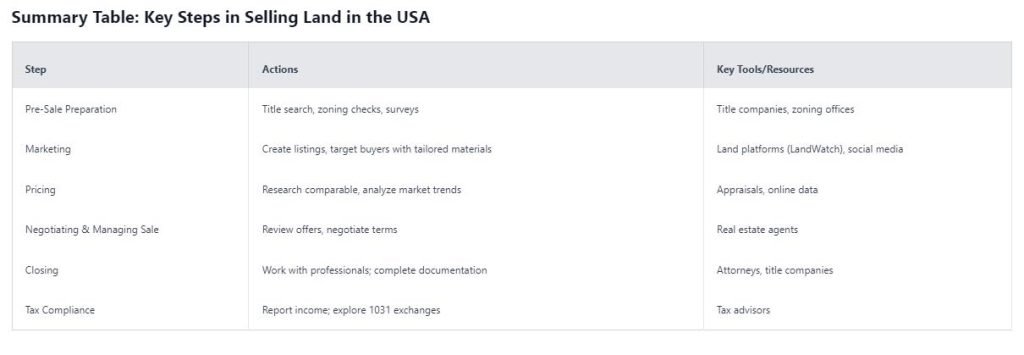
Key Takeaway: Simplicity Meets Meaning
Successfully selling land requires precise planning across legal preparation, pricing strategy, targeted marketing, and transaction oversight.
Your results depend on understanding zoning regulations, leveraging contemporary marketing techniques, and adapting to market conditions. In today’s dynamic land market, sellers must integrate conventional methods with innovative approaches.
The most successful strategies pair thorough market analysis with high-quality visual assets and targeted outreach to connect with qualified buyers. Every parcel offers unique characteristics that appeal to specific buyer segments. When you highlight these attributes while addressing potential concerns proactively, you significantly enhance marketability.
The expertise of land specialists, legal counsel, and tax advisors proves essential for navigating complex regulations and maximizing financial outcomes. When executed properly, a land sale converts a fixed asset into liquid capital, unlocking possibilities for reinvestment or personal advancement.