Foundation underpinning is a critical investment for homeowners facing structural settlement, with costs ranging from about $5,000 for resin injection to over $60,000 for extensive helical pier systems. Pricing varies by method—for example, resin injection may cost $3–$25 per square foot; mass concrete underpinning ranges from $200–$400 per linear foot; concrete piers average around $1,000 each; and helical piers cost between $2,000–$4,000 per unit.
Pricing differences help property owners make informed decisions that balance effectiveness, disruption, and budget. The foundation repair industry provides distinct approaches, including beam and base systems averaging $2,500 per meter (totaling $15,000–$35,000 per project) and steel push pier systems, which typically range from $12,000–$36,000. Each method has a specific cost structure and is suited to different soil conditions and structural requirements. Property owners should also be aware of the signs your sidewalk is damaged, as these can indicate underlying issues that may require immediate attention. Cracks, uneven surfaces, or sinking areas not only pose safety hazards but may also signal the need for foundational repairs when spotted early on, which might decrease the initial costs for foundation repair.

George is a seasoned interior designer and property marketing strategist with over 13 years of experience. He specializes in transforming properties into visually stunning spaces, helping clients recognize the potential and beauty in each property. With an impressive international client base of exciting projects throughout Europe and America.
Main Underpinning Methods

Six primary underpinning methods are commonly used in the U.S. construction industry. Mass concrete underpinning involves excavating beneath existing foundations and filling the space with reinforced concrete; it is the most traditional method.
Beam and base underpinning distributes structural loads using new concrete beams placed at key support points. Mini-pile systems include helical piers, which screw into stable soil; steel push piers, driven to bedrock; and concrete piers, used for lighter structural loads. Resin injection underpinning lifts settled foundation sections by injecting expanding polyurethane foam into voids with minimal excavation.
Cost Comparison different underpinning methods
Key Takeaways
Underpinning costs vary based on installation complexity and materials.
1. Mass concrete underpinning ranges from $200–$400 per linear foot, averaging $300 for residential projects.
2. Beam and base systems cost $1,500–$3,500 per meter, with a typical average of $2,500.
3. Helical piers are the most expensive option at $2,000–$4,000 per pier, averaging $3,000.
4. Steel push piers range from $2,000–$3,000, with most installations averaging $2,500 per pier.
5. Concrete piers are the most affordable, averaging $1,000 per pier.
6. Resin injection has the widest range, from $3–$25 per square foot, with most projects averaging $10.
Project Cost Analysis
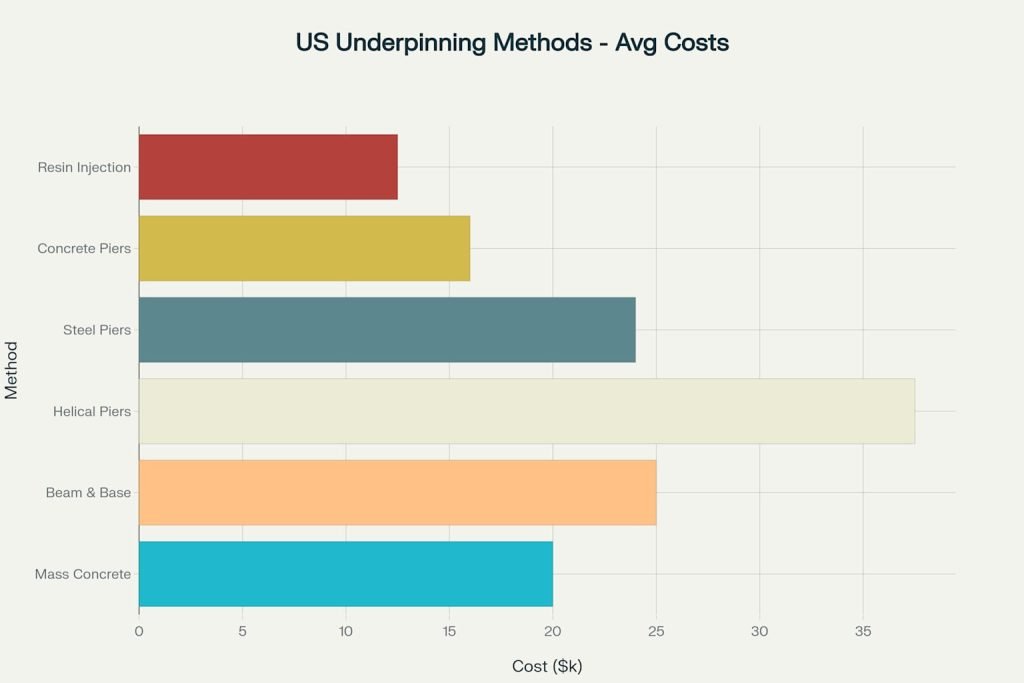
Total project costs depend on unit pricing and the extent of foundation repair. Mass concrete underpinning typically ranges from $10,000–$30,000 for full residential applications.
Beam and base systems cost $15,000–$35,000 for average-sized homes needing structural reinforcement. Helical pier systems are the most expensive, ranging from $15,000–$60,000, due to their use in difficult soil conditions requiring deep support. Homeowners should also consider the long-term implications of foundation issues, as neglecting them can lead to more significant problems and higher repair costs. Furthermore, the cost of subsidence can escalate rapidly if not addressed promptly, making timely intervention crucial. Investing in robust foundation solutions not only safeguards the home’s integrity but can also enhance its overall market value.
Steel push pier projects range from $12,000–$36,000, depending on pier count and installation depth. Concrete pier installations cost $8,000–$24,000 for homes with moderate structural loads. Resin injection is the most affordable option, ranging from $5,000–$20,000, and is often used for minor settlement issues.
How underpinning a house work?
Underpinning is a construction method used to strengthen or repair a home’s existing foundation when it is no longer stable. This type of foundational repair works by transferring the building’s structural load from weak soil near the surface to deeper, more competent ground.
The most common modern technique involves excavating sections next to the sinking foundation and driving strong steel piers—either “push piers” or “helical piers” (which screw into the earth)—deep into the ground until they reach stable bedrock or load-bearing soil.
Once the piers are in place, heavy-duty steel brackets are attached to the home’s foundation footing. Hydraulic jacks are then used to carefully transfer the house’s weight from the failing soil onto these new, solid piers. This process permanently stabilizes the foundation, and in many cases, can be used to lift the settled portion of the home back towards its original, level position.
Spotting the Difference from Normal Settling: While typical settling causes minor hairline cracks, foundations requiring underpinning show severe symptoms: cracks wider than 1/4 inch, stair-step cracks in brickwork, horizontal foundation cracks, doors and windows that jam or won’t close properly, and noticeably sloping floors. Underpinning becomes necessary when settling has progressed beyond normal adjustment to structural instability.
Installation Timeline and Disruption Factors
Installation time affects both direct costs and indirect expenses such as temporary housing or business disruption.
Mass concrete underpinning takes 4–6 weeks, including excavation, curing, and site restoration.
Beam and base systems require 2–4 weeks, causing moderate disruption. Helical piers install in 1–2 days, minimizing impact despite higher material costs.
Steel push piers take about one week, balancing speed with support. Concrete pier projects need 3–5 days for typical residential work. Resin injection completes in 1–2 days, offering the fastest solution with minimal disruption.
which underpinning method to select?
Underpinning method provides increased load-bearing capacity or stability to an existing foundation by installing new temporary or permanent support elements beneath it.
Selecting the right underpinning method depends on cost, technical requirements, and site conditions.
Mass concrete underpinning is suitable for widespread settlement on stable soils, where low cost outweighs construction disruption.
Beam and base systems work well for complex structural conditions requiring distributed load support across variable soils. Helical piers provide high load capacity for poor soils or tight access areas, justifying their higher cost.
Steel push piers offer reliable deep support for unstable soils at a moderate price. Concrete piers are a cost-effective option for light structural loads. Resin injection is ideal for minor settlement and occupied buildings, offering fast, low-disruption installation.
Most underpinning method / Cost-Effectiveness
The most economical option depends on project requirements, not just unit cost. Resin injection offers the lowest upfront price but is limited to minor settlement, such as lifting a sunken corner of a garage or sidewalk. Mass concrete underpinning provides good value for widespread foundation issues on stable soils, such as older brick homes with uniform settling.
Helical piers justify higher costs with fast installation and high load capacity, making them ideal for hillside homes or structures on expansive clay. Steel push piers balance cost and performance, often used for homes in flood-prone areas with deep, shifting soils. Concrete piers suit smaller structures like porches or single-story additions with light loads. Factors such as soil type, site access, and disruption tolerance ultimately determine the most cost-effective solution.