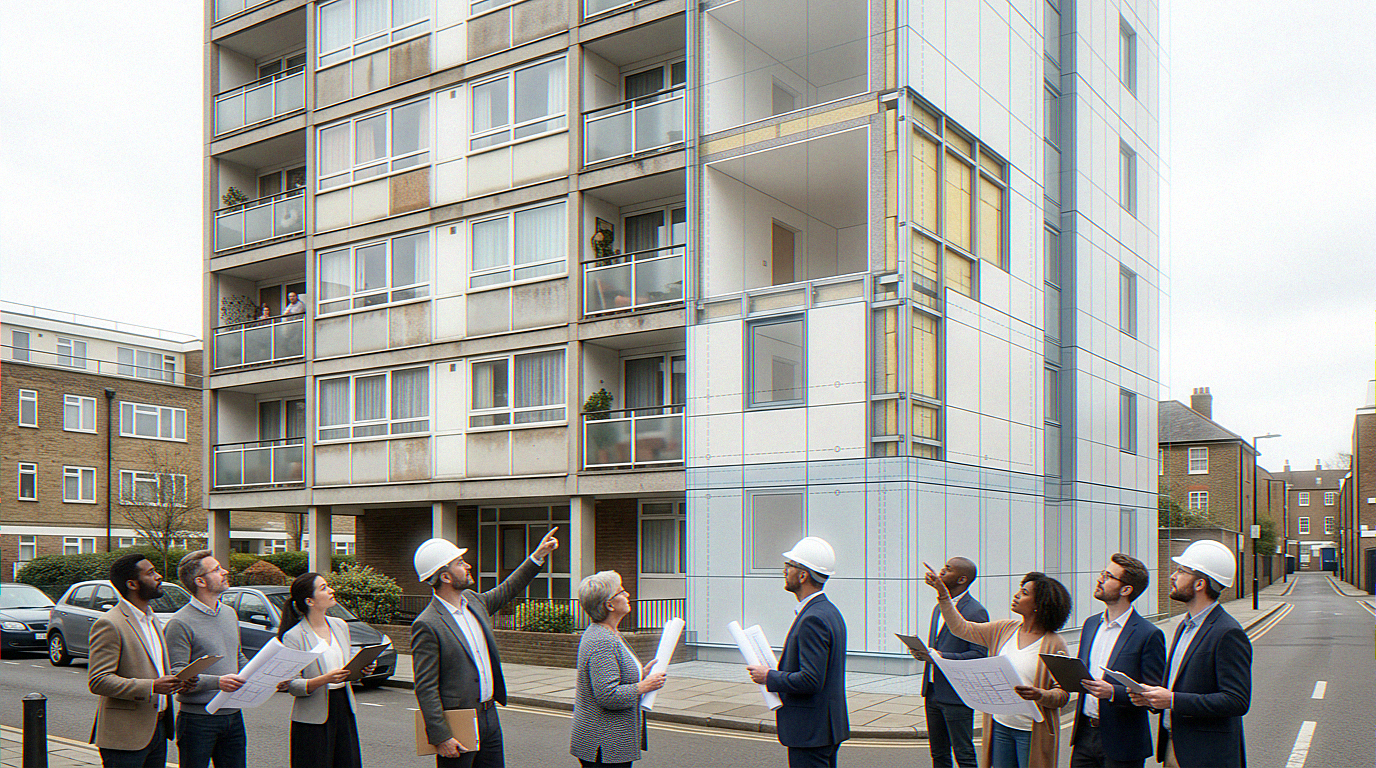
The UK Building Safety Regulator is changing how it approaches Building Assessment Certificates for higher-risk buildings. The July 2026 update keeps legal safety duties in place while making the certificate process more targeted, so project images need to show what has changed, what is proposed and what remains unconfirmed.
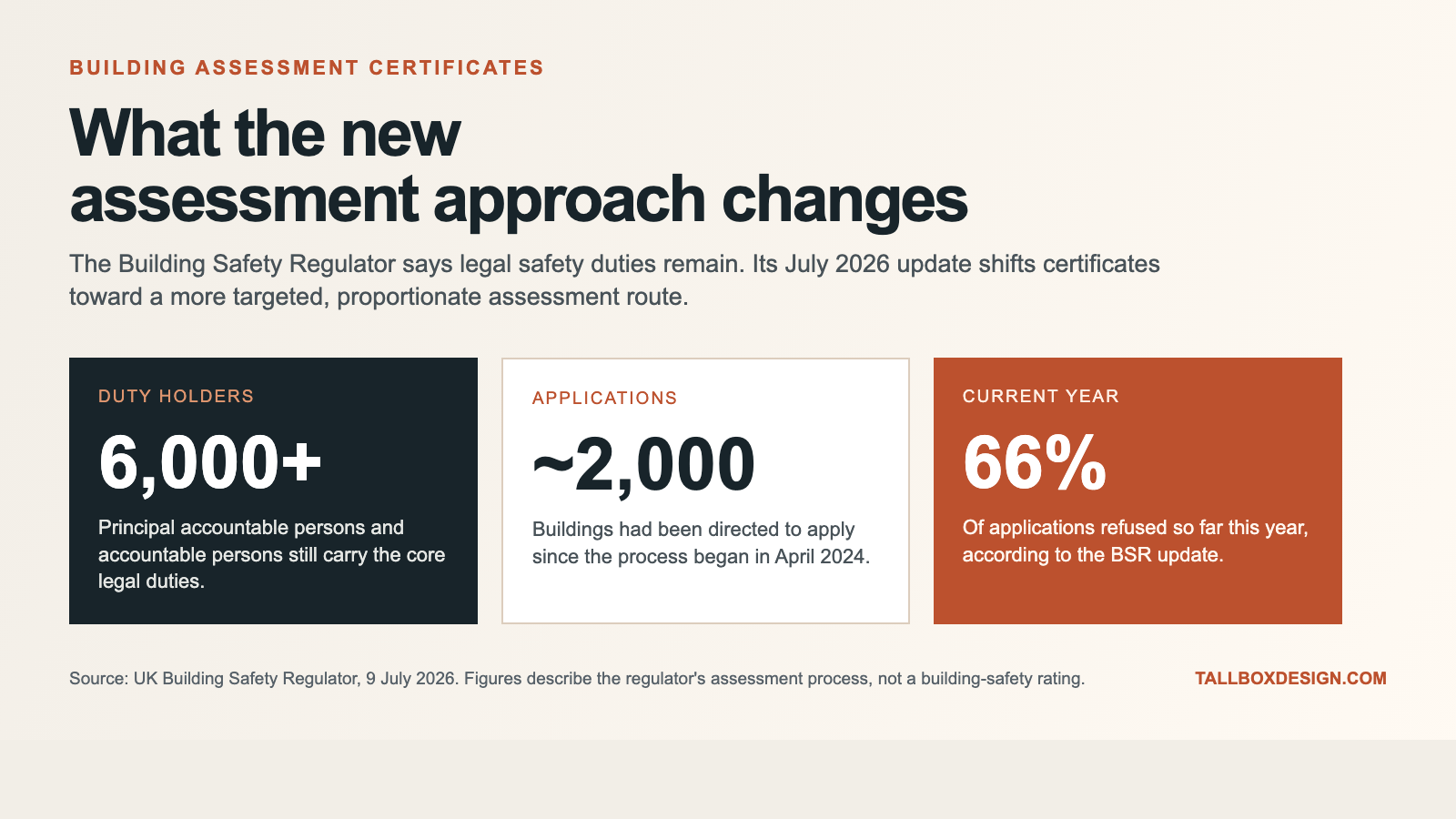
The regulator says more than 6,000 principal accountable persons and accountable persons continue to carry those duties across England. It also says nearly 2,000 buildings have been directed to apply since April 2024, which makes a clear distinction between record, scope and image unusually important.
What has actually changed?
The BSR says it will concentrate on existing certificate applications, call for new applications only where necessary, consider fast-track reassessments after required standards are met, and offer targeted support for resident-led principal accountable persons. The core Building Safety Act duties do not change.
That distinction matters because an assessment certificate is only one part of a wider safety regime. A proposal image may help residents, leaseholders and project teams understand a work package, but it cannot establish that a building has met a legal duty or that a safety risk has been resolved.
Why the usual “after” render is not enough
A finished-looking facade image is useful when it is explicitly a proposal. It becomes misleading when the viewer cannot tell whether it depicts existing cladding, a planned replacement, works in progress or a completed intervention. Each state carries a different decision for a resident or building owner.
The BSR’s earlier selection factors included height, flats, combustible aluminium composite material and large panel system construction. Those are reasons an assessment route may be relevant, not visual labels a studio should attach to a building without an accountable project source.
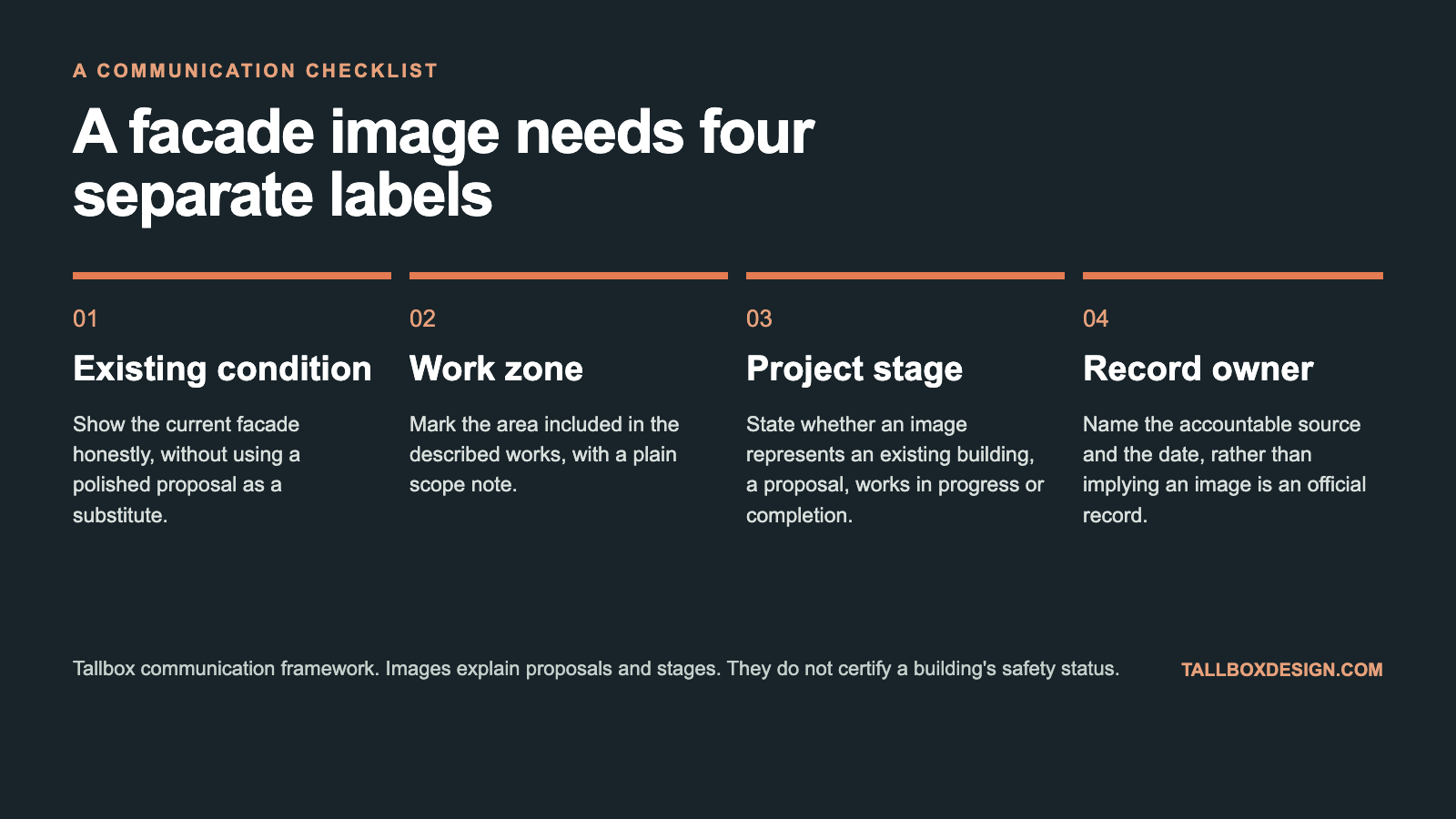
Four labels that make a facade image defensible
| Label | What it should clarify | What it must not imply |
|---|---|---|
| Existing condition | The visible building condition on the stated date. | That every issue has been surveyed or assessed. |
| Work zone | The facade or element included in the described visual scope. | That an image defines the legal scope of works. |
| Project stage | Existing, proposed, in progress or completed. | That a future image proves delivery. |
| Record owner | The accountable source and issue date. | That the visual itself is the regulator’s record. |
The contrast is deliberate. A useful image shows a specific location and status. A weak image collapses every stage into a glossy end state. In a safety-sensitive project, the first approach lets a viewer ask a better question; the second can make a still-open decision look settled.
Why residents need a readable sequence
Residents do not experience a remediation scheme as an abstract programme. They encounter a letter, a scaffolded elevation, a changed access route, a noisy work period and then a claimed next stage. A communication set that jumps straight to a new facade leaves the practical sequence invisible.
The better sequence begins with a wide existing view, moves to a close crop of the stated work area, and finishes with a proposed material or completed detail only when that status is explicit. The relationship between those views should be visible through matching camera angles, reference lines or a consistent facade grid.
That is a communication choice, not a claim about risk. The accountable person, designers and contractors still need their own records and approvals. A visual package can help people locate a description in those records, but it should never replace the document that carries the decision.
How the new BSR direction changes the visual brief
The BSR says its revised approach will focus attention where it is most needed, rather than treating every certificate application as the same kind of task. A project brief should mirror that precision. It should state the identified building area, the responsible source, the purpose of the image and the date on which the depiction was issued.
The visual brief should also separate public explanation from technical approval. An elevation can use a subtle highlight to orient a resident to the relevant zone. A detail image can show the proposed finish. Neither visual should carry labels such as “safe”, “compliant” or “approved” unless the accountable source has supplied that exact, current claim for use.
The UK Parliament’s accompanying written statement also points to a National Remediation Database expected from autumn 2026. As public information becomes easier to find, project imagery has an opportunity to become easier to check: a clear address-side view and issue date let a viewer match an image to the relevant project material rather than treating it as a free-floating promise.
What project teams should show next
Start with a camera-matched exterior view that identifies the address-side facade, the visible work area and the issue date. Pair it with a clean plan, elevation or sectional crop that identifies only the elements the source documentation actually describes. A close view can then explain material change without inventing performance claims.
That sequence is close to the discipline behind good architectural CGIs: a view has a job, a stated point in time and an audience decision to support. The same principle appears in Tallbox’s work on project renderings that need to explain a public scheme and site images for future neighbourhoods.
The BSR expects updated application resources in September 2026. Until then, the most responsible project image is not the one that makes a building look safest. It is the one that makes the current stage, the physical scope and the responsible record easy to separate.
For a public-facing board or resident update, the test is practical. Could a person looking at one image identify the side of the building, see whether the image is existing or proposed, and find the record that carries the official status? If not, add the label rather than adding more visual polish.
Sources: Building Safety Regulator, 9 July 2026; UK Parliament written statement, 9 July 2026. Check the responsible person’s current records for building-specific information.
The takeaway
The assessment route may be becoming more targeted, but the communication task is becoming more exacting. Show a project stage and a defined scope, then leave legal and safety conclusions to the accountable records.