
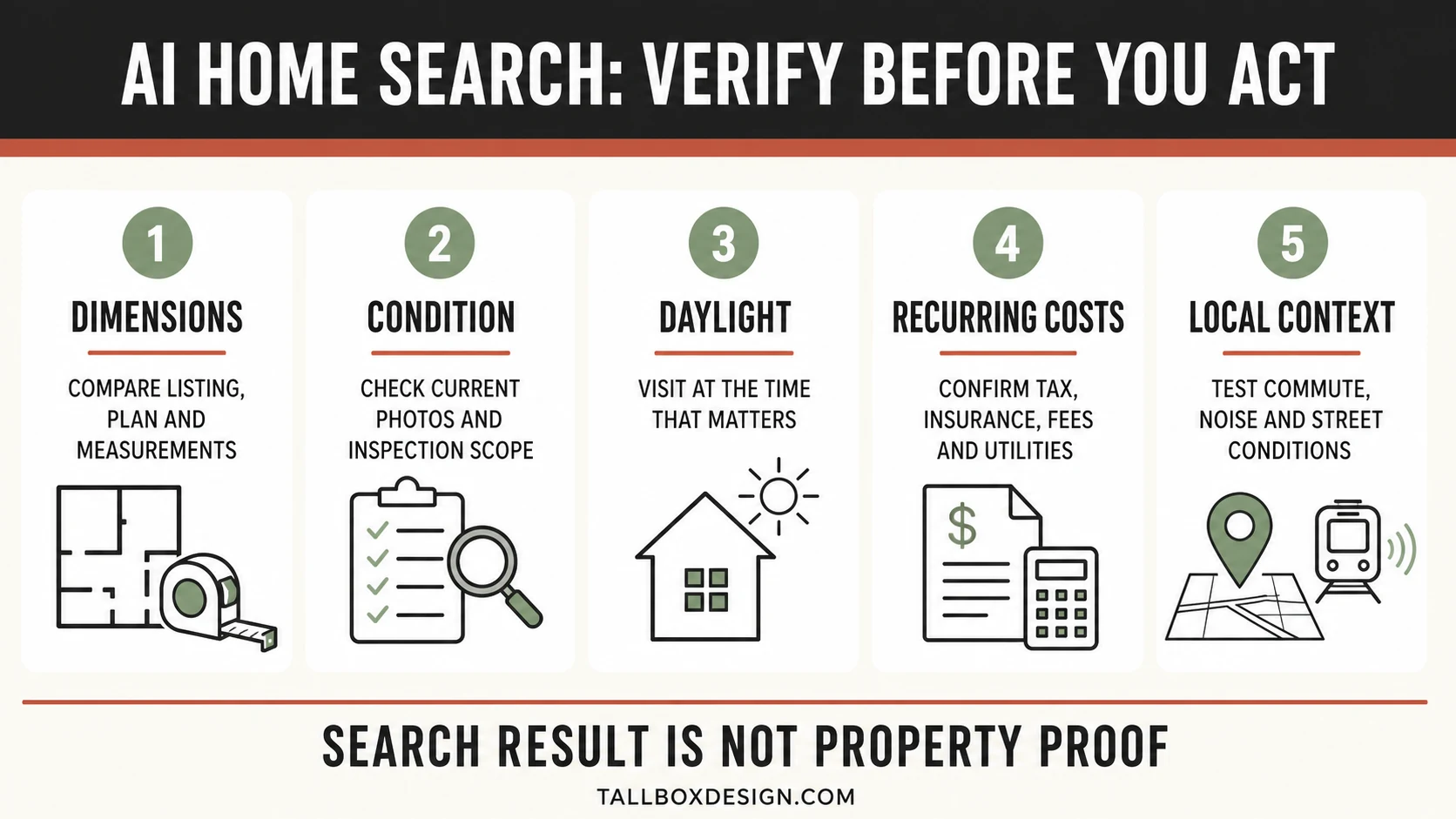
AI home search translates your plain-language preferences into a property shortlist. The portal interprets budget, commute and listing data, but the match does not verify the property. Verify dimensions, condition, daylight, recurring costs and local context before treating any result as evidence.
On July 16, the UK PropTech Innovation Showcase will put seven emerging property companies before a live audience. The event supplies the immediate technology hook, while June product announcements from three major US portals show why buyers need a verification method now.
How does AI home search differ from filter search?
AI home search differs from filter search by interpreting a multi-part request instead of matching only fixed fields such as price, bedrooms and property type. Conversational search can connect price, space and location preferences to return candidates beyond a rigid filter sequence.
A buyer might ask for a manageable commute, room for visiting parents and outdoor space without choosing every filter separately. AI can form a shortlist while the buyer is still learning which trade-offs matter.
Unlike fixed filters, AI interpretation adds an inference layer. A fixed bedroom field either matches or does not. Phrases such as quiet street, good natural light or renovation potential depend on source data, wording and the portal’s interpretation.
Buyer questions can reveal hidden priorities, but they can combine image, listing-data and location signals into one confident-looking answer. Treat the ranked result as a search suggestion. Result order does not establish that the first property satisfies every part of the request.
Which AI home-search capabilities do three property portals claim?
Zillow, Realtor.com and Homes.com say their AI tools accept plain-language, conversational, voice or text requests and return listing candidates from property and neighborhood data. Product access and inputs differ by portal.
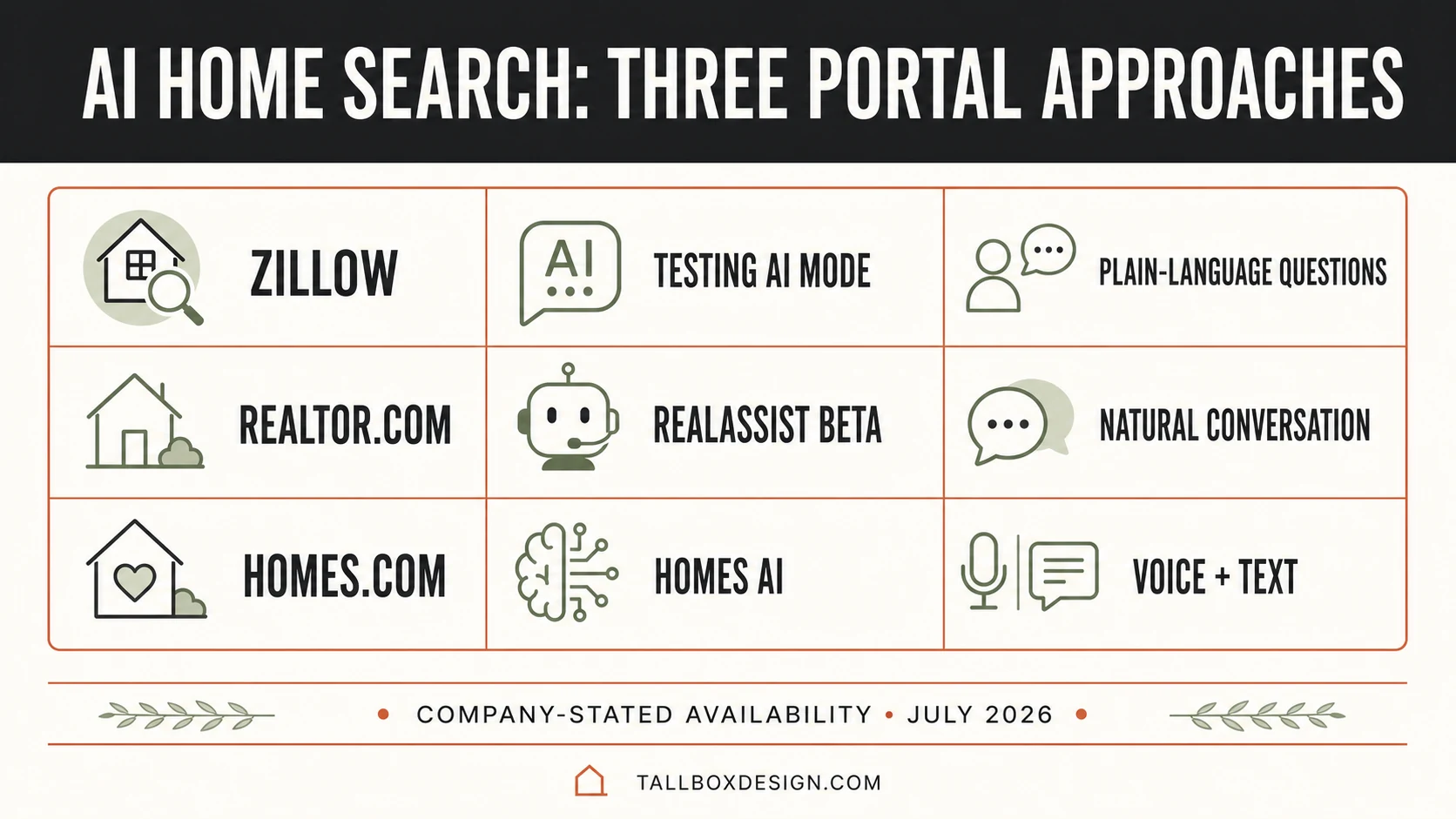
Zillow’s June 23 product announcement says its AI mode is being tested for plain-language questions about affordability, neighborhoods, tours and agents. Zillow notes fair-housing risk and describes an open-source classifier designed to detect problematic queries.
Realtor.com’s June 2 RealAssist announcement describes a beta for selected logged-in users. The company says buyers can use natural conversation and smart prompts, including requests involving budget, commute and imagined visual scenarios such as another exterior finish.
Homes.com’s February announcement says Homes AI accepts voice or text and draws on property data, images, schools, neighborhoods and Matterport 3D tours. These are company-stated capabilities and availability claims, not independent tests of completeness or accuracy.
Portal announcements establish what each company intends the product to do. They do not reveal how often a conversational request misses an eligible home, misreads an image or relies on an outdated field. Buyers should therefore separate interface convenience from evidence quality.
Sources: company product announcements from Zillow, Realtor.com and CoStar Group, accessed July 2026. Availability may vary by user and product stage.
Which five AI home search claims should buyers verify?
Buyers should verify five AI home-search claim classes: dimensions, condition, daylight, recurring costs and local context. Tallbox’s AI Home Search Evidence Ladder grades supporting material from a listing claim to a framed view, spatial model, measured record and scoped professional check.
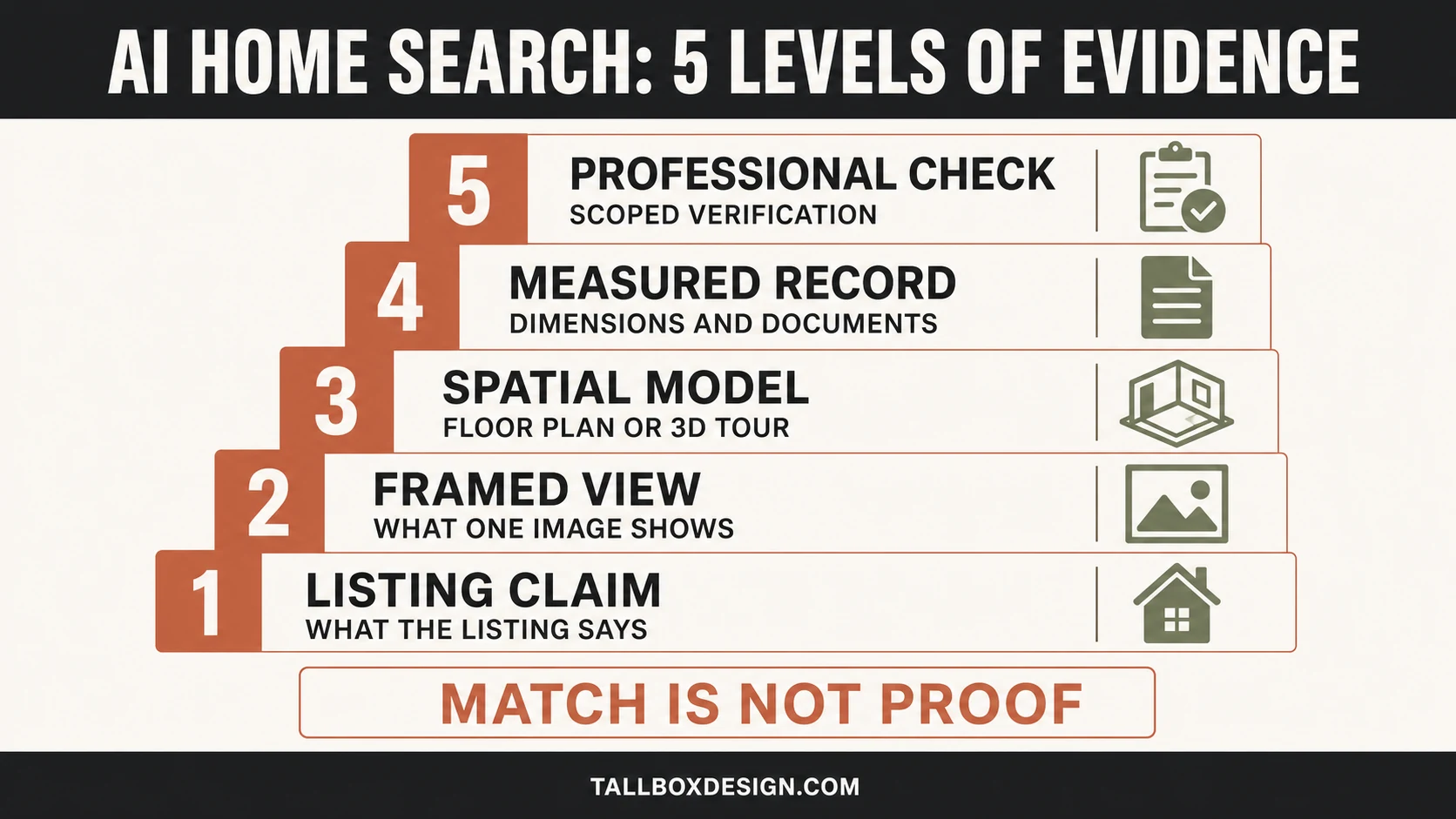
Dimensions need a plan, measurement or survey rather than a wide-angle image. Condition needs current photographs, disclosures and an inspection scope. Daylight needs orientation, window placement and a visit at a relevant hour.
Recurring costs need tax, insurance, association, utility and maintenance records. Local context needs a real commute, street observation and independent checks for noise, access or other daily conditions. An AI description can point to these questions, but it cannot close them.
Dimensions deserve special attention because a photographed room can feel larger than its usable floor area. Confirm whether a plan is measured, illustrative or supplied without warranty. Furniture scale, door swings, ceiling slopes and circulation clearance can change whether the room supports the use suggested by the search result.
What does each AI home search view actually prove?
Listing photographs support visible finish and one moment of light, floor plans support adjacency, circulation and stated dimensions, and 3D tours support sequence and sightline checks. Capture gaps, outdated scans and framing still limit what each view can prove.
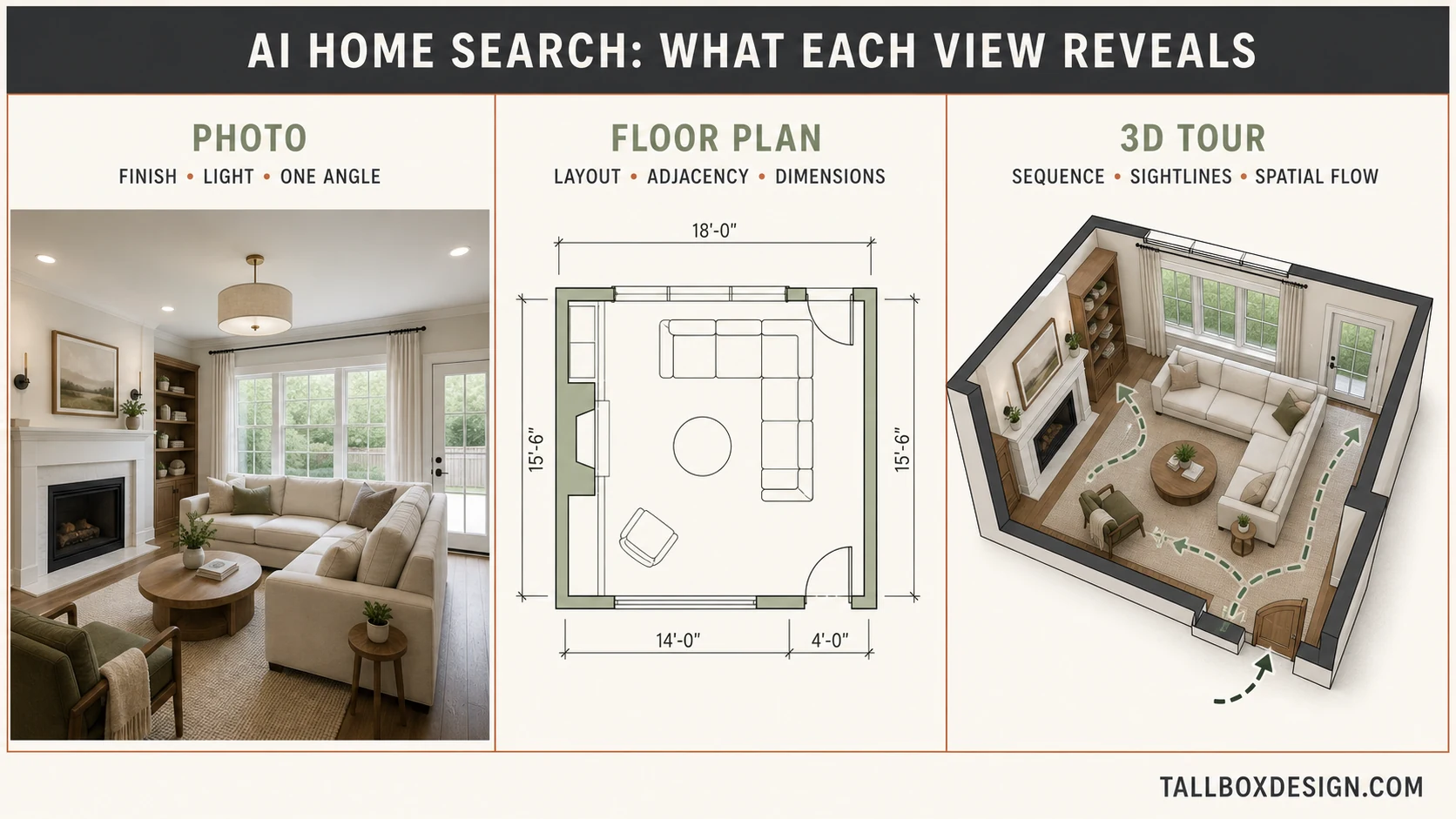
Buyers can evaluate an AI home-search match by studying listing photographs that document layout and visible condition. Room-to-room continuity establishes orientation, while images of utility rooms, storage areas and building services document details omitted from a hero shot.
Photograph order shapes the buyer’s first impression, but the cited portal announcements do not disclose whether image sequence changes an AI summary. Compare exterior views, room sequences and window positions with the plan. Missing transitions between spaces call for more evidence.
How can generated property views change buyer understanding?
Generated views let a buyer test a paint color, finish or furniture layout before committing to a renovation idea. The useful version labels the image as a concept and preserves the property’s geometry. The risky version looks current while quietly changing windows, scale, condition or surroundings.
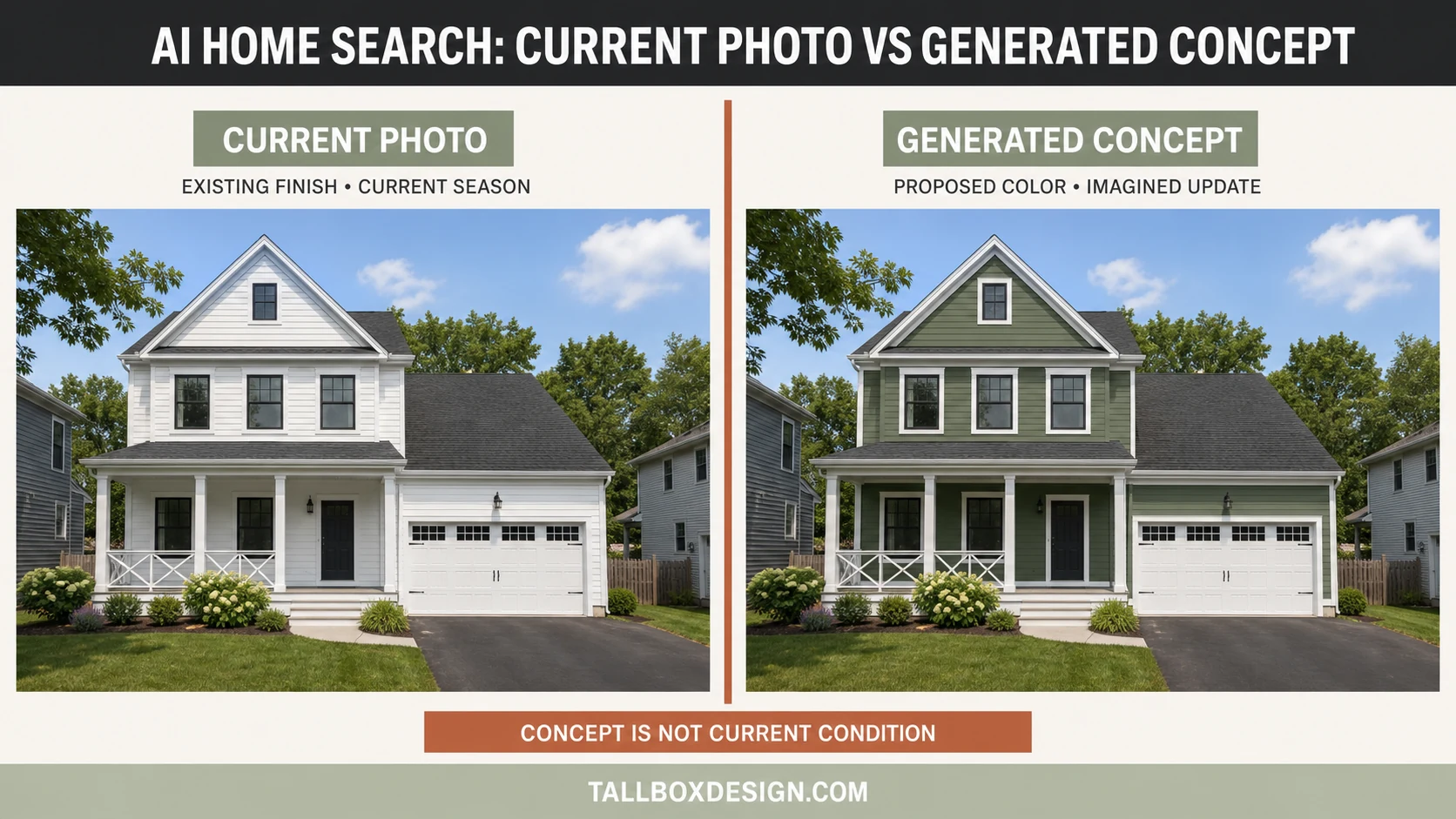
The current-photo-versus-generated-concept distinction separates buyer research from seller copy. Tallbox’s guide to AI listing descriptions examines how marketing language is produced. Buyer verification asks which parts of that language survive contact with plans, records and an in-person visit.
Generated seasonal, furnishing and finish variations can be valuable when the label stays attached to the image. Save the current photograph beside the concept and list the changed finish, furnishing and seasonal details. The side-by-side record keeps current condition distinguishable from the imagined upgrade.
Which records corroborate an AI home-search result?
Start with the listing, floor plan and available 3D tour, then compare them with seller disclosures, permits, tax records and association documents where applicable. Use inspection and appraisal reports for their defined purposes, because a home inspection and an appraisal answer different questions.
Record quality matters as much as record quantity. Check the date, named property, author and scope before relying on any document. Conflicts between a listing field, floor plan and public record should become questions for the agent or relevant professional rather than facts selected by convenience.
- ✓Ask which listing facts came from structured records, seller input, image interpretation or generated content.
- ✓Mark every claim about size, condition, cost, daylight or location that could change an offer.
- ✓Match each important claim to the strongest available record, view or professional check.
The three verification actions keep an AI home-search shortlist tied to identifiable records and defined scopes. Each disputed claim remains open until matching evidence resolves it.
How should buyers classify an AI home-search claim after checking the evidence?
After checking the evidence, classify each AI home-search claim as confirmed, unresolved or contradicted. A portal match stays a discovery result until records or accountable people support it. Unresolved or contradicted claims need more evidence before a viewing, offer or loan decision.