With interest rates still near historic lows, you can refinance commercial property in the United States through attractive fixed rate and variable rate loans.
Banks offer stable long-term fixed rates up to 25 years. Credit unions provide variable rates that fluctuate with market conditions. SBA 504 loans finance up to 90% of costs for owner-occupied properties.
CMBS loans have fixed rates based on Treasury rates and flexible 5-10 year terms. To learn more, continue reading about specialized local bank loans and FHA programs for multifamily properties.
Want to get 3D rendering for your interior design project?

George is a seasoned interior designer and property marketing strategist with over 13 years of experience. He specializes in transforming properties into visually stunning spaces, helping clients recognize the potential and beauty in each property. With an impressive international client base of exciting projects throughout Europe and America.
TALLBOX provides information for educational purposes only and does not offer financial advice; users should consult with qualified professionals before making any investment decisions. TALLBOX and George Nicola are not liable for any losses or damages incurred as a result of relying on the information provided.
George Nicola shares:
Based on the criteria we decided at TALLBOX, these are the main types of commercial property refinance loans available in the USA.
For established businesses with strong credit profiles, conventional commercial refinance loans are best, with interest rates ranging from 5.0% to 6.3%, LTV ratios between 60% to 80%, and terms up to 20-25 years.
For businesses struggling to access traditional loans, SBA 504 Refinance loans are ideal, with lower interest rates than conventional loans, longer repayment terms, and lower down payment requirements.
Benefits:
For business expansion and immediate access to property equity, cash-out refinancing is beneficial, and may also offer potential tax benefits on interest and higher loan amounts.
Requirements:
To qualify, cash-out refinancing typically requires a minimum credit score of 680, a debt-to-income ratio under 43%, a debt service coverage ratio of 1.25 or higher, and adequate cash reserves.
Factors influencing interest rates include credit score (800-850 gets 3.0-3.5% rates), the loan-to-value ratio (lower LTV means better rates), property type and location, and overall market conditions.
Best Time to Refinance?
It’s best to refinance when you can reduce the interest rate by 1-2%, when the property value has increased significantly, when the business needs additional capital for expansion, or when current loan terms are unfavorable.
Current commercial refinance loan rates?
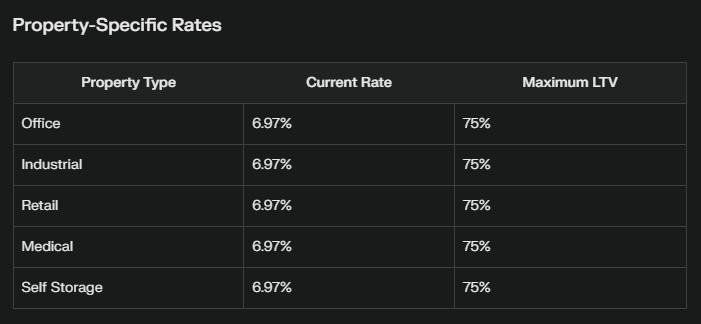
Fixed Rate Loans From Banks
One popular option for commercial real estate refinancing is to look into fixed rate loans from banks. These loans offer stable, long-term fixed interest rates for up to 25 years, providing predictability for financial planning.
Traditional bank loans have fixed rates for 3-5 years, but programs like JPMorgan Chase’s start at $500,000 and lock rates for construction projects on day one. JPMorgan is the top bank by loan volume, with 13% of its loans being made in CRE.
The key advantages of fixed rate loans from banks include locking in rates to avoid future increases, flexibility through features like rate portability and assumability, and the potential for lower monthly payments.

Eligibility requires meeting criteria like minimum loan amounts, typically $750,000, and loan-to-value ratios up to 80%. Borrowers need a minimum net worth, often $1 million, and a stabilized minimum debt service coverage ratio.
Closing involves standard documents with added provisions for rate locks.
Considerations include prepayment fees if rates decrease, how rate changes impact attractiveness, and yield curve effects on long-term loan rates.
There’s minimal documentation and straightforward closing. These loans offer stability amidst shifting rates and the ability to lock in favorable long-term rates. Their structure supports cash flow management and provides cost savings.
Variable Rate Loans From Credit Unions
Variable rate loans from credit unions can provide some key benefits for commercial real estate financing needs. During periods of declining interest rates, rate flexibility allows businesses to potentially capitalize on lower rates because the rates on variable rate loans can fluctuate based on market conditions.
Over set periods such as 5 years, some credit unions offer fixed rates providing predictable payments for those terms. When making extra payments or paying off loans early, variable rate loans allow for flexibility in repayment which can lead to significant interest savings.
- For owner-occupied properties, credit unions typically allow loan-to-value ratios up to 85%, and for investment properties, up to 75%
- Allowing businesses to refinance or pay off loans early with no extra fees, most credit unions don’t charge prepayment penalties.
- To align loan payments with business cash flow cycles and seasonality, the flexible repayment options can be very helpful.
The key considerations include market volatility risk, having sufficient financial flexibility, understanding credit union guidelines, evaluating amortization periods, and comparing to other lenders on rates and terms.
SBA 504 Loans for Owner-Occupied Properties
SBA 504 loans can provide attractive long-term financing for commercial real estate projects involving owner-occupied properties. These loans have a maximum amount of $5. 5 million and can finance up to 90% of the project cost for owner-occupied commercial real estate like office buildings, retail stores, and daycares. SBA 504 loans often have lower down payment requirements and longer repayment terms than traditional bank loans or hard money loans, making them an ideal quick option for small businesses looking to acquire or expand their own commercial property or for fix-and-flip projects.
To qualify, businesses must meet SBA size standards, have net worth under $15 million, and average net income below $5 million over the last two years. The property must have at least 51% occupancy for existing buildings or 60% for new construction.
SBA 504 loans offer low fixed interest rates starting around 5%, fully amortizing terms up to 25 years, and no balloon payments. They can finance acquisition of land, construction, renovations, furniture, fixtures, equipment, professional fees, and other costs.
Compliance with owner-occupancy rules is strictly enforced, with no exceptions allowed. Defaulting can trigger the SBA to recall the loan. Applicants must present a feasible business plan and qualified management proficiency.
These loans promote business growth, job creation, and community development when used as intended.
CMBS Loans With Flexible Terms
A vast range of flexible terms can be structured with CMBS loans for commercial properties. CMBS loans offer fixed interest rates, commonly lower than conventional mortgages, based on the Treasury rate plus a margin. Loan terms of 5, 7, or 10 years are available, with 25-30 year amortization schedules. Non-recourse status protects borrowers since CMBS loans are assumable without refinancing. Loan sizes come in a wide range, not restricted by major agency mortgage terms. LTV ratios can go up to 75%, or higher with mezzanine debt.
CMBS loans provide flexibility since they lack federal/state regulation, so terms can suit different properties. Lower-risk CMBS get principal/interest payments first, while higher-risk bear more default risk. CMBS loans work for multi-family, hotels, industrial, retail, offices, warehouses. Typical amortization is 25-30 years with a balloon payment. Interest rates derive from the Treasury swap rate plus the lender’s margin.
Lender underwriting looks at DSCR, LTV ratio, appraisal, risk assessment, and securitization. Collateral release is difficult due to long lock-outs. Early exit costs are high, often requiring defeasance. Dealing with primary servicers can be challenging. Reserves and prohibitions on secondary financing are considerations.
Life Company Loans With Low Rates
Now is the time to take advantage of life company loans with historically low rates. Life insurance companies provide highly competitive fixed interest rates, remaining steady for 10 to 30-year terms, making them ideal for investing in waterfront property as a rental.
With amortization periods up to 25 years, monthly payments decrease. Assumable loans allow flexibility when selling, avoiding prepayment penalties.
Early rate locks get low rates locked in. Class A apartments, retail, office, industrial and hospitality properties in major markets qualify.
Minimum debt service coverage ratio is 1.25x, with 8-10% minimum debt yield. Loan-to-value ratio maximums are 65-75%.
Refinancing consolidates debt into a single lower rate loan, or allows for cash-out with lower LTV ratio or payments. New buyers can assume existing loans when selling, avoiding hefty balloon payments.
Long amortizations provide stability. Clear eligibility criteria and conservative underwriting lead to low rates on long-term, non-recourse loans starting at $2 million.
Life company loans offer ideal options to refinance commercial properties.
FHA and HUD Loans for Multifamily Properties
One of the most attractive financing options for multifamily property developers are FHA and HUD loan programs. The HUD 223(f) Program provides refinance or acquisition of multifamily properties like market-rate apartments and subsidized housing.
The HUD 221(d)(4) Program enables construction or substantial rehab of multifamily properties, focusing on market-rate, low-income, rental assistance, and other developments. The HUD 223(a)(7) Program refinances existing HUD borrowers, aiming to reduce rates, increase amortizations, and enhance project cash flow.
The HUD 241(a) Program offers supplemental loans to current HUD borrowers for property improvements like safety and efficiency upgrades. HUD-insured loans are fully amortizing, non-recourse, and have competitive rates and high borrowing capacity.
Key advantages of HUD loans include low-cost, fixed-rate, non-recourse financing and flexible terms from $2 million to over $100 million. HUD loans provide benefits for affordable housing like increased LTV, lower DSCR, and reduced MIPs. They’re compatible with LIHTC and RAD.
FHA construction loans offer 40-year fixed rates plus 3 years during construction. Challenges involve complexity, prepayment penalties, stringent requirements, bureaucratic processes, and needing specialized knowledge.
FHA and HUD loans offer the longest terms, lowest rates, and highest borrowing capacity in the industry for multifamily properties.
Local Bank Loans With Personalized Service
With a local bank loan, you can get bespoke service and flexible terms suited to your specific commercial real estate needs. Local banks provide one-on-one interaction and understanding of the local market. Terms can be customized to your precise borrowing requirements.
For example, you may negotiate a loan-to-value ratio up to 70%, with the bank taking a first-lien position on the property for collateral. Interest rates are competitive but vary based on the individual bank and market fluctuations.
To qualify, you’ll generally need a credit score of 680+, a debt-to-income ratio of 43% or less, and net operating income that covers the loan payments. Cash flow must be stable and predictable. You’ll additionally need to submit a thorough business plan and financial statements.
Benefits of local bank loans include tapping into specialized local knowledge, potentially faster processing, bespoke solutions, lower fees, and building a long-term relationship.
However, you may face stricter qualification criteria, smaller loan amounts, variable rates, higher down payments, and terms influenced by local economic factors. Overall, local banks can provide individualized service and financing customized to your commercial real estate goals.
Conclusion
You have multiple options for commercial property refinance loans in the United States; carefully research lenders, compare rates and terms, analyze your financial situation, and consult professionals to determine the best loan for your specific commercial property.
To align with your investment objectives, cash flow, and ability to service debt, select a loan that meets your needs.
For short-term needs, consider a bridge loan; for example, a real estate investor uses a bridge loan to quickly refinance a condo to free up capital for another acquisition.
For long-term stability, a conventional refinance with fixed rates may be best; for example, a business owner refinances a warehouse with a 20-year fixed-rate loan to secure predictable payments.
If looking to access equity, a cash-out refinance may be suitable; for example, an owner of a waterfront property uses a cash-out refinance to fund a new business venture.
For pre-construction projects where flexibility is important a construction loan could be suitable; for example, a developer secures a construction loan to refinance land they have purchased, before development begins.
In what scenarios there is Additional interest on loans added?
Additional interest on loans can be added in several scenarios, primarily related to changes in loan terms, borrower behavior, or market conditions. Here are some common situations:
Variable Interest Rate Adjustments: For loans with variable or adjustable interest rates, the interest charged can increase if the benchmark interest rate (e.g., prime rate, SOFR) rises. This is common in many types of loans, including mortgages, lines of credit, and commercial loans.
Late Payments: When borrowers fail to make payments on time, lenders typically charge late payment fees, which can effectively increase the total cost of borrowing. These fees can compound over time, adding significant costs.
Default or Loan Modification: If a borrower defaults on a loan or requests a loan modification, the lender might add interest, fees, or penalties to cover increased risk or administrative costs. This is common in mortgage modifications.
Prepayment Penalties: Some loans have prepayment penalties if the borrower pays off the loan before the agreed-upon term. This is essentially an additional cost, which can be seen as added interest, for paying off the loan early.
Balloon Payments: If a loan has a large balloon payment at the end, and the borrower is unable to pay that amount, they might need to refinance, and this refinancing can come with higher rates or fees. This would increase the total interest paid over the life of the debt.
Exceeding Credit Limit: In cases of credit lines or credit cards, exceeding the credit limit might trigger over-limit fees, and the additional amount could be charged at a higher interest rate.
Changes in Loan Type or Terms: When a borrower converts a loan to a different type (e.g., converting an adjustable-rate mortgage to a fixed-rate) or changes other loan terms, lenders can alter interest rates, often leading to higher costs.
Risk-Based Pricing: If a lender reassesses a borrower’s risk profile as higher due to changes in credit score or financial situation, they might increase the interest rate to reflect the increased risk.
Market Changes: Market fluctuations, especially changes in central bank policy, can lead to changes in rates for variable-rate loans. This can result in more interest over time.