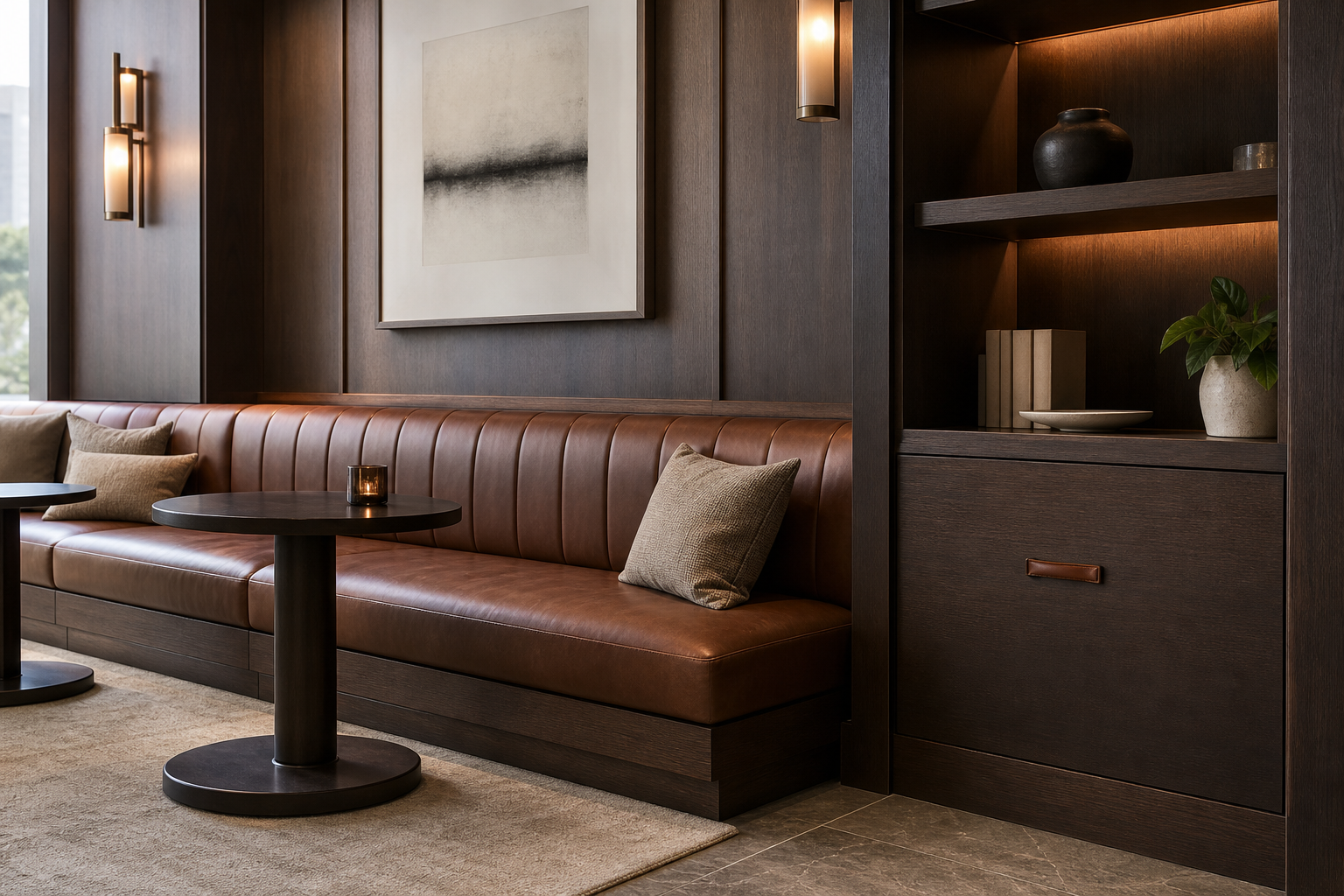
Leather gives interior details warmth, grain and a tactile contrast that painted or laminated surfaces rarely match. Designers still need more than a showroom swatch before specifying it for hospitality seating, wall panels, joinery pulls, desk inlays or bespoke furniture accents.
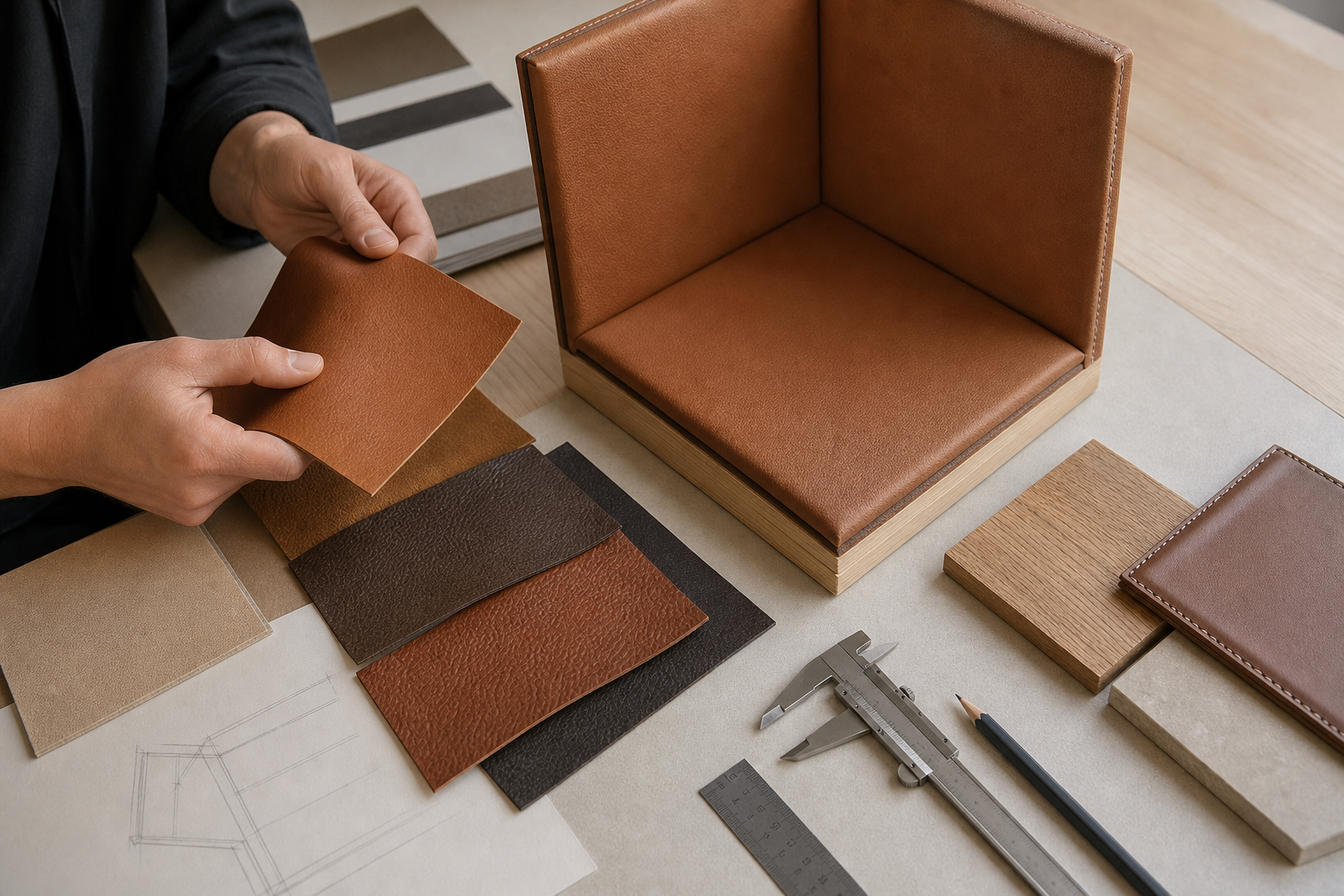
A useful leather sample tests three connected decisions: how the finish reads beside the room palette, whether the pattern survives at full scale, and how the selected material responds to cutting, folding, stitching, adhesives and daily handling. That physical evidence should sit beside drawings and visualisations before the specification is fixed.
Assess leather grain, coating and backing before approving an interior finish
Leather is a natural or engineered surface system, not a flat colour reference. Grain, thickness, tanning, pigment, wax, protective coating, backing and filler can change its sheen, flexibility, edge quality and visual depth. Two brown samples can therefore support very different design outcomes.
Lighting adds another variable. A polished, heavily pigmented finish may reflect pendants and windows, while a softer aniline surface can absorb light and show natural variation. Tallbox’s guide to tactile texture in interiors explains why surface character must be judged through touch and changing light, not photography alone.
The specification also needs to name the application. Leather stretched over a wall panel has different edge, backing and maintenance demands from a wrapped pull or a removable seat cushion. A generic note such as “tan leather” leaves the fabricator to resolve decisions that belong in the design process.
Match leather sample tests to seating, wall panels, joinery pulls and desk inlays
Each interior application puts a different question in front of the sample. The comparison below turns a decorative idea into a set of observable checks before the material reaches a schedule, tender package or fabricator.
The comparison prevents one attractive swatch from standing in for five different performance questions. It also clarifies where custom work adds value and where a standard component is more sensible, a distinction developed further in Tallbox’s ready-made furniture and custom joinery comparison.
Test full-size leather mock-ups for pattern scale, edge finish and handling
A small sample establishes colour and touch, but it does not show the rhythm of a repeated perforation, the scale of an engraved motif or the visual weight of a stitched border. A full-size corner, pull, cushion panel or inlay reveals those relationships while changes are still inexpensive.
Architecture and interior mock-ups are most useful when they answer a named decision. “Looks good” is too vague. The review should record whether the pattern is legible at viewing distance, whether the edge reads cleanly beside the substrate, and whether the finish supports the intended atmosphere under project lighting.
Digital images remain useful for comparing placement and proportion before fabrication. They do not prove touch, edge behaviour or material construction. Tallbox’s five checks before trusting a design render provides a related principle: visual confidence should be matched by evidence appropriate to the decision.
Record leather prototype references for procurement and fabrication
A prototype loses value when the approved piece cannot be traced back to a supplier reference and production method. The design team should connect the control sample to the hide or sheet description, finish code, thickness, backing, pattern file and named fabrication process.
Natural variation also needs an agreed boundary. Hospitality seating may accept visible shifts in grain and tone as part of the concept, while a repeated wall-panel grid may require tighter visual consistency. The mock-up review should state which variation is intentional and which would interrupt the designed rhythm.
The three sample stages solve different problems. A concept swatch should not become the workmanship standard by accident, and a carefully made prototype should not be approved without confirming that its material can be supplied at the required scale.
Installation context belongs in the review as well. A desk inlay meets hard edges and repeated contact, a wall panel meets junctions and grazing light, and a pull meets hands and moving doors. Recording those interfaces keeps the leather detail connected to the architecture around it.
Verify leather composition and extraction before workshop-scale CO2 laser pattern tests
A CO2 laser can support workshop-scale sample prototyping when a designer or fabricator needs to compare engraved contrast, perforation density or cut-edge behaviour. For teams comparing equipment for laser engraving, machine choice should still follow material identification and extraction planning. The tool is subordinate to the material decision. A successful test on one identified sample does not approve another hide, coating, backing or batch.
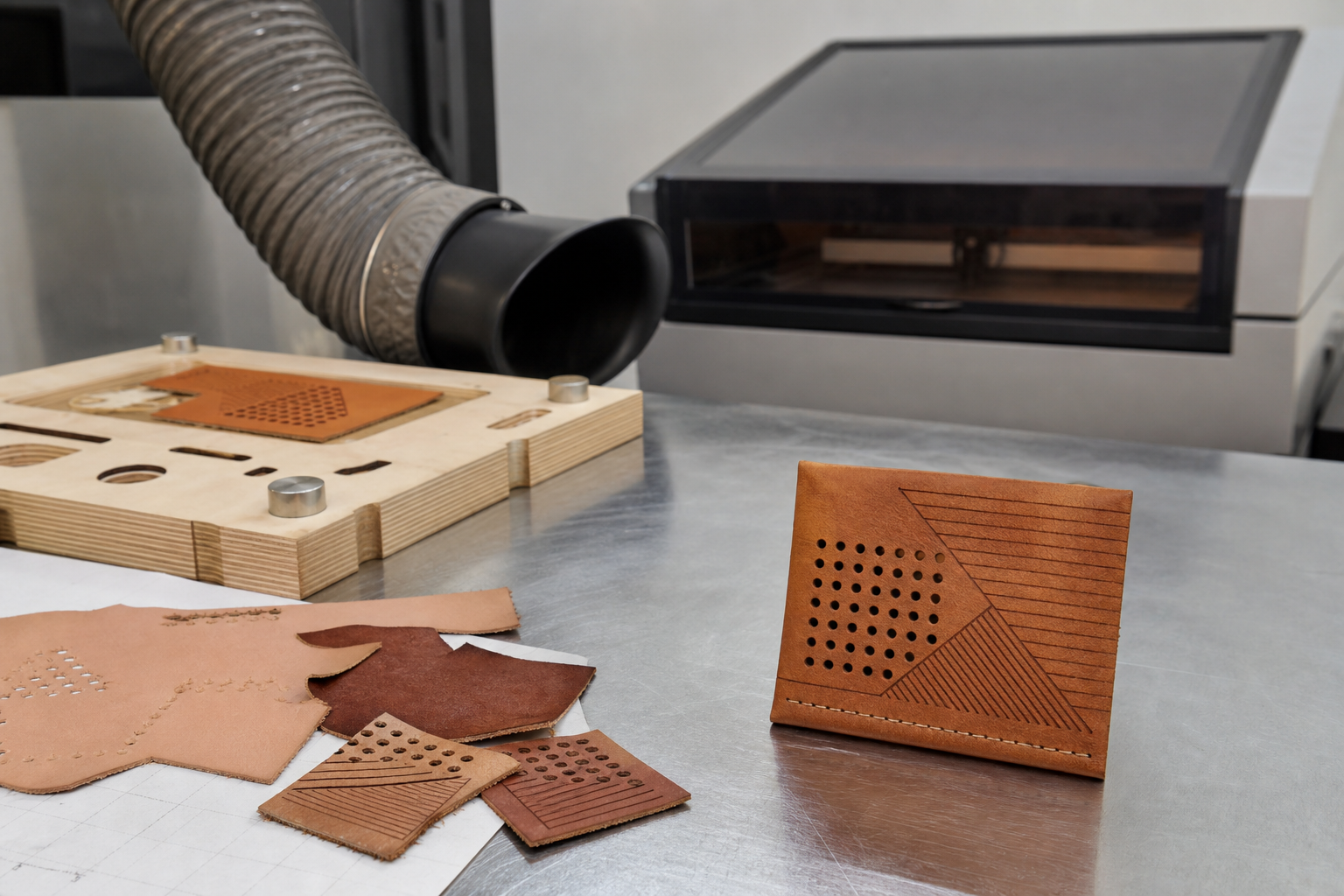
Material verification comes first. PVC must not be processed with a laser. Coated leather, bonded constructions and unknown synthetic layers need supplier confirmation before testing because heat can affect coatings, adhesives and fillers differently from the visible face.
Effective fume extraction is part of the test setup, not an optional response to odour. If an unfamiliar sample produces a strong chemical or plastic-like smell, the workshop should stop and recheck the material rather than increase power or continue production. The test record should identify the sample, batch and observed result.
Record the approved leather sample in the interior specification
A concise decision record connects the approved sample to the documents used by the supplier and fabricator. The following checks are useful for a hospitality, residential or workplace interior where leather forms a permanent, visible detail.
- ✓Name the leather construction, thickness, finish, colour reference, backing and intended application.
- ✓Approve a physical control sample large enough to show grain variation, pattern scale, joints and finished edges.
- ✓Record the substrate, adhesive or fixing method, seam position, fold radius and acceptable tolerances.
- ✓Review the sample under the lighting and beside the timber, stone, metal or paint used in the finished interior.
- ✓Keep the approved sample and supplier identification available for production and installation checks.
The record gives later reviewers something concrete to compare. It also prevents a substitute described only as “genuine leather” or “similar approved” from bypassing the characteristics that made the original detail work.
Photographing the approved control sample beside its label provides a useful secondary record, but the physical piece remains decisive. Screen colour, camera exposure and compression cannot reproduce grain depth, softness or sheen reliably.
Approve leather seating, wall panels and joinery details from physical mock-ups
Leather earns its place in an interior when the specification describes more than colour and the sample proves more than appearance. Full-size mock-ups align finish, pattern, fabrication and adjacent materials before installation.
Workshop tools can help answer a narrow prototype question, but the design decision remains material-led. Workshop teams considering this method can review OMTech CO2 laser machines as an equipment category reference after confirming the material is suitable and extraction is in place.