
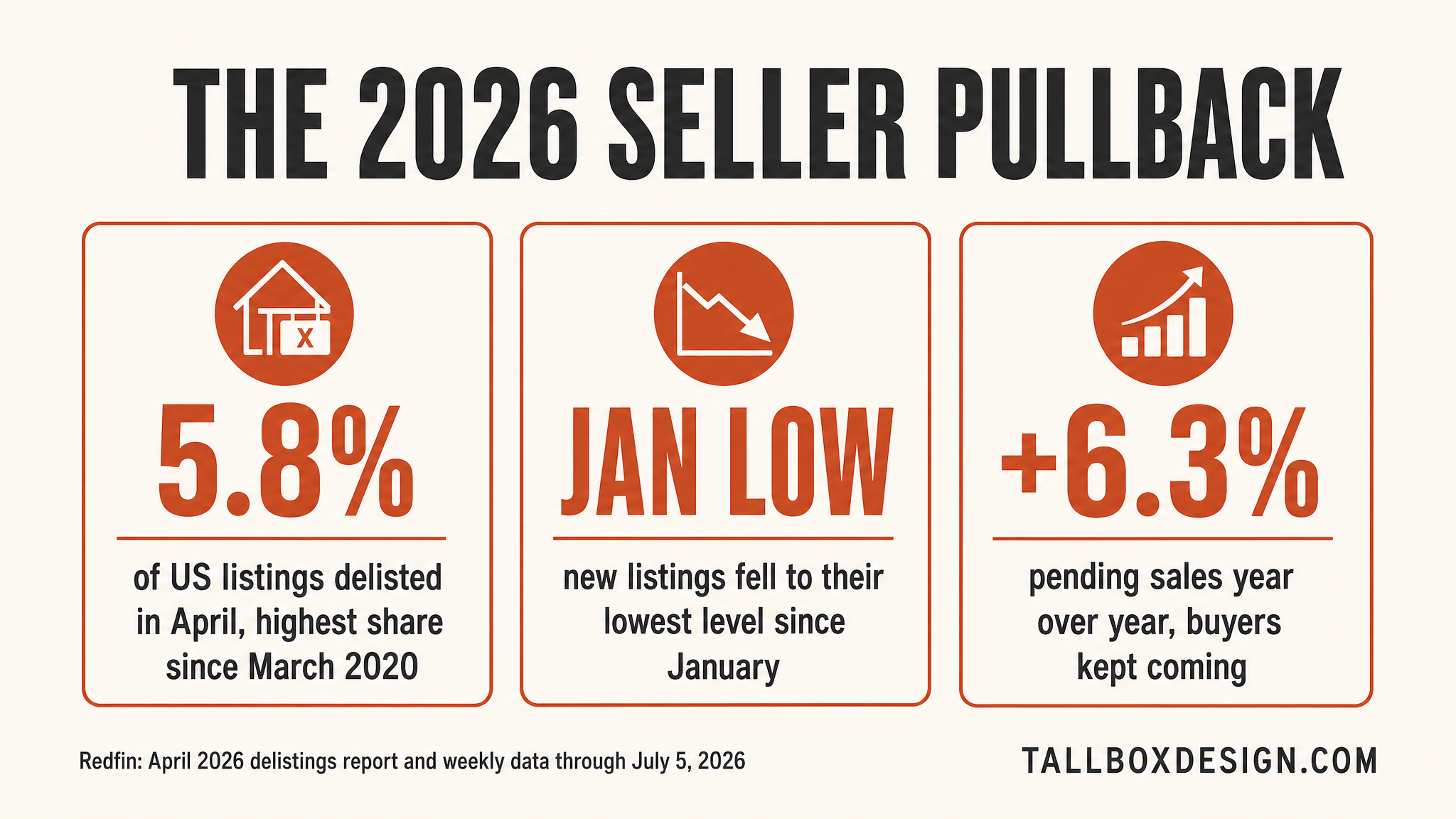
American home sellers are quietly withdrawing: 5.8 percent of US listings were pulled off the market in April, a near-record share, and new listings just fell to their lowest level since January. Buyers kept showing up; sellers stopped.
The delisting share and the new-listings drop both come from Redfin, the brokerage whose listing database tracks the market week by week. The April delisting share tied December 2025 for the highest since March 2020, and the fresh four-week read ending July 5 finds new-listing supply still shrinking.
How many sellers are pulling their homes off the market?
Delistings reached 5.8 percent of all US listings in April, the latest month with delisting data, up 3.8 percent from March on a seasonally adjusted basis. A delisting is a home pulled from the market without a sale, whether the owner quits for good or plans a return.
Metro delisting shares run far hotter than that 5.8 percent national figure, led by Sun Belt and Bay Area markets. The table below ranks the standouts Redfin called out.
Source: Redfin delistings and relistings report, April 2026 data (reported June 2026). Shares measure listings pulled from the market without a sale.
Why do sellers delist instead of cutting the price?
Sellers delist because the price in their head was set in a different market. Owners who watched 2020 to 2022 turn neighbors’ homes into bidding wars now read an offer 10 percent under that memory as an insult rather than a market signal.
Rate lock subsidizes the seller’s wait and taxes everyone else’s. An owner holding a pandemic-era mortgage pays little to stay put, so pulling the listing beats cutting the ask. Buyers, paying today’s rates on today’s prices, have no such cushion.
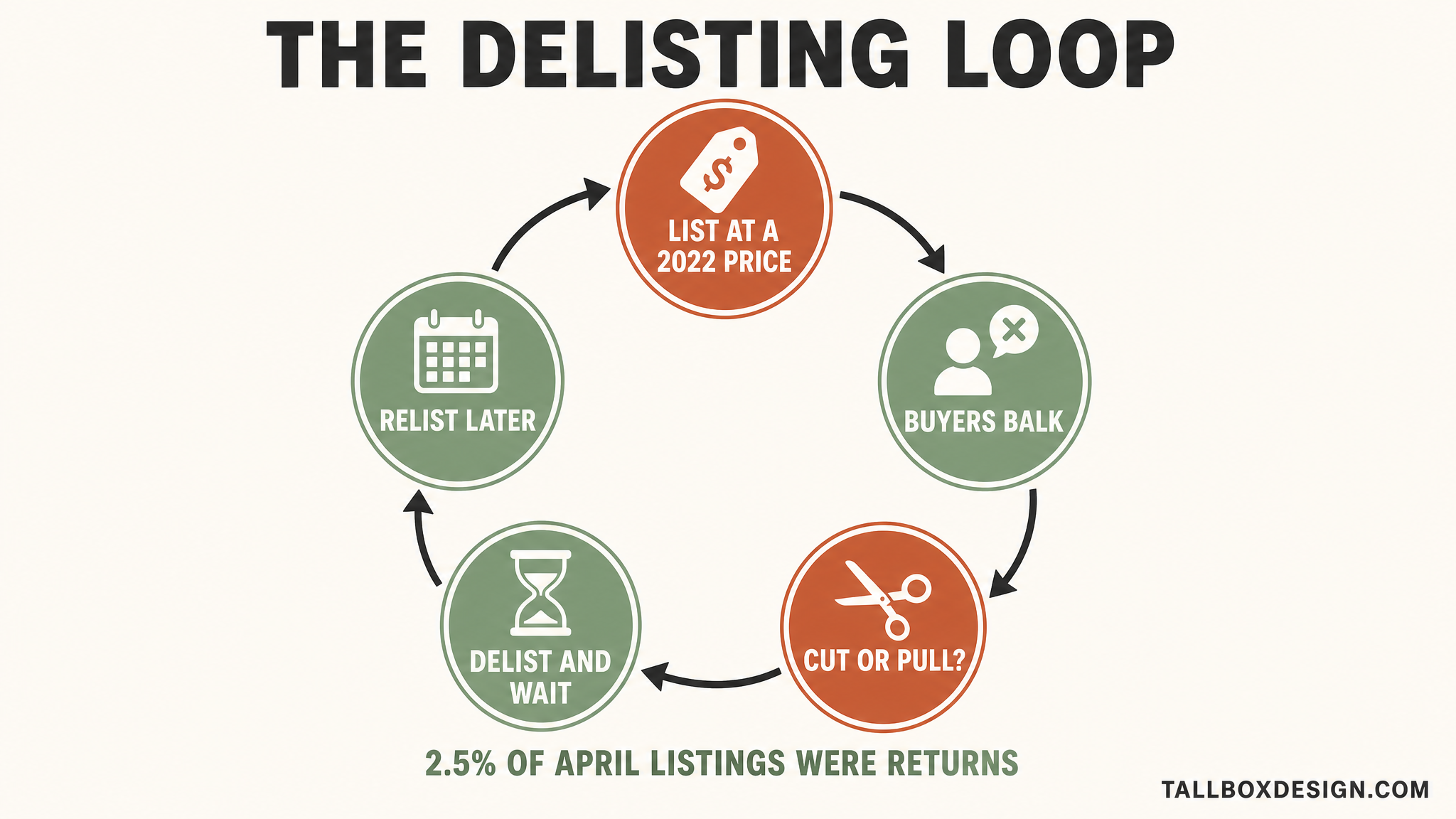
Delisting is usually a pause, not an exit. The owner pulls the home, waits out an off-market window that varies by local listing service, and returns later with a new price, new photos, or a new agent. The relisting loop below is common enough that Redfin tracks it as its own statistic.
New listings just hit their lowest level since January
Redfin’s latest four-week read, ending July 5, puts new listings down 2.5 percent week over week to their lowest level since January. Buyer demand moved the other way: pending sales rose 1.3 percent week over week to 337,402, up 6.3 percent from a year earlier.
Mortgage rates whipsawed inside that same four-week window, dipping to 6.43 percent on July 2, a six-week low, before the daily average bounced to 6.68 percent on July 8. The median sale price reached $408,808, up 2.2 percent and about $500 shy of the all-time high.
Withheld supply is the quiet engine behind the near-record $408,808 median. Buyers hold the leverage house by house, yet the market’s shelf keeps thinning, and a thin shelf holds prices up even when demand is soft. Every delisting pulls one more home off that shelf.
The median sale price moves on mix as much as on demand. Half of each month’s closings land above the median and half below, so when rate-locked owners skip listing, the affordable end thins first and the middle number climbs. A thinner, pricier pool of closings lifts the median without a bidding war.
Builders cannot sit out the way owners can. A finished spec house has no cheap mortgage to retreat into, so builders discount and add incentives instead, the dynamic we mapped in the new-home glut report. A patient owner and an impatient builder now compete for the same buyer.

What to do instead of delisting your home
Pulling a listing is a decision, not a default. Four moves are worth testing before the sign comes down.
- 1Reprice against sold comps, not memories. Price to what closed in the last 90 days, not to what a neighbor got in 2022. The market answers list prices with silence, and silence is data.
- 2Fix the visual layer before you quit the market. Buyers shortlist from the photo carousel, and AI leveled the listing words, so weak photos now cost more than weak prose ever did. Reshoot before you withdraw.
- 3Negotiate terms before price. A closing-cost credit or a rate buydown can bridge a gap that a headline price cut cannot, while keeping the listing’s posted price intact.
- 4Plan the relist before you pull the listing. Redfin’s April data counts 2.5 percent of listings as returns from earlier pull-outs. Fix what stalled the first run, using our buyers-market selling guide, before round two.
Days on market is the first number a relist has to beat. Buyers sort search results by it, agents screen showings by it, and a listing that lingers reads as overpriced before anyone steps inside. A relist that fixes nothing resets the date without changing that verdict.

Delisting questions homeowners ask
QDoes delisting hurt my home’s value later?
No, not directly, but the history follows the house. Buyers and agents can see prior listings and days on market, so a relisted home invites the question of what went wrong. A visible fix (new photos, new price, new staging) answers it.
QWhy are home prices near a record if buyers hold the leverage?
Withheld supply props the median. Sellers who delist or never list shrink the shelf, and the median sale price ($408,808 in Redfin’s early-July read) holds near its peak even while individual buyers negotiate hard on the homes that remain.
QWhich cities have the most delistings?
Atlanta led major metros with 10.7 percent of listings pulled in April 2026, followed by San Jose at 9.3 percent, per Redfin. The national share was 5.8 percent, tied with December 2025 for the highest since March 2020.
QShould I wait until 2027 to sell my home?
Waiting pays only if your local supply stays thin and your reason for moving can wait too. Nobody can promise 2027 rates or prices, so the honest test is the household one: a job, a school, or a life change usually outweighs the market timing.
The takeaway on the seller pullback
The 2026 housing story is a standoff: 5.8 percent of April listings pulled, new listings at a January low, and buyers still arriving in greater numbers than last year. Sellers who sit out are collectively holding prices near the record.
Before the sign comes down, reprice to sold comps, reshoot the photos, and trade on terms. A delisting should be a strategy with a relist date, not a stall.