Glass walls are transforming modern offices by maximizing daylight, enabling real collaboration, and adapting to changing needs. This guide explores the practical and psychological benefits of glass partitions, compares key types and features, and offers strategies to design a workspace that is both functional and inspiring.

George is a seasoned interior designer and property marketing strategist with over 13 years of experience. He specializes in transforming properties into visually stunning spaces, helping clients recognize the potential and beauty in each property. With an impressive international client base of exciting projects throughout Europe and America.
Why Choose Glass Walls for Offices?
The use of glass walls in modern office design goes beyond aesthetics—it’s a strategic response to key workplace challenges. Glass partitions boost natural light, enhance visual connectivity, encourage collaboration, and create adaptable spaces for evolving office needs.
Natural Light Drives Productivity
Studies show that exposure to natural light can increase productivity by up to 60%, while reducing eye strain and improving morale. Glass walls allow daylight to penetrate deeper into the workspace, creating bright, welcoming environments that support well-being and circadian rhythms. This aligns with 2024’s trend toward biophilic design, which prioritizes natural elements for healthier workplaces.
Major companies such as Adobe and Google have reported higher employee satisfaction and 20-33% lower absenteeism after incorporating glass partitions to enhance natural light. The resulting energy savings from reduced artificial lighting also lower operational costs and support sustainability targets.
Visual Connection and Collaboration
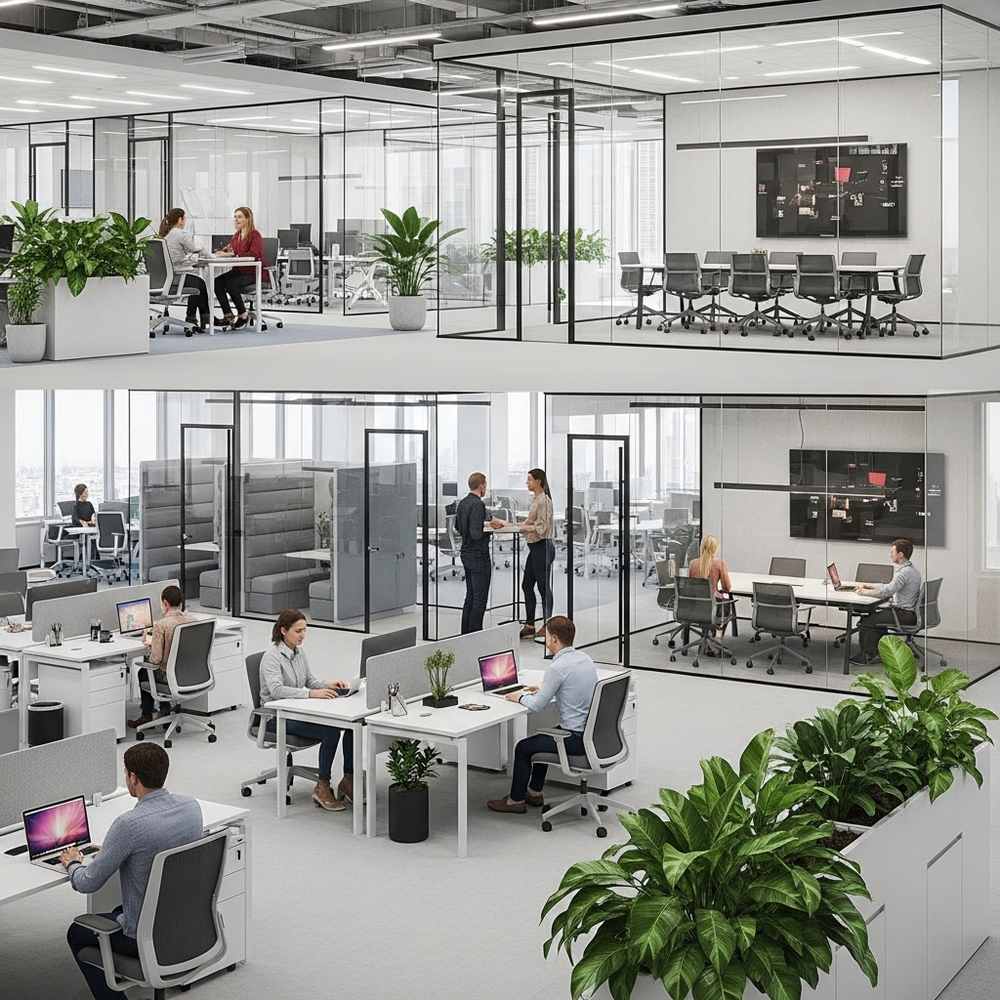
Glass partitions reshape workplace dynamics by eliminating physical and psychological barriers between teams. Unlike traditional offices, transparent dividers encourage spontaneous communication and idea-sharing while preserving needed boundaries. This visibility reduces silos and promotes a culture of openness and accountability.
Strategic use of glass walls creates semi-private meeting spaces that stay connected to the larger office, supporting both focused work and collaboration. Technologies like switchable privacy glass add flexibility, letting spaces shift between open and private as needed.
Types of Glass Partitions: Comparing Features and Uses
Glass Partition Options for Every Workplace
You can choose from several types of glass partitions to meet specific office needs and design goals.
Acoustic Glass Partitions
Acoustic glass brings both transparency and sound control to open offices. Laminated glass with special interlayers absorbs sound and reduces noise transfer.
Modern acoustic glass walls have Sound Transmission Class (STC) ratings of 40–55, which matches the performance of traditional walls. Double-glazed and well-sealed systems provide privacy for confidential meetings while maintaining openness. Single-pane glass (STC 30–35) and double-pane glass (STC 42–47) allow you to balance acoustic needs and budget.
Switchable Smart Glass
Switchable glass delivers instant privacy through Polymer Dispersed Liquid Crystal (PDLC) or Polymer Stabilized Cholesteric Texture (PSCT) technology. With the flip of a switch, glass panels turn from clear to opaque, giving you privacy control while keeping natural light.
PSCT systems, such as Cardinal IG’s CLiC™, offer better clarity and durability than traditional PDLC and connect easily with building automation for lighting and privacy.
Frosted and Textured Glass
Frosted glass provides privacy and light by using acid-etched, sandblasted, or film textures to obscure views. Research from Cornell University shows that frosted partitions can reduce eyestrain by 84% while still allowing employees to sense the presence of colleagues.
These partitions create focus areas in open offices and offer customization through gradient frosting, branded designs, or selective transparency zones.
Demountable and Modular Systems
Demountable glass walls provide flexibility and sustainability. You can reconfigure pre-assembled panels quickly, without demolition, which limits disruption and reduces waste.
Top-quality systems reach STC ratings of 53 and adapt as teams expand or shift. This flexibility lowers renovation costs and makes it easier to reshape office layouts over time.
Key Benefits for Teams and Individuals
Enhanced Natural Light and Space Perception
Glass walls create the impression of larger, brighter offices by distributing daylight more evenly, even in areas far from windows. This solves the problem of dark interior zones often found in deep office layouts.
Natural light boosts alertness, mood, and job satisfaction. Strategic use of glass walls can cut artificial lighting needs by 30–40%, lowering operating costs and supporting sustainability goals.
Improved Communication and Team Dynamics
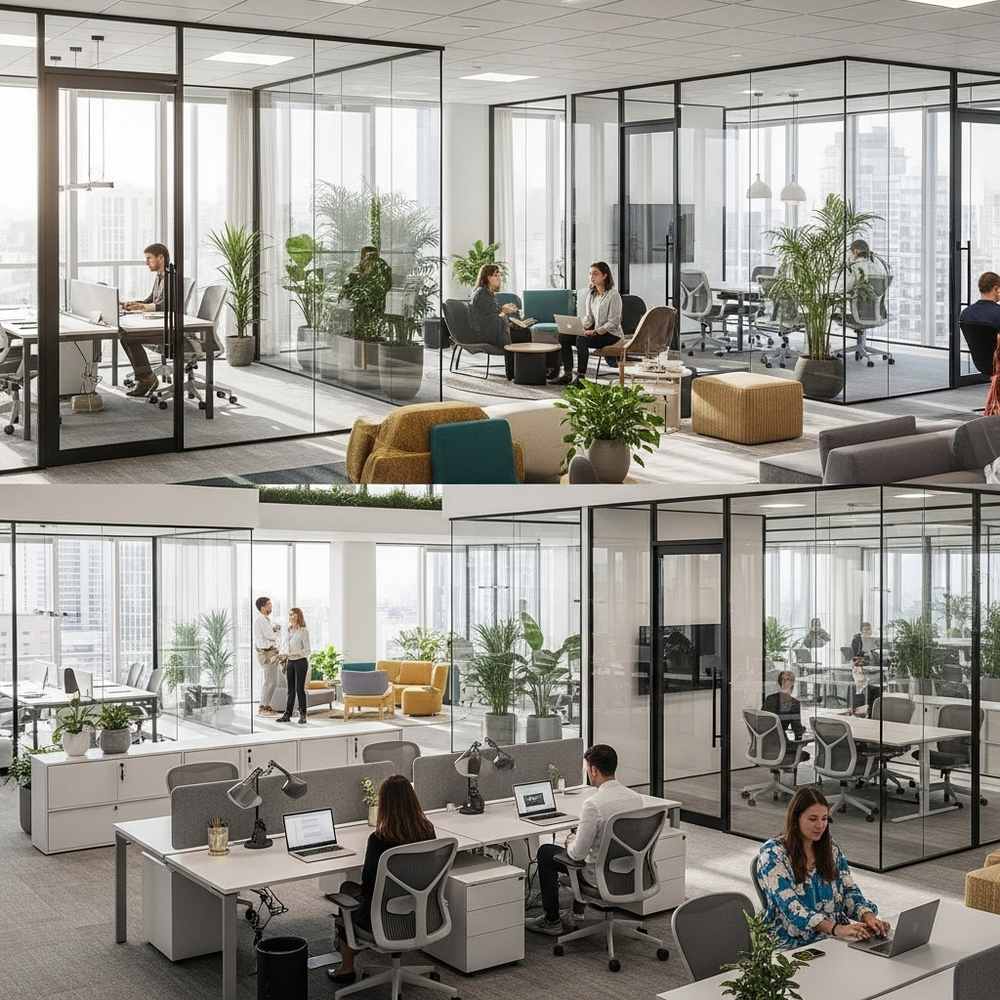
Glass partitions change how teams interact. Employees report more informal collaboration, quicker problem-solving, and better project coordination when barriers come down. Being able to see colleagues improves accessibility and reduces unnecessary interruptions.
However, too much openness can feel intrusive. Adding opaque panels, varying glass finishes, and creating focus zones help balance visibility with privacy for deep work.
Flexibility for Organizational Growth
Glass partitions support fast, low-disruption office changes. Teams can expand, shrink, or reorganize without major construction, keeping both the look and function of the space intact.
This flexibility matters in fast-changing industries. Modular glass systems allow quick layout adjustments, saving time, money, and reducing disruption.
Privacy and Acoustic Performance: Fact vs. Myth
There’s a common misconception that glass walls are only about aesthetics. In reality, as seen with CGP glass partition walls, they address deeper workplace issues. These partitions offer openness with accountability, making people feel visible but not exposed—a balance that can shift workplace culture. For this reason, many professionals now see glass partition walls as a practical alternative to traditional drywall or fixed panels.
The belief that glass walls destroy privacy is a misconception. New glass technologies now offer many ways to control privacy without losing transparency.
Switchable glass provides instant privacy when needed. Frosted and gradient glass offer permanent privacy solutions while still letting light through. Thoughtful design, with varying transparency and selective opaque zones, places privacy exactly where it’s required and keeps other areas open.
Acoustic Solutions and Performance
Properly designed glass walls can match the sound performance of solid walls. Results depend on the glass type, thickness, and installation quality.
Double-glazed laminated glass with good seals reaches STC ratings of 42–47—enough for private offices and meeting rooms. Triple-glazed glass can deliver STC ratings above 50, making it suitable for executive suites or highly confidential areas.
Adding acoustic doors with proper weatherstripping and gaskets ensures that sound control isn’t lost at the doorway. These doors keep a seamless look while providing effective noise isolation.
Cost, ROI, and Maintenance
Initial Investment vs. Long-Term Value
Glass partitions cost more upfront than drywall—typically $40 to $150 per square foot for glass versus $5 to $12 per square foot for drywall, making the initial investment 4 to 20 times higher. Long-term benefits make the investment worthwhile.
Offices save on energy costs by using less artificial light, with potential reductions of 15–40%. Studies from the World Green Building Council show that employees in naturally lit environments can be up to 18% more productive. Tempe businesses report higher ROI through better collaboration, improved satisfaction, and lower turnover.
Demountable glass systems add value by allowing easy reconfiguration. While changing a drywall layout requires demolition and new materials, modular glass systems need only labor for moving panels and can reuse nearly all components. This makes future layout changes up to 90% cheaper and much faster—crucial for growing or frequently changing companies.
Glass partitions need little upkeep beyond occasional cleaning, unlike drywall, which requires frequent repainting and repairs. Anti-static and hydrophobic coatings further cut maintenance needs. Durable glass systems last longer and avoid the design updates that other materials need.
For ROI, factor in both direct savings (energy, maintenance, renovations) and indirect gains (productivity, retention, brand). Better natural light and satisfaction lower turnover costs, and modular glass lets companies reconfigure spaces quickly without expensive renovations.
Practical Design Tips
Design Tips:
Place glass walls to maximize daylight, maintain privacy, and guide movement. Mix clear, frosted, and smart glass to balance openness and privacy.
Tech Integration:
Connect glass walls with automation for lighting and privacy. Smart and interactive glass can support collaboration and turn partitions into workspace tools.
Avoiding Mistakes:
Plan for acoustics and privacy from the start. Choose the right glass for each area and work with professionals to avoid poor system integration and unmet expectations.
Safety, Compliance, and Building Code Requirements
Safety and Code Compliance:
Use tempered or laminated safety glass to prevent dangerous breakage and meet building codes, especially near doors and walkways. Follow ADA rules by marking glass for visibility and keeping protruding features safe and accessible.
Fire Safety:
Fire-rated glass maintains integrity in emergencies and supports safe evacuation. Integrate glass walls with fire suppression and emergency lighting to meet safety standards.
Conclusion
Glass walls mark a new era in office design, bringing transparency, flexibility, and a focus on well-being. They boost natural light, collaboration, and adaptability—key for today’s workplaces.
Investing in quality glass partitions pays off through energy savings, higher productivity, easier hiring and retention, and space flexibility. As technology evolves, glass walls will add even more value.
Success requires careful planning for acoustics, privacy, and system integration. Professional guidance helps avoid mistakes and ensures the best results.
Modern offices need spaces that grow with teams and support people. Glass walls deliver the clarity, flexibility, and performance to meet these goals.