Thirty-six percent of roughly 1,000 U.S. prospective movers ranked a “clean home” among their top three features. Redfin published the Ipsos survey on July 21, 2026. Redfin defined that option as high-end air, water and other filtration, but the survey did not define a performance standard.
Ipsos surveyed 4,000 U.S. residents in May, and Redfin analyzed the prospective-mover group. Each respondent chose three options from a prompted list of 22 features. The result records preference, not willingness to pay, sale-price impact, equipment performance or a health outcome.
A residential filtration claim gives a buyer something to inspect when the listing names the exact equipment and the particle or contaminant it targets. The same claim identifies the treated rooms or outlets, installed condition and service history.
Air ratings describe filter capability, not whole-home results. Water certifications apply to an exact model and reduction claim. Current property records or testing answer the address-specific question. The listing points the buyer to that evidence without replacing address-specific records or testing.
Clean-home filtration now sits beside security in mover priorities
The bundled clean-home option reached 36%, compared with 38% for security systems. Redfin treats those results as statistically equal within the survey’s plus or minus 3.9 percentage-point credibility interval. Views reached 25%, smart-home technology 20% and backup power 19%.

“Clean home” combined air, water and other filtration into one choice. The survey therefore cannot distinguish which system drove the response or whether movers would trade another feature, pay more or reject a home without filtration.
Respondents did not independently name filtration as an open-ended priority. Because they selected it from a prompted list, the result supports comparison but is narrower than a market-wide demand forecast.
Air-filtration claims depend on filter fit, airflow and maintenance
An air-filtration claim depends on the filter rating, a bypass-free fit, compatible airflow and a current maintenance record. A MERV rating describes particle capture under a test method, while EPA recommends MERV 13 or the highest rating the equipment can accommodate.
A MERV rating does not establish whether the HVAC system can move sufficient air through the filter or whether the system runs long enough to treat occupied rooms. The model, filter slot, fan setting and service history establish the installed context.
Portable cleaners require room-level scope. Clean air delivery rate supports particle-removal sizing for a stated room. A gas or odor claim needs media designed for gases and evidence for the named pollutant. Neither number should be translated into an unqualified “whole-home clean air” claim.
- Equipment: model, filter dimensions, rating and treated zone.
- Installation: filter fit, return path, bypass condition and compatible fan setting.
- Operation: replacement date, run schedule and service record.
ASHRAE notes that installed effectiveness changes with air distribution, maintenance, aging, airflow, installation and room volume. The listing can identify those fields. An inspection or measurement establishes their current condition.
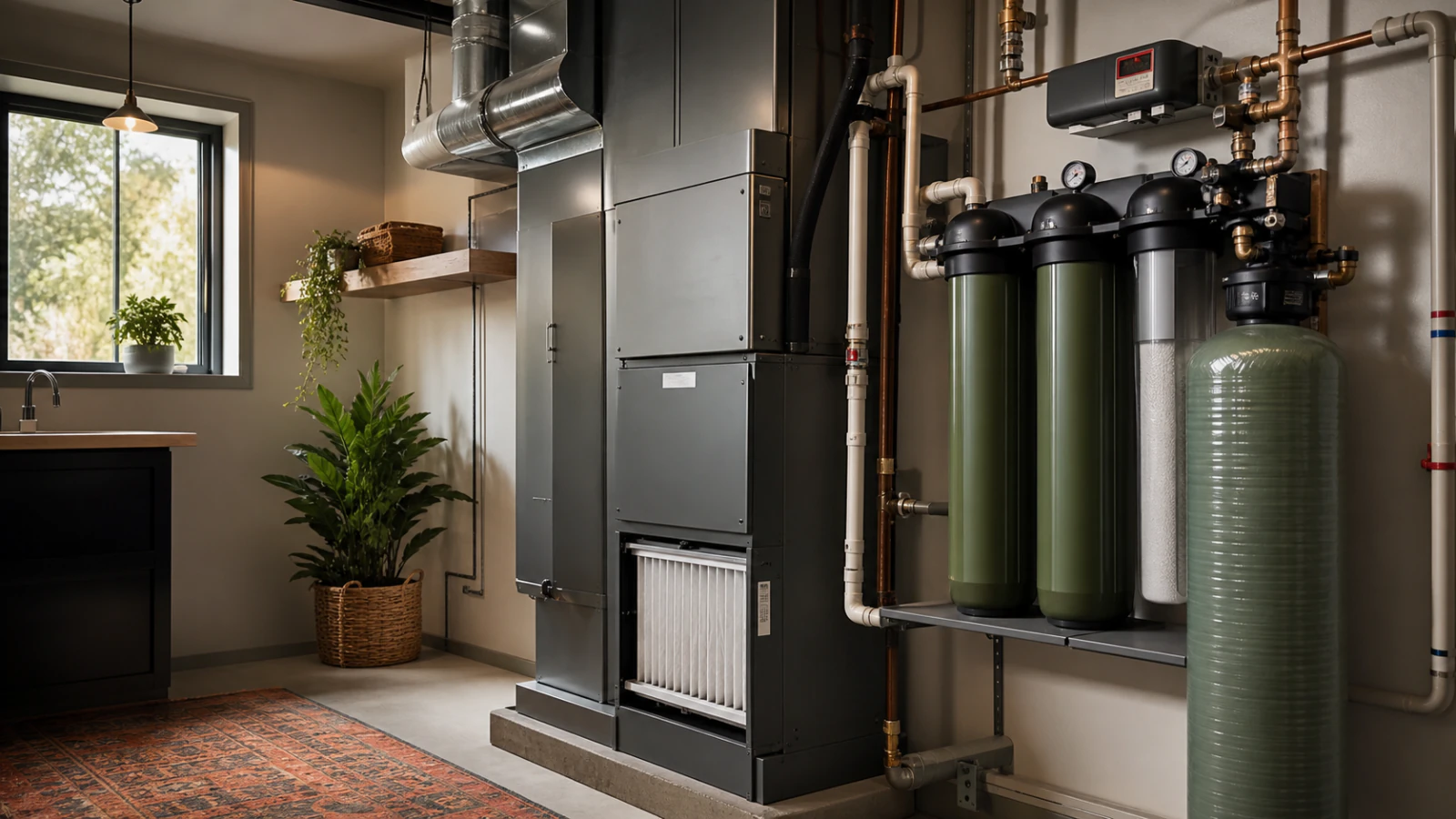
Filtration works alongside source control and ventilation. Source control reduces pollutants before they enter the air, while ventilation exchanges indoor and outdoor air. EPA treats air cleaning as a supplement to those measures, so a filter label should not carry the entire indoor-air claim.
Water-filtration claims depend on the contaminant and certified model
A water-filtration claim depends on the contaminant being addressed and the exact model certified to reduce it. A public water system’s annual Consumer Confidence Report describes system-level results, not the condition at one tap or the home’s service line and plumbing.
Private wells and address-specific water concerns need relevant sampling from a qualified laboratory. The sample location and date connect the result to the property question, while the treatment model identifies which reduction claim can be checked.
NSF standards cover distinct treatment claims. NSF/ANSI 42 covers aesthetic effects, 53 covers health-effect contaminants, 58 covers reverse osmosis, 55 ultraviolet treatment and 401 selected emerging contaminants. A standard number or logo alone is incomplete; the exact model and certified reduction claim are the useful evidence.
The performance data sheet defines rated flow, capacity, replacement interval and installation conditions. A mover can compare those operating boundaries with household use. A cartridge beyond its service cycle or a bypassed system changes the property question even when the product remains certified.
What must a filtration claim show in the listing and mechanical room?
A filtration claim should make five records traceable. Those records are the amenity claim, equipment label, installed treatment path, service record and current address-specific evidence. A buyer can then match “whole home,” “at the kitchen sink” or “bedroom air cleaner” to the installed treatment path.
Filtration claims follow the same boundary Tallbox applies to listing evidence beyond the view. A listing can direct readers to the system and its records, while property-specific performance still depends on the underlying documents and current checks.
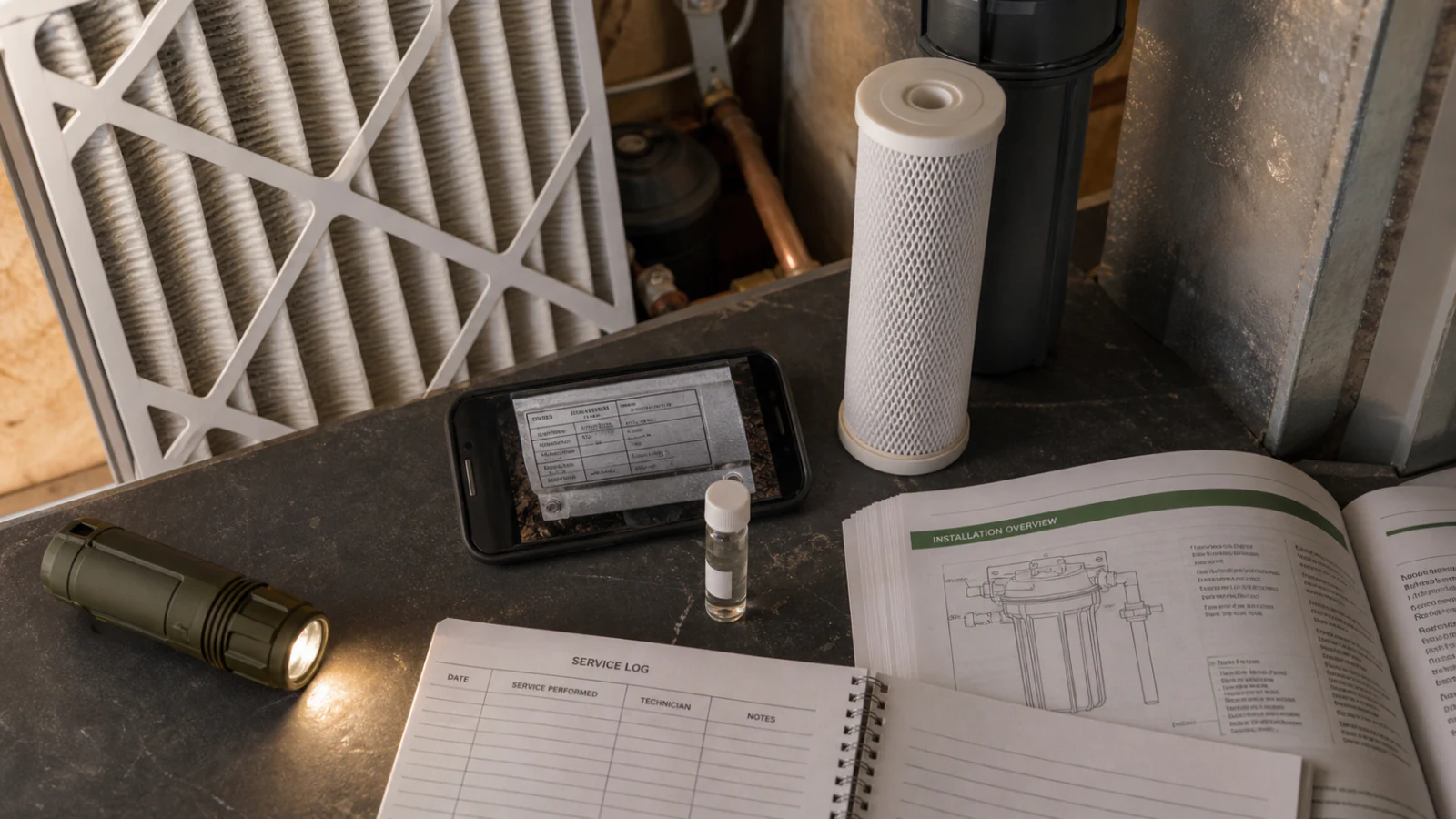
The mechanical room adds physical confirmation. Model plates, filter dimensions, valves, bypass positions, cartridges, UV lamps, drains and service labels indicate whether the listing language matches the installed path. They do not replace a qualified inspection or a relevant current test.
Photography can document that path by capturing readable model plates, the treatment path and dated service labels. A polished equipment-room image without those identifiers only proves that equipment was photographed. The caption should state the treated scope and point to the supporting record.
A filtration proof pack gives prospective movers a usable next step
A compact filtration proof pack lets a prospective mover trace the listing claim to the installed system and its current records. It preserves a concise property description while pointing to the supporting evidence.
- 1. Name the system. Record the manufacturer, model, installation date and serial number when the equipment label provides one.
- 2. Name the target. State the rated particle range, contaminant reduction or named treatment function.
- 3. Define the scope. Identify rooms, air handlers, taps or the point where water enters the home.
- 4. Attach service evidence. Include replacement dates, invoices, settings and the next scheduled action.
- 5. Point to current property evidence. Include the relevant water report, laboratory result or inspection note with its date and sampling location.
The filtration proof pack does not promise “pure water,” “clean air” or a financial return. It lets a prospective mover see what is installed, what it is rated to do and which question still belongs in due diligence.
The listing sentence can stay short. Name the system, scope and last service date, then identify where the model sheet and current record are available. That structure preserves the appeal of the amenity while giving a buyer enough specificity to verify it.
Sources and citations
- Redfin: House Hunters Value Clean Air in Their Homes More Than Views and Other Luxuries
- U.S. EPA: Guide to Air Cleaners in the Home
- U.S. EPA: What is a MERV rating?
- ASHRAE: Position Document on Filtration and Air Cleaning
- NSF: Standards for Water Treatment Systems
- NSF: Product Label and Literature Claims
- U.S. EPA WaterSense: Guide to Selecting Water Treatment Systems
- CDC: About Choosing Home Water Filters