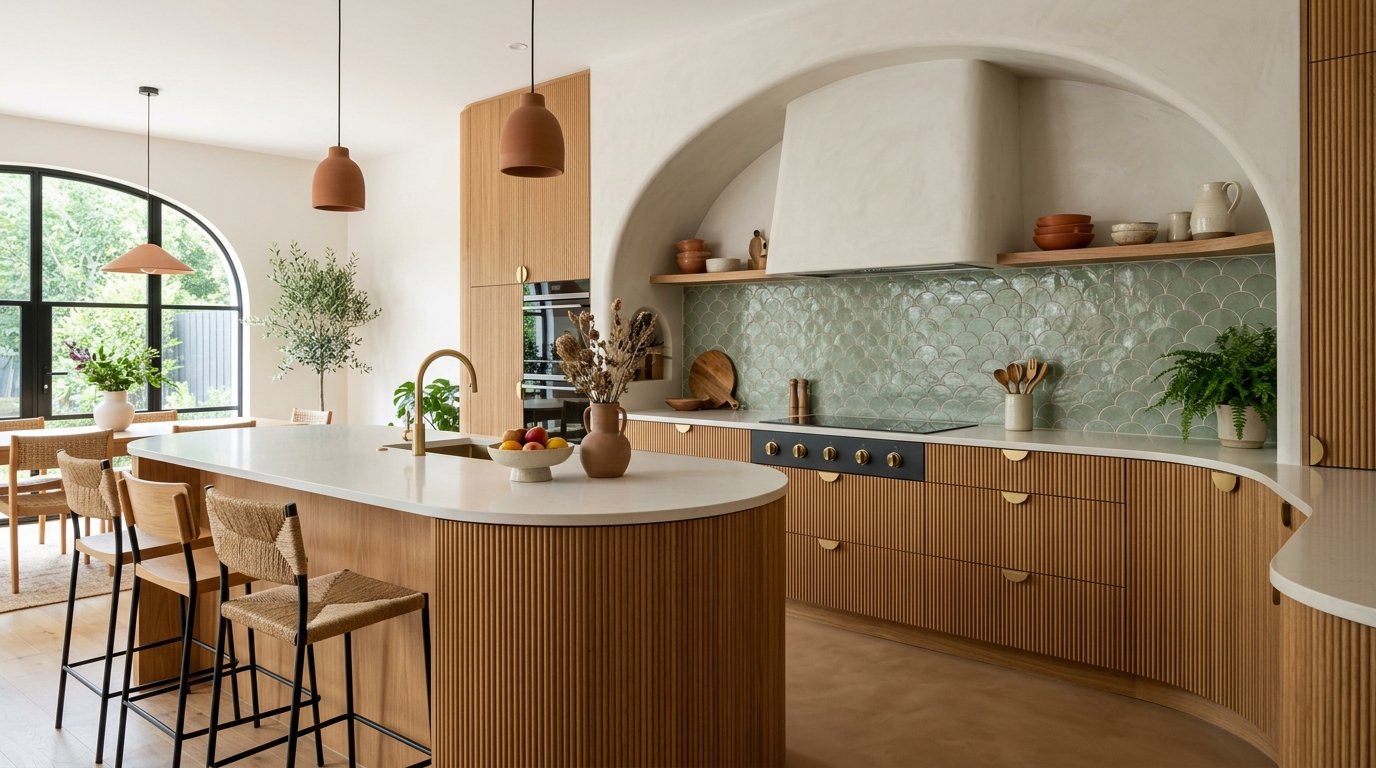
Curved kitchen design has overtaken the straight-edged kitchen as the defining look of 2026. The evidence comes from Houzz, the home-renovation platform where millions of US homeowners plan real projects. Its 2026 Emerging Summer Trends Report compares what people searched on the platform this year against the year before, and curves dominate the fastest risers: searches for “arched range hood” rose 177 percent year over year, “scalloped tile” searches more than tripled, and “rounded kitchen island” climbed 123 percent. We watch this report because Houzz searches come from homeowners actively planning remodels, which makes these numbers a preview of what will be built over the next year or two. The boxy, hard-edged kitchen of the last decade is being softened at every corner.
We model kitchens for a living, months before anyone breaks ground. So when a trend moves this fast, we see the same split every time. Some of these curves will still look right in ten years. Some will date the moment the trend cools. This article separates the curved kitchen elements that last from the ones that date, shows what each curve costs to build, and explains how to tell the two apart before you commit.
The scale of the curve trend is easy to underestimate: this is not one style choice but a whole vocabulary of soft shapes moving at once, and the Houzz report shows exactly where homeowners are looking.
Source: 2026 U.S. Houzz Emerging Summer Trends Report. Year-over-year growth in search interest for curved and arched kitchen elements.
Why the kitchen went curved in 2026
The curved kitchen is a reaction. After a decade of flat-front cabinets, waterfall islands, and grid-straight subway tile, kitchens started to feel more like showrooms than homes. Soft, rounded forms are the correction.
Designers describe 2026 as a move toward “curated calm,” and curves do the emotional work: an arch reads as calm and permanent, a rounded island invites people to gather instead of lining them up along a hard edge. It is the same instinct driving the year’s warmer palettes and lived-in materials, the shift we cover in our look at what makes a home feel premium to a buyer.
There is also a practical driver. A curve softens traffic. In a tight kitchen, a rounded peninsula lets people pass without catching a hip on a corner, and that felt difference is exactly the kind of thing a floor plan hides and a 3D model reveals.
The curves that will last, and the ones that will date
This is where the trend pieces stop and the studio view starts. Not every curve ages the same way. The reliable rule: curves that are architectural tend to last, and curves that are purely decorative tend to date. An arch built into the structure of the room reads as permanent. A novelty shape chosen because a report said so reads as a timestamp.
A rendering studio’s read on which 2026 kitchen curves age well. Verdicts are general guidance; the right call depends on your room, your light, and how restrained the execution is.
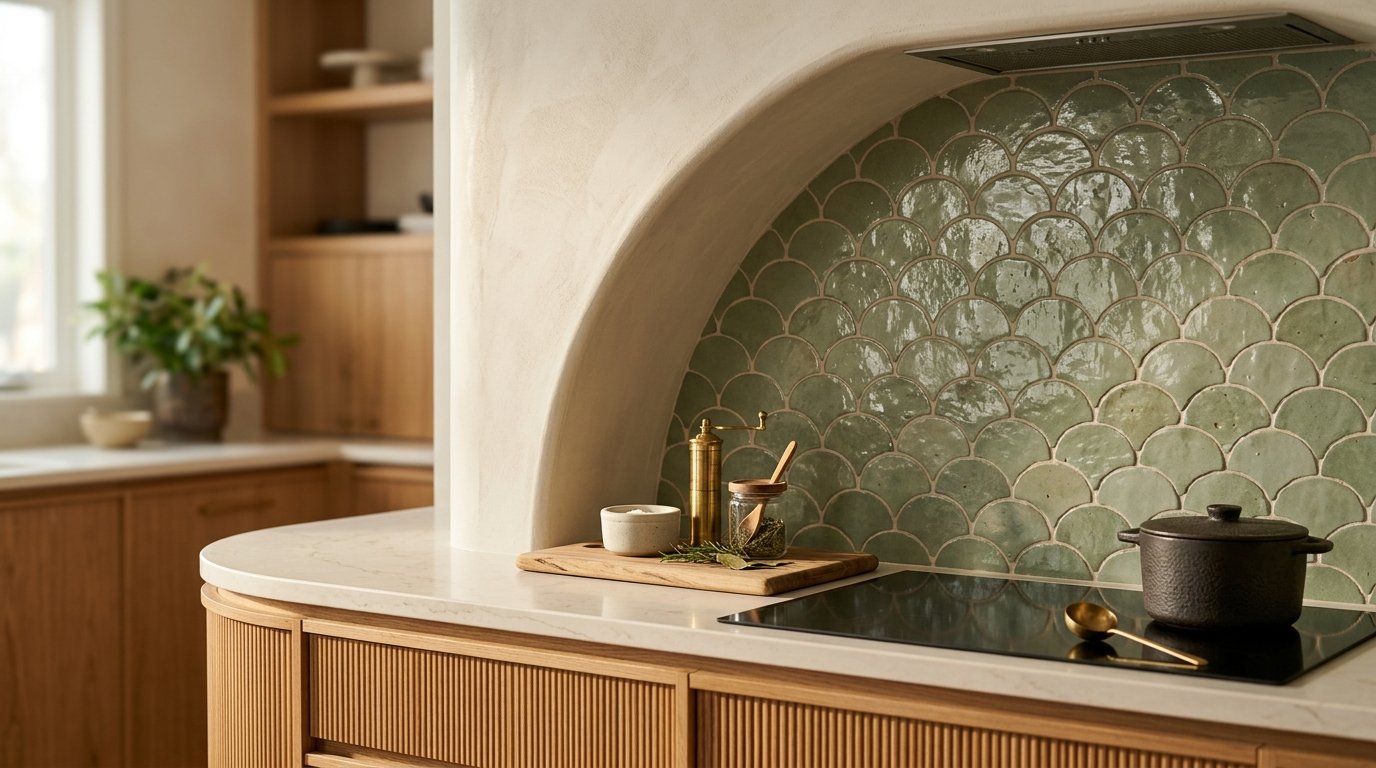
The hardest one to call is tile. Scalloped and zellige tile carry the most personality of anything on the list, which is exactly why they carry the most risk. Personality reads as bold today and as dated tomorrow. If you love the shape, the safe move is a restrained, timeless glaze, so the form stays interesting even when the color feeling changes. That is a materials decision as much as a style one, and it pays to think about how the surface will wear over a decade of daily use.
What the trend pieces skip: clearance and cost
Every article celebrating the curve leaves out the two things that decide whether you regret it: the clearance it needs and the premium it costs. Curves are more expensive to build than straight lines, because a curve has to be fabricated, not just cut.
Cost ranges compiled from published 2026 US remodeling and contractor cost guides. Curved and arched work carries a fabrication premium over straight equivalents because it requires custom radius boxes, curved stone edges, and slower installation. Figures vary by region, material, and complexity; treat them as planning ranges, not quotes.
The cost is only half the story. Curves also change the clearances a kitchen needs. A rounded island looks generous in a photo and can quietly eat the 42 to 48 inches of walkway a working kitchen needs on every side. An arched plaster hood needs a real ducting path to the outside, and adding the arch late can force the vent run to be re-routed after the cabinets are set. These are the conflicts we catch in a model, where they cost nothing to fix, rather than on site, where they cost thousands. It is the same lesson from our deeper look at the custom kitchen remodel decisions that are locked in before demolition.
How to test a curve before you build it
A curve is a commitment. You cannot square off a rounded island later without rebuilding it, and a scalloped wall you tire of is a full tear-out. That permanence is the argument for seeing it first.
When we render a kitchen, the curve stops being a mood board and becomes a decision you can actually judge. You see whether the arch is proportioned to the ceiling or looms over it. You see how a scalloped backsplash catches morning versus evening light, which is where a lot of textured tile either sings or turns busy, a relationship we break down in our piece on how light shapes the perception of interior space. And you see, at eye level, whether the rounded island still leaves room to actually cook. Seeing those before build day is the entire return on visualizing first, which we quantify in our breakdown of where 3D rendering pays back.
A curve-by-curve buyer’s guide
Before you sign off on any soft shape, run it through these questions:
- ✓Is this curve architectural (an arch, a cased opening) or purely decorative? Architectural curves age better.
- ✓Does the rounded island still hold a 42 to 48 inch walkway on every working side, with appliance doors open?
- ✓If you love scalloped or zellige tile, is the glaze a timeless neutral rather than a trend color?
- ✓Does the arched range hood have a real, unobstructed ducting path to an exterior wall?
- ✓Have you priced the curve premium (roughly 15 to 30 percent on an island) against a simpler shape you would still be happy with?
- ✓Have you seen the curve rendered at eye level, in your room, under your light, before committing?
Frequently asked questions
QAre curved kitchens just a passing 2026 trend?
Partly. The vocabulary of arches and soft edges is having a moment, but architectural curves (arched openings, a well-proportioned plaster hood) have been used for centuries and are unlikely to date. The decorative, high-personality pieces like bold scalloped tile are the ones most tied to the current moment.
QHow much more does a curved island cost than a straight one?
Expect roughly a 15 to 30 percent premium. Curved islands run about $4,500 at the entry level, $6,500 to $8,000 mid-range, and $12,000 to $15,000 for premium builds with waterfall edges. The extra cost is custom radius cabinet boxes and stone edges that have to follow the curve.
QIs an arched plaster range hood worth it?
As a single sculptural focal point, yes, and it ages well when the arch is restrained. Budget roughly $3,000 to $6,000 or more for a custom build, and confirm the ducting path early. The mistake is adding the arch after the layout is set, which can force an expensive vent re-route.
QWhat is the safest way to try the curve trend without regretting it?
Start with one architectural curve rather than five decorative ones. An arched cased opening or a single plaster hood gives you the soft, current feeling with far less risk than committing every surface to a shape you may tire of. And render it first so you can judge the proportion before it is permanent.
The takeaway
The curve is the real story of the 2026 kitchen, and the Houzz numbers prove the demand is real. But a trend report tells you what is popular, not what is right for your room. The curves that last are the ones built into the architecture and proven in a model before they are built in drywall. Chase the shape that still looks calm in ten years, not the one that peaks with this year’s trend cycle.