Dedicated game rooms are the surprise breakout of the 2026 U.S. Houzz Emerging Summer Trends Report. Searches for mahjong rooms jumped 1,986 percent year over year, with card rooms, board game rooms, and poker rooms all climbing alongside them. Converting a spare room to meet that demand runs from $3,000 to $50,000, depending on where you start.
Those numbers come from Houzz, the platform homeowners use to browse renovation ideas and hire contractors before a project begins. Its search data reflects what people actively planning remodels want, which previews what actually gets built in the months ahead.
Why the Game Room Revival Is Happening Now
Mitchell Parker, Houzz’s home design trends expert, tied the surge to “a renewed love of tabletop gaming, screen-free enjoyment, and social gathering.” Three practical forces sit underneath that nostalgia.
First, going out keeps getting more expensive. A one-time $3,000 to $20,000 room conversion starts to look reasonable against years of restaurant meals and movie tickets. Houzz linked the trend to homeowners investing at home because “recreational activities and dining out are increasingly expensive.”
Second, the dedicated home theater lost its grip on the bonus room. Streaming put a screen in every room, so a sealed, single-purpose box no longer earns its square footage. Homeowners are swapping single-use media rooms for flexible spaces that host movie nights, card games, and socializing in one layout.
Third, the equipment grew up. GLD Products values the U.S. game room sector at $230 million in 2026, with custom billiard table orders up 27 percent year over year. The same appetite shows up beyond games: Houzz tracked a 191 percent rise in home library searches and a 75 percent rise in speakeasy-style home bars.
What a Game Room Conversion Actually Costs
The bill depends on where you start. Converting a finished spare bedroom costs a fraction of finishing a raw basement for a full billiards setup. HomeAdvisor’s 2026 remodeling data breaks it down by starting point.
Source: HomeAdvisor 2026 U.S. remodeling cost data. Figures are national planning ranges, not contractor quotes.
Where the budget goes matters as much as the total. These are the pieces that move the number most.
Source: Compiled from HomeAdvisor and GLD Products 2026 U.S. game room data. Figures are planning ranges.
Game Room or Guest Bedroom: The Resale Math
A well-designed game room returns 50 to 70 percent of its cost at resale, per HomeAdvisor’s 2026 data. That trails a minor kitchen remodel at 96 percent but beats a swimming pool, which Opendoor’s 2026 analysis says many buyers treat as a liability.
The difference between a room that helps resale and one that hurts it is reversibility. A spare bedroom with a convertible table and a shelf of games converts back to a guest room in an afternoon, and an appraiser still counts it as a bedroom while the closet and egress window stay.
A sunken billiards pit with a built-in wet bar does not reverse, and it locks you into a buyer who wants that exact setup. If resale matters, keep the furniture movable, test the layout in a 3D rendering, and pair the conversion with staging that helps homes sell faster.
What to Get Right Before You Convert
- ✓Measure ceiling clearance first. A pool cue needs about 58 inches of clearance around the table. Many 8-foot-ceiling bedrooms fail this with a standard 57-inch cue.
- ✓Test basement moisture. A raw basement needs a vapor barrier and dehumidifier before finish work, or flooring warps and mold grows behind new drywall within two years.
- ✓Plan the electrical load. A surround system, LED strips, and a mini fridge on one circuit will trip the breaker. Budget a dedicated 20-amp circuit; the electrical planning checklist for renovations covers the rest.
- ✓Soundproof shared walls. One layer of mass-loaded vinyl ($1,000 to $2,600) keeps the room usable past 10 p.m. without noise complaints from adjacent bedrooms.
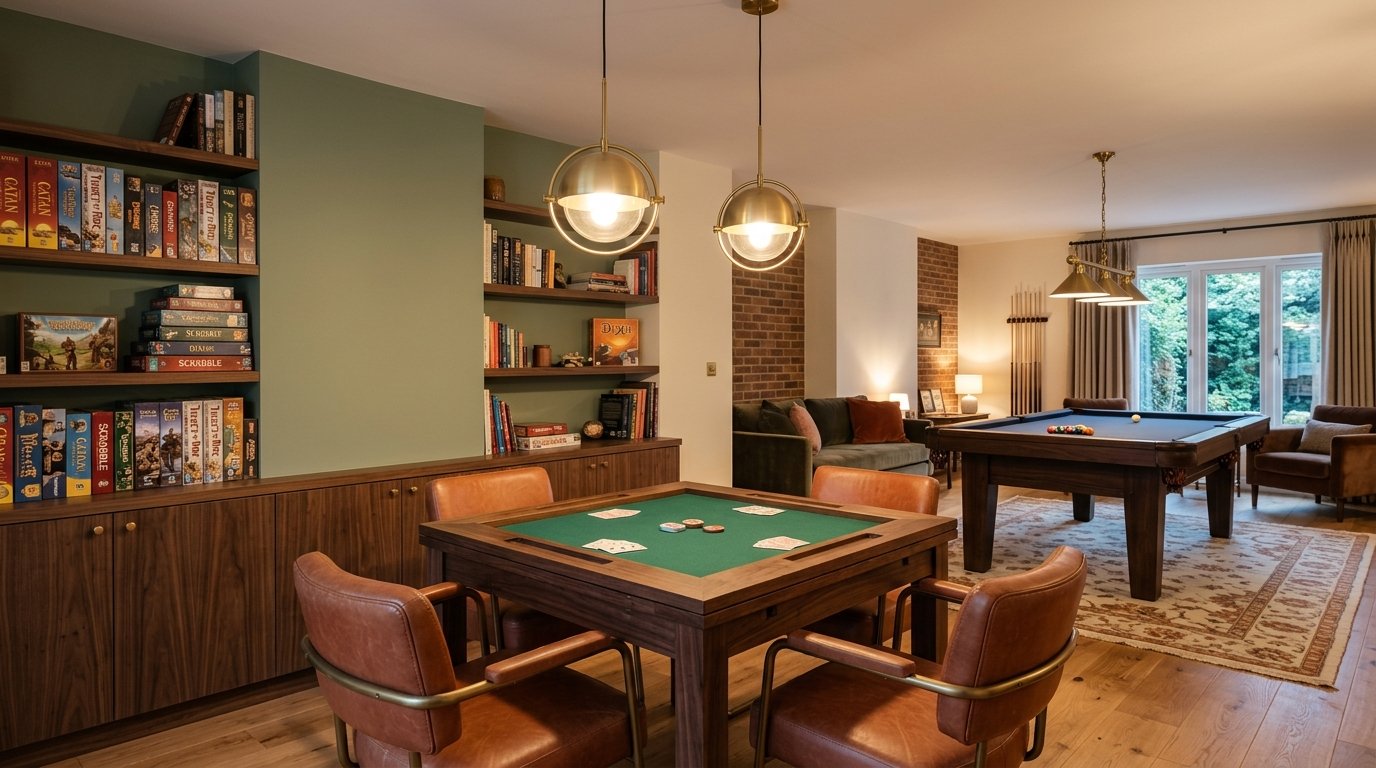
- ✓Get the lighting right. Pendants mounted 30 to 36 inches above the table kill glare and shadow, because how light falls in a room shapes both comfort and function.
- ✓Render before you buy. A 3D model shows whether a 12-by-14 bedroom actually fits a pool table with clearance on all sides. Many do not, and finding out in a rendering costs nothing versus discovering it after construction starts.
Common Questions About Game Room Conversions
QCan I convert a spare bedroom into a game room without a permit?
Swapping furniture and adding lighting in a finished room needs no permit in most U.S. jurisdictions. Electrical upgrades, wet-bar plumbing, or removing a closet wall usually do. Check with your local building department before anything structural.
QWhat is the minimum room size for a pool table?
A 7-foot table needs a room at least 13 by 16 feet for a full cue stroke; a 9-foot table needs 14 by 18 feet. If the room is smaller, a card table or multi-game table fits better.
QDoes removing a closet to fit a game table lower my appraised value?
It can. Bedrooms need a closet, egress window, and minimum square footage to count as a bedroom in most appraisal standards. Remove the closet and the room may stop counting, lowering the appraised bedroom total.
QHow long does a typical game room conversion take?
A finished-bedroom swap takes a weekend or two. An unfinished basement runs 4 to 8 weeks; a garage conversion falls in between at 3 to 6 weeks.
The Takeaway
Analog entertainment is reclaiming the bonus room the home theater held for two decades. Cards, board games, mahjong, and poker are all surging at once, and the conversion runs from $3,000 for a furniture swap to $50,000 for a full basement build.
Favor movable furniture over built-ins if resale matters, and model the layout before you commit. Finding out the pool table does not fit costs nothing in a rendering and a fortune after the floor is down.