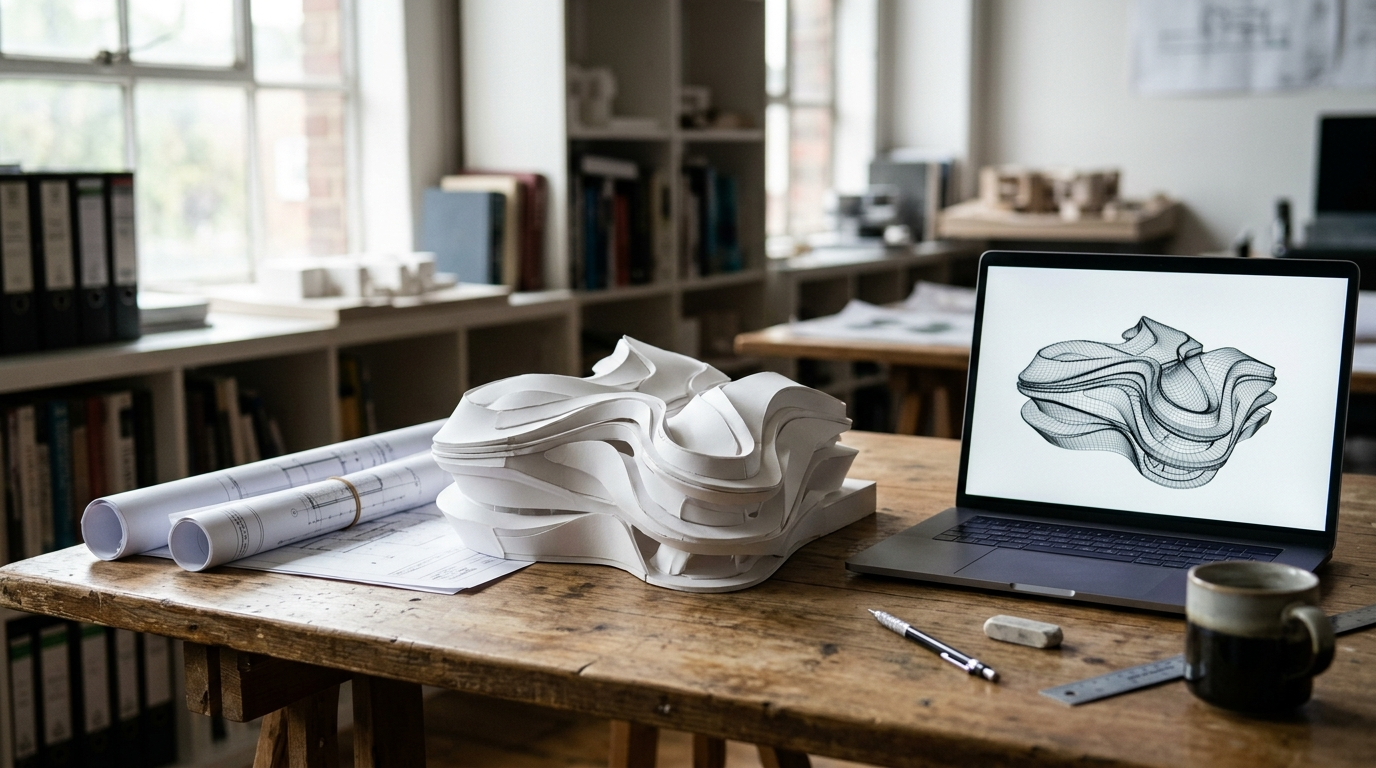
Frank Gehry died in December at 96, and his buildings keep breaking ground. Abu Dhabi started construction this month on Dar al-Funoon, a Gehry-designed performing arts centre with more than 6,000 seats across four venues, set to open in 2030.
Gehry, the architect behind the Guggenheim Bilbao and Walt Disney Concert Hall, died December 5, 2025, at his Santa Monica home (NPR). Dar al-Funoon, revealed by Abu Dhabi’s Department of Culture and Tourism on June 26, now becomes the clearest test of how a design survives its designer.
Dar al-Funoon: the Gehry hall that broke ground after his death
Dar al-Funoon sits on Saadiyat Island, Abu Dhabi’s museum district, near the Louvre Abu Dhabi and the still-unfinished Guggenheim Abu Dhabi that Gehry also designed. The emirate’s Department of Culture and Tourism unveiled the design on June 26 and broke ground in early July.
Dar al-Funoon’s program packs four venues under one undulating, fabric-like roof: a performance hall with more than 2,000 seats, a 3,500-seat open-air amphitheatre, a 400-seat studio theatre, and a 250-seat jazz room. A transparent facade is meant to open the building’s activity to the street.
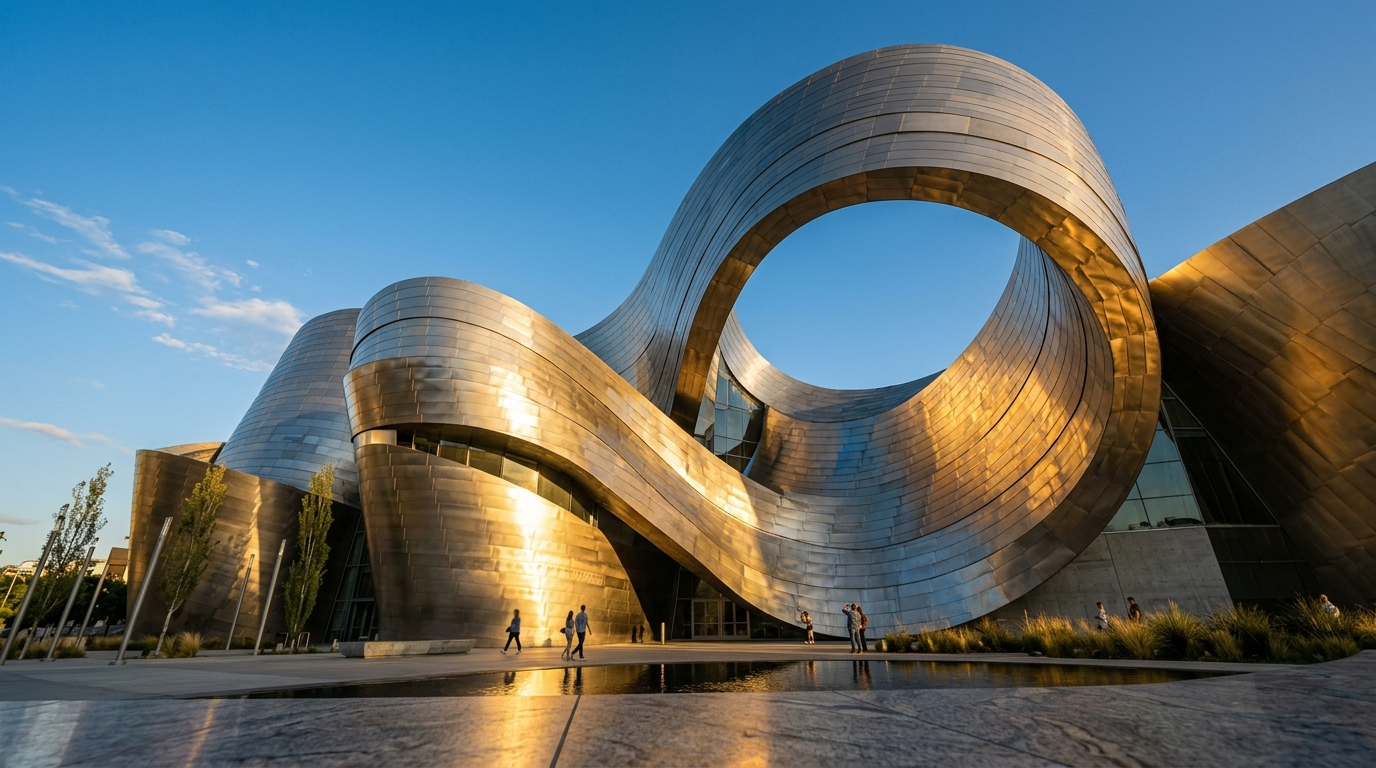
Frank Gehry’s final buildings still under construction
Dar al-Funoon is not the only Gehry design advancing without its architect. Two more projects were mid-construction when he died, on two other continents, and his firm, Gehry Partners, carries all three forward.
Source: Abu Dhabi Department of Culture and Tourism reveal (June 2026); CNN architecture preview (January 2026). Statuses as reported at publication.
Forma carries a personal note: Gehry was born in Toronto in 1929, and the stacked towers bring his sculptural language to his birthplace’s skyline. The Guggenheim Abu Dhabi, decades in the making, remains the biggest open question, with its opening date unannounced.
How does a building get finished without its architect?
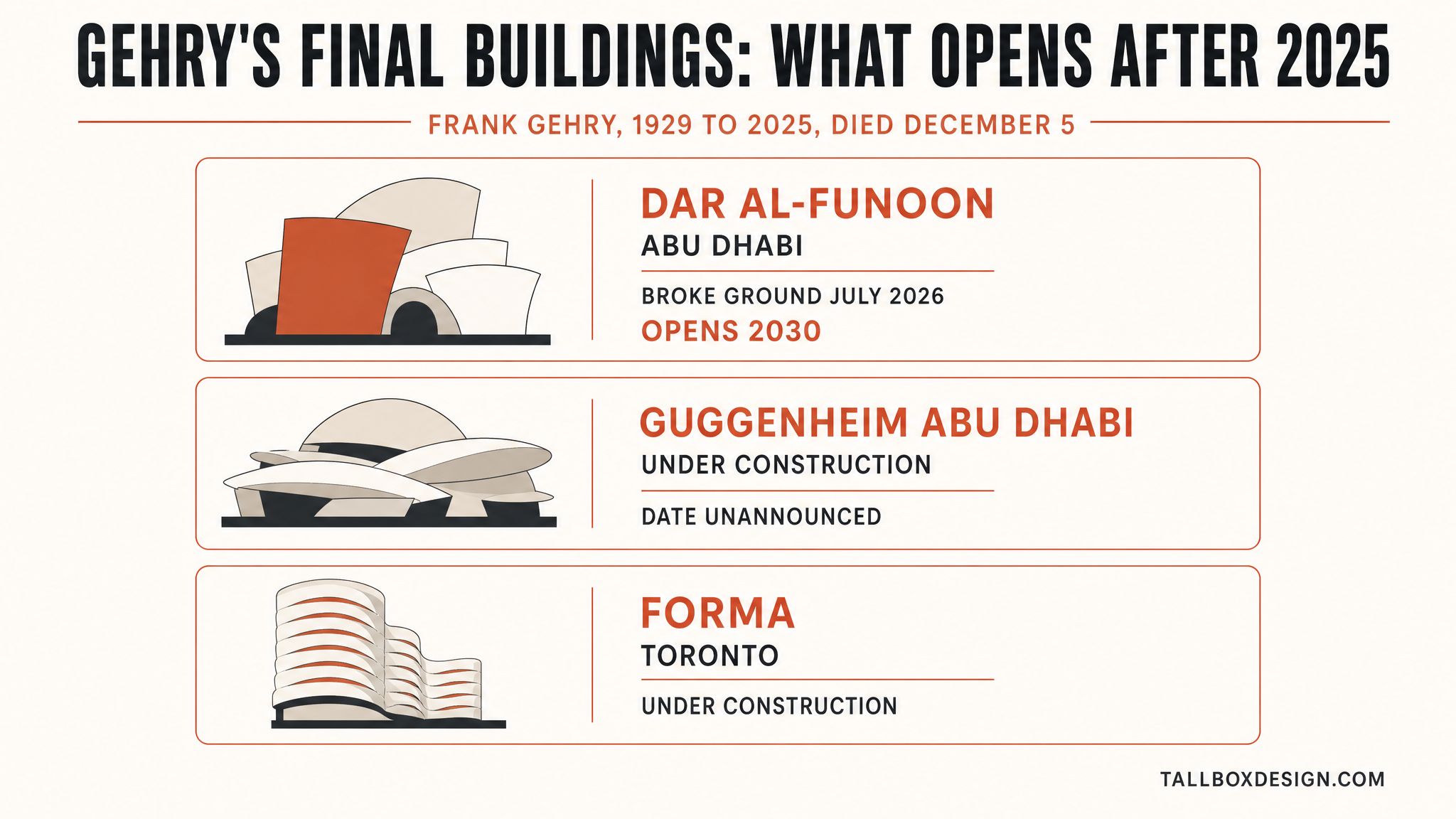
A building gets finished without its architect because the design stops living in the architect’s head long before opening day. The design lives in a documentation chain: sketches, physical massing models, a contract-grade digital model, and the construction documents crews build from. By groundbreaking, the drawings, not the designer, carry the authority.
A contract-grade model is not an illustration. It fixes the dimensions, tolerances, and material specifications a contractor is bound to build, which is why a curved Gehry facade can be priced and fabricated without a single new sketch.
Gehry engineered that documentation chain himself. His office adapted aerospace modeling software into the digital-model workflow that made curved buildings like Bilbao buildable. That model-first practice now lets Gehry Partners pour concrete on designs he will never walk through.
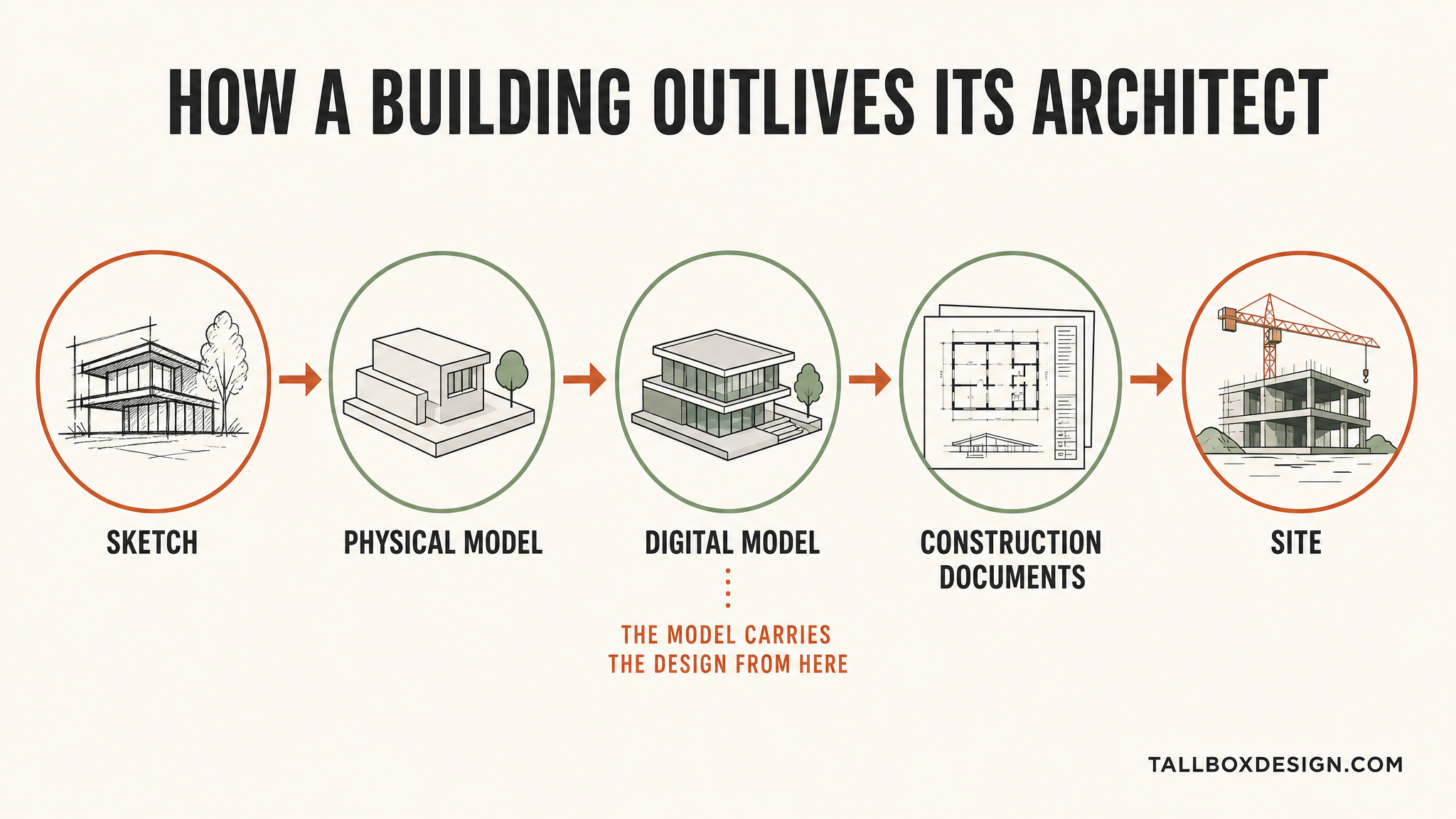
Gehry’s process began in physical models: crumpled paper and card studies that his team digitised once the gesture settled. The physical model set the shape, the digital model made the shape a contract, and that handoff is what a successor office inherits intact.
A construction site runs on documents, not on the architect’s presence. Contractors price the work from the drawings, engineers certify the structure, and the architect’s office reviews shop drawings against the approved model. The contract binds the client to the firm, not to the individual, so the commission itself survives the architect.
The same documentation chain decides where unbuilt architecture gets judged, approved, and sold: in model space. Developers, councils, and buyers meet a building years before it exists through architectural renders built from the working model, the everyday version of what Gehry’s office industrialized. American housing runs the same pattern, where new homes sell before they are built.
Dar al-Funoon met its public in model space. The June 26 reveal presented the hall as renders, and the finished building will be measured against those images when it opens in 2030.
What a posthumous Gehry building keeps, and what it loses
A posthumous Gehry building keeps everything the documents can carry. Geometry, materials, seat counts, and acoustic targets all sit in the model, and a disciplined firm can execute them precisely.
- The design documents keep the form. Dar al-Funoon’s roofline curvature, venue geometry, and material palette are fixed in the model Gehry approved.
- The digital model keeps the performance. Sightlines and acoustic targets are engineering specifications, and they survive any change of hands.
- The construction site loses the revision. A living architect walks the scaffolding and changes details against the light and the city; a model cannot make that judgment call.
- Gehry’s office loses the next sketch. A posthumous portfolio is finite: after Forma, the Guggenheim, and Dar al-Funoon, there is no new Gehry commission.
A posthumous building is a closed argument. The documents guarantee the form its architect approved, and the remaining judgment calls pass to the people executing it. On Gehry’s three sites, Gehry Partners now makes those calls inside the geometry he fixed.
Frank Gehry questions readers ask
QWhen did Frank Gehry die?
Frank Gehry died December 5, 2025, at age 96, at his home in Santa Monica, as reported by NPR. His firm, Gehry Partners, continues his active projects, and the Guggenheim Bilbao and Walt Disney Concert Hall stand as his best-known completed works.
QWhat is Dar al-Funoon in Abu Dhabi?
Dar al-Funoon is a Gehry-designed performing arts centre on Saadiyat Island with four venues totaling more than 6,000 seats. Abu Dhabi’s Department of Culture and Tourism revealed the design June 26, 2026, broke ground in early July, and plans a 2030 opening.
QWill the Guggenheim Abu Dhabi still open?
Yes, construction continues, but the museum’s opening date is unannounced. A Guggenheim spokesperson said in early 2026 that the official date would be announced later. The Guggenheim shares Saadiyat Island with the Louvre Abu Dhabi and the Dar al-Funoon site, so Gehry’s unfinished museum will stand beside his posthumous concert hall.
QWho finishes a famous architect’s buildings?
The architect’s firm finishes the buildings, working from the contract documents and the digital model. For Gehry’s three unfinished projects, that firm is Gehry Partners, following the documentation chain his own office pioneered. Construction administration is a standard architectural service, so the office that drew the documents keeps answering the contractor’s questions until handover.
The takeaway on Gehry’s final buildings
Frank Gehry’s last buildings will open without him: Dar al-Funoon in 2030, the Guggenheim Abu Dhabi on an unannounced date, and Forma over Toronto. Each one finishes because the design left his head early and moved into models a construction site can follow.
A building’s real author survives in its documents. Gehry built that fact into modern practice, and his final buildings are proving it.